Introduction
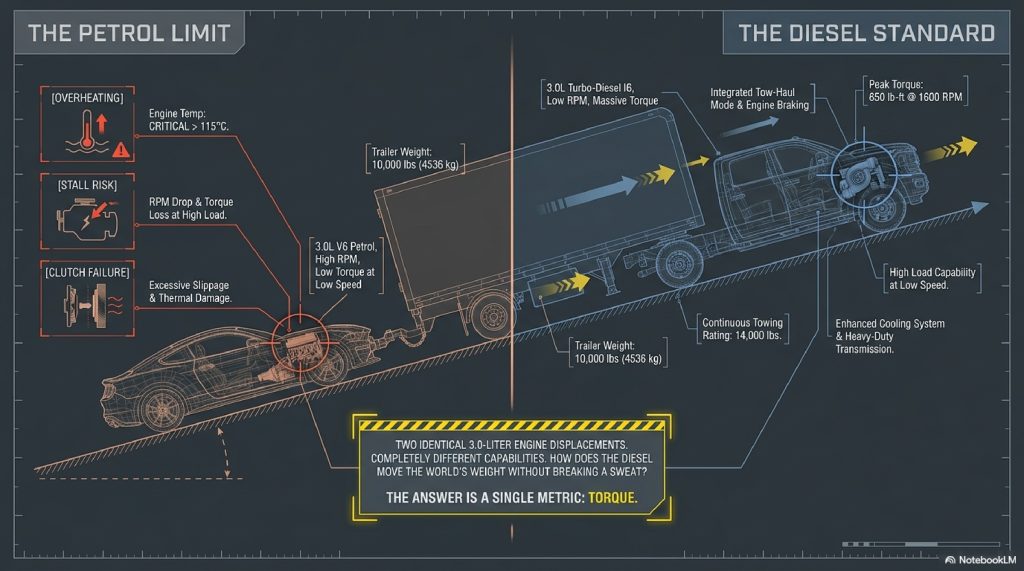
Picture two engines, both displacing 3.0 liters. One is a petrol (gasoline) engine in a sports coupe; the other is a turbo-diesel in a heavy-duty pickup truck. If you hook a 10,000-pound trailer to the sports coupe, the engine will likely stall, overheat, or burn its clutch to ashes. Hook that same trailer to the diesel truck, and it will pull it up a mountain pass without breaking a sweat.
Why? The answer is a single word: Torque.
Globally, diesel engines are the undisputed workhorses of modern civilization. From the container ships crossing the Pacific to the delivery vans in European cities and the agricultural tractors in India, diesel moves the world’s weight. But why does a diesel engine inherently produce more twisting force than a identically sized petrol engine?
It is not magic; it is pure mechanical physics and thermodynamics. Here is the deep engineering breakdown of why diesel engines dominate the torque war.
Technical Explanation: The Physics of Diesel Torque
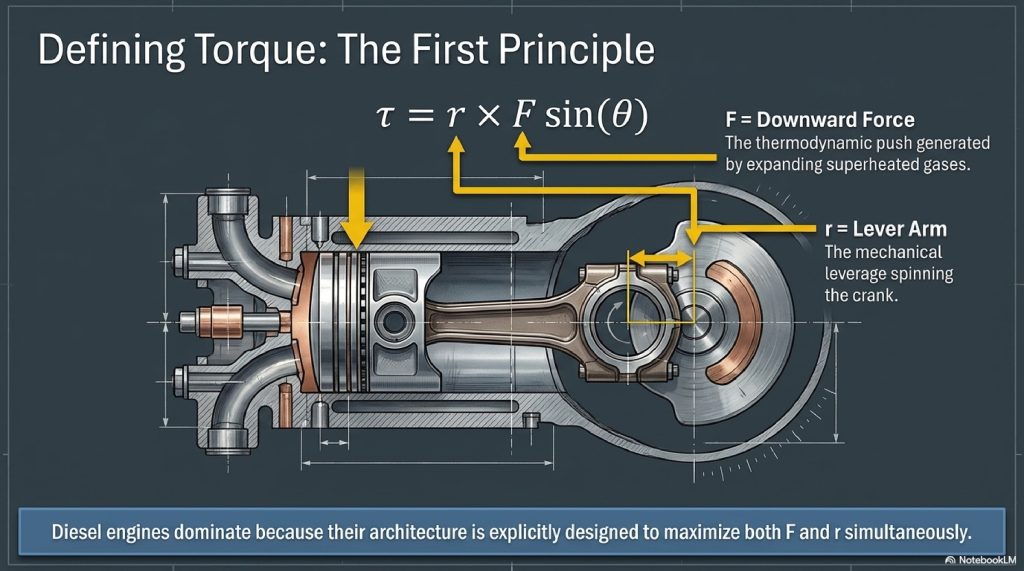
To understand this phenomenon, we must step away from marketing brochures and look at the fundamental physics of internal combustion. Torque is defined as a twisting force that causes rotation. Mathematically, it is expressed as:
Where is torque, is the length of the lever arm (the crankshaft throw), and is the downward force applied by the piston. Diesel engines maximize both and through four primary engineering differences.
1. The Stroke Length (The Lever Arm)
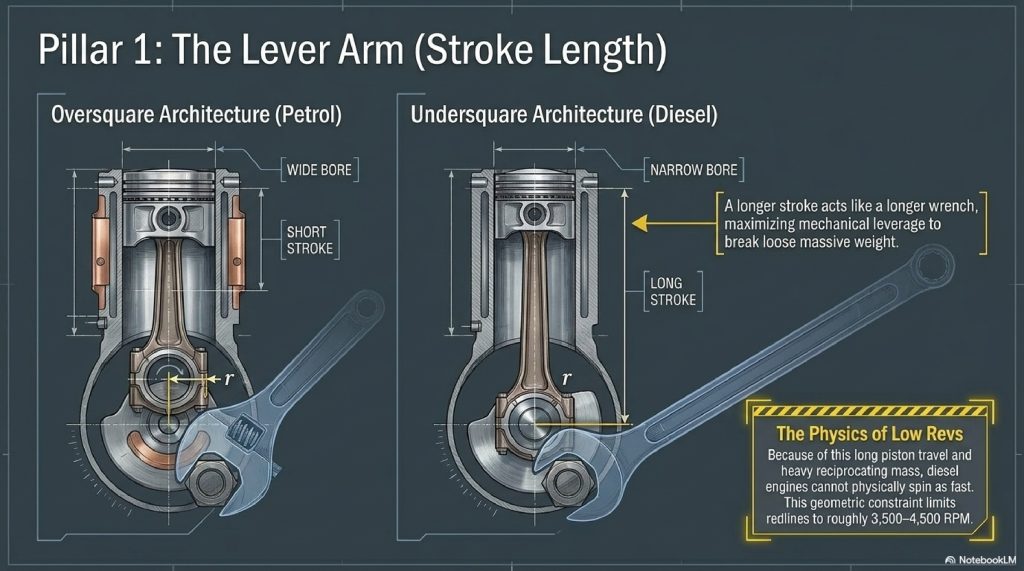
Diesel engines are traditionally undersquare, meaning the length of the piston’s stroke is greater than the bore (diameter) of the cylinder.
Because a diesel engine relies on high compression to ignite its fuel (compression-ignition), the piston must travel further up the cylinder. This longer stroke inherently means the crankshaft “throw” (the in our equation) is longer. Just like using a longer wrench makes it easier to break loose a stubborn bolt, a longer stroke gives the piston more mechanical leverage to twist the crankshaft.
2. Massive Compression Ratios
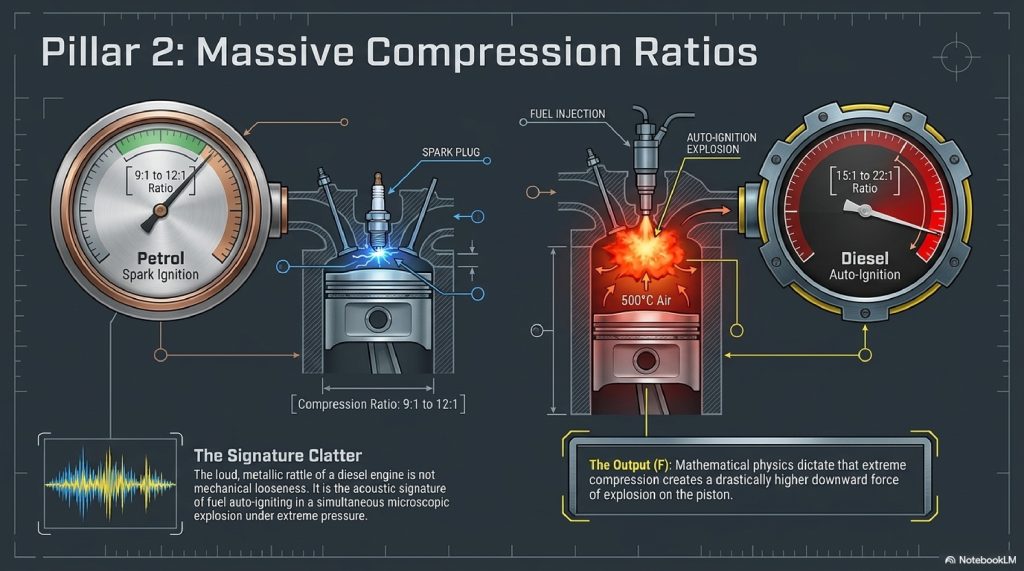
Petrol engines use spark plugs to ignite fuel, typically running compression ratios between 9:1 and 12:1. If you compress petrol too much, it explodes prematurely (engine knock).
Diesel engines have no spark plugs. They compress pure air until it becomes superheated (up to 500°C), and then inject fuel which auto-ignites. To achieve this heat, diesel compression ratios range from 15:1 to 22:1.
The mathematical relationship between compression ratio and cylinder pressure dictates that the downward force of the explosion on the piston is drastically higher in a diesel engine, resulting in a massive surge of torque per power stroke.
3. Fuel Energy Density
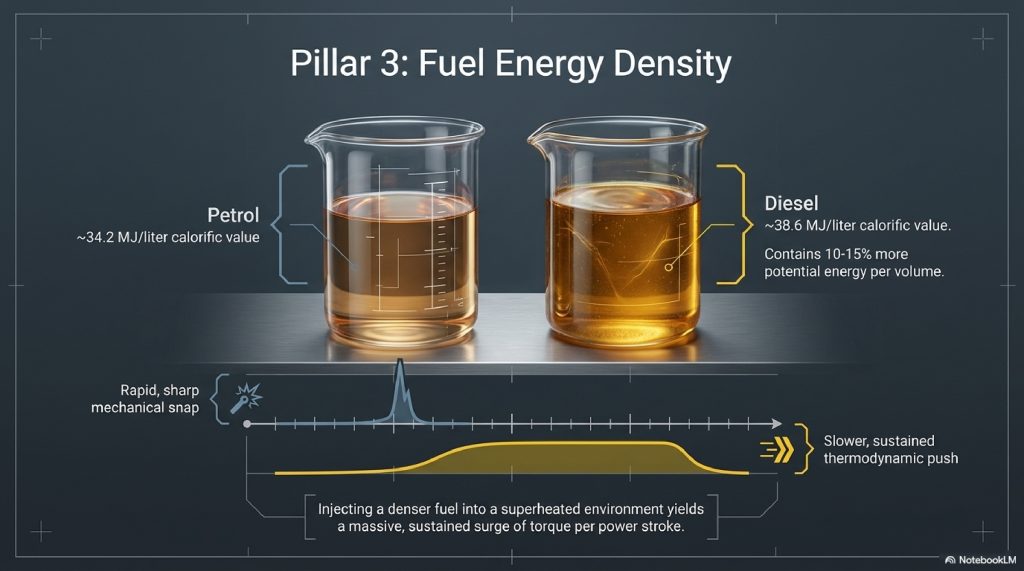
Diesel fuel is denser and heavier than petrol. It contains roughly 10% to 15% more potential energy per gallon.
- Petrol Calorific Value: ~34.2 MJ/liter
- Diesel Calorific Value: ~38.6 MJ/liter
When you inject a denser fuel into a high-compression, superheated environment, the resulting thermodynamic expansion creates a slower, more sustained, and significantly more powerful push against the piston crown.
4. Turbocharging Synergy
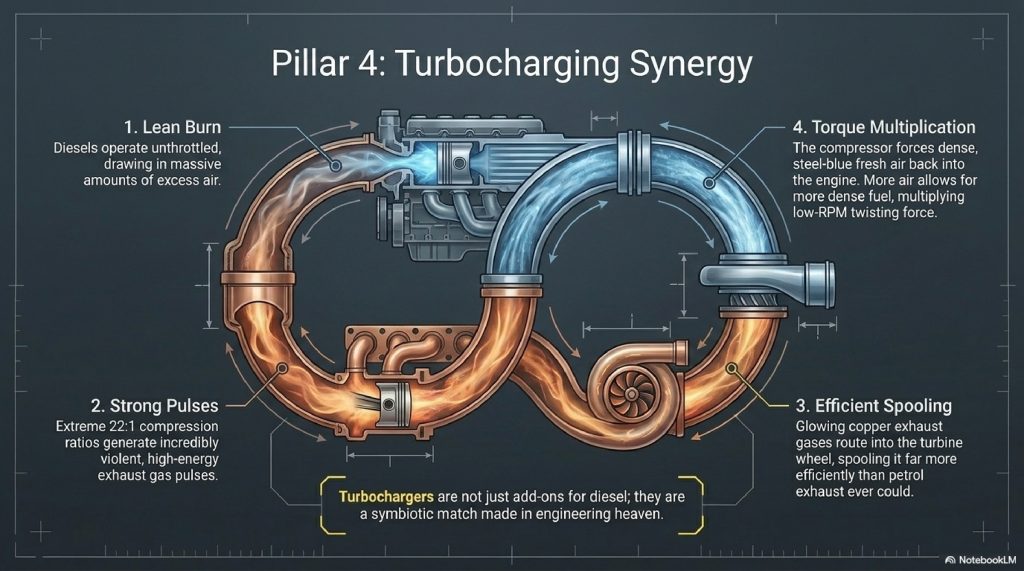
While petrol engines are increasingly turbocharged, turbochargers and diesel engines are a match made in engineering heaven. Because diesel engines run leaner (more air than fuel) and have stronger exhaust gas pulses due to high compression, they spool turbos incredibly efficiently. The excess air allows for more fuel to be injected, multiplying the torque output drastically at low RPMs.
Real-World Performance: Heavy Loads and Efficiency
How do these physics translate to the asphalt?
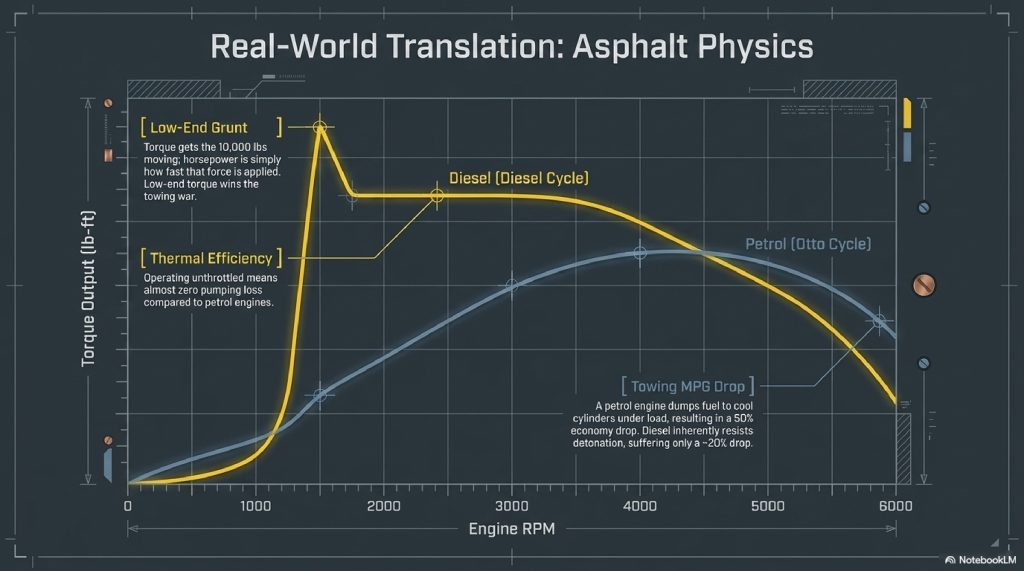
- Low-End Grunt: A typical petrol engine reaches its peak torque around 4,000 RPM. A modern turbo-diesel achieves peak torque as low as 1,500 RPM. This is why diesel trucks feel incredibly powerful right off the idle line.
- Thermal Efficiency: Modern diesels are vastly more thermally efficient than petrol engines. Because they operate unthrottled (controlling speed by fuel volume, not an air throttle plate), they suffer from very little “pumping loss.”
- Towing Fuel Economy: When you load a petrol engine heavily, it must dump excess fuel into the cylinders to keep temperatures down and prevent detonation. Diesels do not suffer from detonation in the same way. Consequently, a diesel truck towing 8,000 lbs might see a 20% drop in MPG, while a petrol truck doing the same will see its fuel economy cut in half.
Common Problems: The Price of High Compression
The massive torque generation of diesel engines comes at a steep price in complexity and weight.
Symptoms & Causes of Diesel Failure
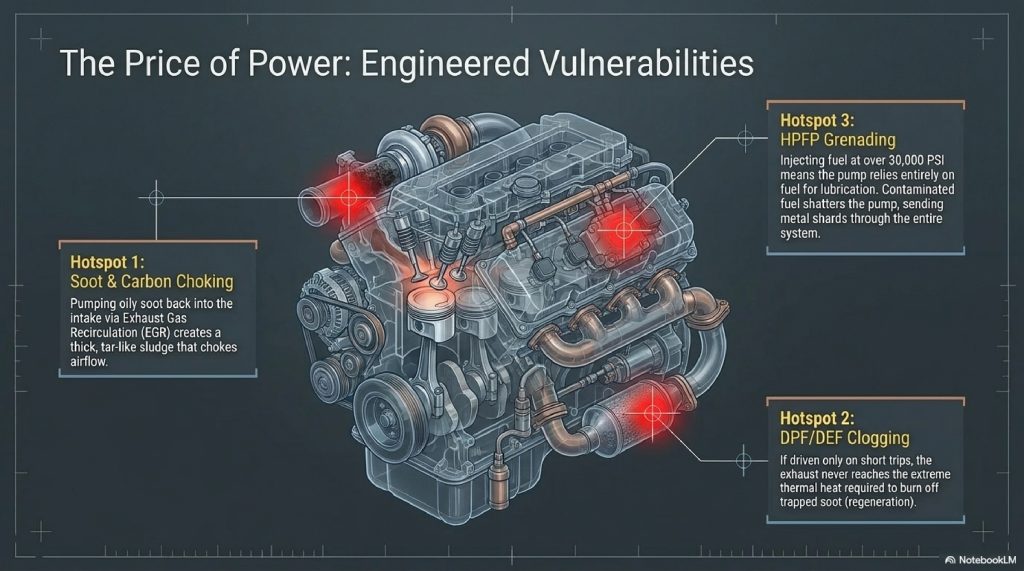
- Soot and Carbon Choking: Because diesel fuel is a heavy hydrocarbon, it produces soot. To meet global emissions, modern diesels use Exhaust Gas Recirculation (ETR). Pumping oily soot back into the intake creates a thick, tar-like sludge that chokes the engine.
- Prevention: Installing a high-capacity baffled oil catch can minimizes oily vapors mixing with soot.
- DPF/DEF System Failures: The Diesel Particulate Filter traps soot, but if the vehicle is only driven on short trips, the exhaust never gets hot enough to burn it off (regeneration).
- High-Pressure Fuel Pump (HPFP) Grenading: Modern diesels inject fuel at pressures exceeding 30,000 PSI. If poor-quality or contaminated fuel is used, the HPFP loses lubrication and shatters, sending metal shards through the entire fuel system.
Servicing & Maintenance: Keeping the Workhorse Alive
Maintaining a modern turbo-diesel is fundamentally different from servicing a petrol car.
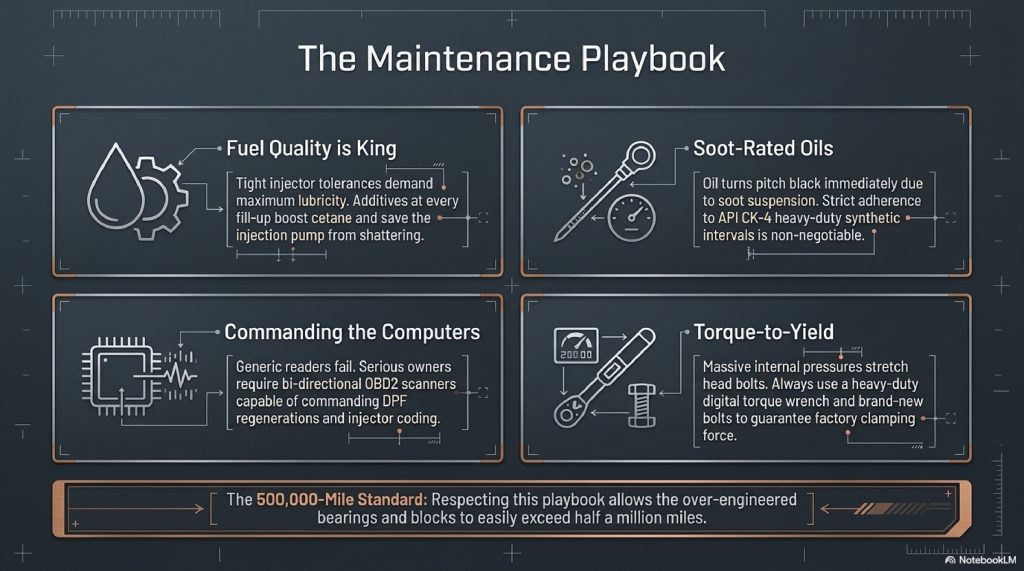
- Fuel Quality is King: The tight tolerances of diesel injectors demand maximum lubricity. Adding a high-quality diesel fuel additive at every fill-up boosts cetane and lubricates the injection pump.
- Oil Change Intervals: Diesel engine oil turns pitch black almost immediately due to soot suspension. This is normal. However, strictly adhere to manufacturer intervals using heavy-duty, soot-rated synthetic oils (e.g., API CK-4).
- Diagnostic Superiority: Because of complex emission controls (SCR, DPF, EGR), generic code readers are useless. Serious owners must invest in a professional bi-directional OBD2 scanner capable of commanding DPF regenerations and resetting injector coding.
- Torque Specs: If you are rebuilding a diesel block, the massive internal pressures mean head bolts stretch. Always use new bolts and a heavy-duty digital torque wrench to ensure factory clamping force.
Comparison Section: Otto Cycle vs. Diesel Cycle
| Metric | Petrol Engine (Otto Cycle) | Diesel Engine (Diesel Cycle) |
| Ignition Method | Spark Plug | Compression Auto-Ignition |
| Max Torque RPM | High (3,000 – 6,000 RPM) | Low (1,200 – 2,500 RPM) |
| Block Construction | Lighter (Aluminum common) | Heavier (Cast Iron / CGI) |
| Compression Ratio | 8:1 to 14:1 | 15:1 to 22:1 |
| Primary Strength | High RPM Horsepower | Low RPM Massive Torque |
Future Technology: The Evolution of Diesel
Many believe the EV revolution spells the end of diesel. In passenger cars, this is likely true. However, in heavy-duty and global commercial applications, battery weight and charging infrastructure make pure EVs unviable.
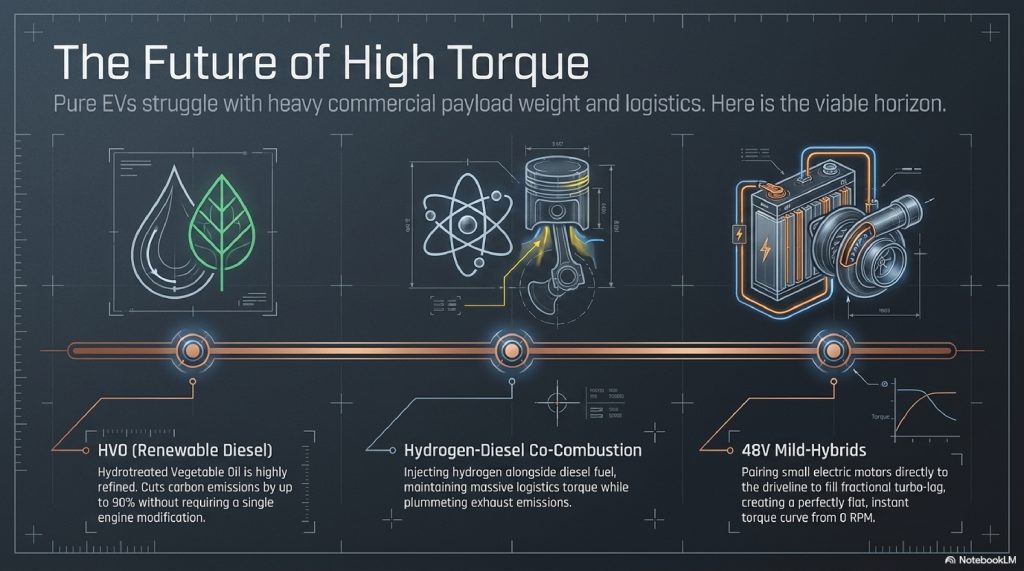
- HVO (Hydrotreated Vegetable Oil): A highly refined renewable diesel that reduces carbon emissions by up to 90% without requiring any engine modifications.
- Hydrogen-Diesel Co-Combustion: Engineering firms like Cummins are developing blocks that inject hydrogen alongside diesel fuel, drastically lowering emissions while maintaining the massive torque required for logistics.
- 48V Mild-Hybrid Diesels: European automakers are pairing small electric motors with diesel engines to fill in the fractional turbo-lag, resulting in a perfectly flat, instant torque curve from 0 RPM.
Historical Background: Rudolf Diesel’s Vision
In the late 19th century, the steam engine was the pinnacle of power, but it was dangerously inefficient (wasting 90% of its fuel energy). In 1893, German engineer Rudolf Diesel published a treatise describing an engine with combustion inside the cylinder, relying solely on extreme compression to ignite the fuel.
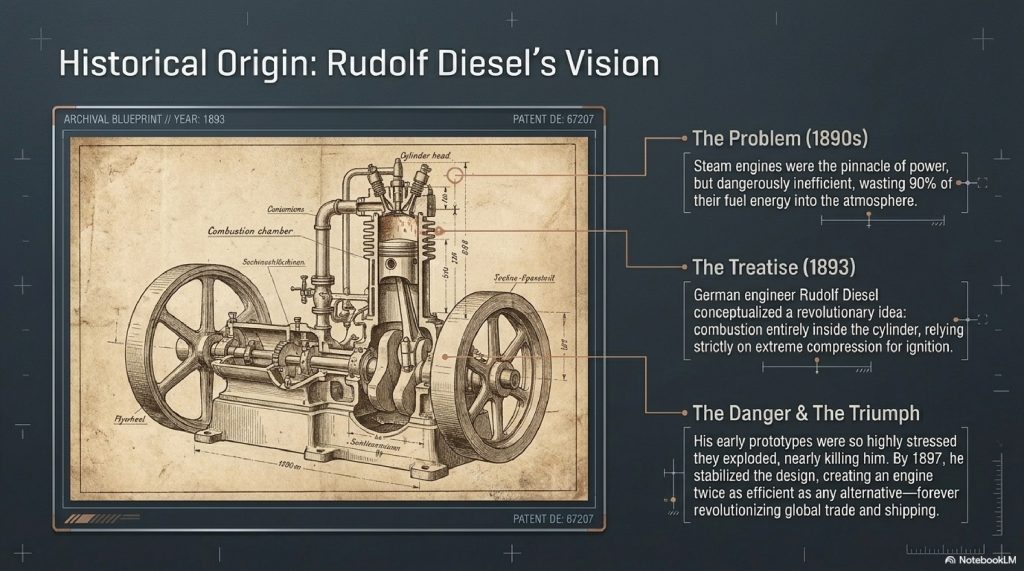
His early prototypes were so highly stressed they exploded, nearly killing him. However, by 1897, he successfully built an engine that was twice as efficient as any alternative. His invention revolutionized global trade, shipping, and agriculture.
Expert Insights: The Ownership Verdict
From an engineering perspective, a diesel engine is a marvel of thermal efficiency. The engine blocks are built from Compacted Graphite Iron (CGI) or thick cast iron to withstand internal pressures that would shatter a normal petrol block.
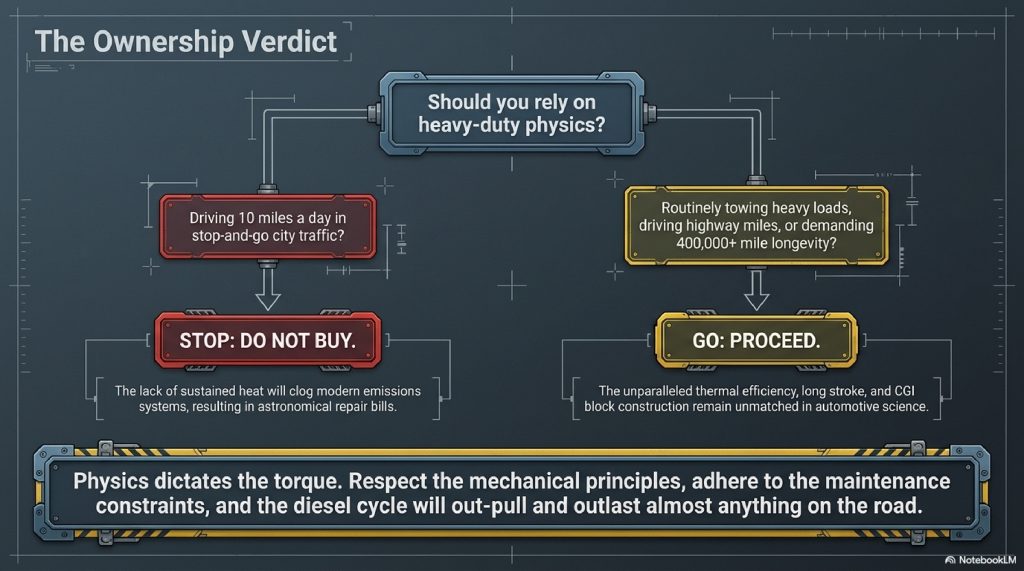
Ownership Recommendation: If you drive 10 miles a day in stop-and-go city traffic, do not buy a modern diesel. The emissions systems will clog, and repair bills will be astronomical. However, if you routinely tow heavy loads, drive long highway distances, or require a vehicle capable of reaching 400,000 miles with high thermal efficiency, the diesel engine remains unmatched in automotive science.
Conclusion
Diesel engines produce more torque than petrol engines because physics dictates it. Through longer lever arms (stroke), explosive high-pressure combustion (compression ratio), and superior energy density of the fuel itself, the diesel cycle converts heat into mechanical twisting force better than virtually any other internal combustion platform.
Understanding these principles makes you a smarter buyer, a better driver, and a more capable mechanic. Respect the maintenance schedule, understand the limitations of the emissions equipment, and a well-engineered diesel will out-pull and outlast almost anything else on the road.
Frequently Asked Questions (FAQ)
Q: Does horsepower or torque matter more for towing?
A: Torque is the rotational force that gets the weight moving, while horsepower is how fast that force can be applied over time. For towing heavy loads, low-end torque is vastly more important than high-RPM horsepower.
Q: Why do diesel engines rev so low?
A: Because of their long piston strokes and heavy internal components (designed to withstand high compression), diesel engines physically cannot spin as fast as petrol engines. The heavy reciprocating mass limits their redline, usually between 3,500 and 4,500 RPM.
Q: Why do diesel engines sound so loud and clattery?
A: The signature “clatter” of a diesel is the sound of the fuel auto-igniting under extreme pressure. It is essentially a controlled microscopic explosion occurring simultaneously across the cylinder, creating distinct pressure waves that sound like a metallic rattle.
Q: Is it true diesel engines last longer than petrol engines?
A: Yes. Because they operate at lower RPMs (less friction over time) and are built with incredibly robust engine blocks and over-engineered bearings to handle high compression, it is common for commercial diesel engines to exceed 500,000 miles before requiring a rebuild.
Comments (2)