Introduction
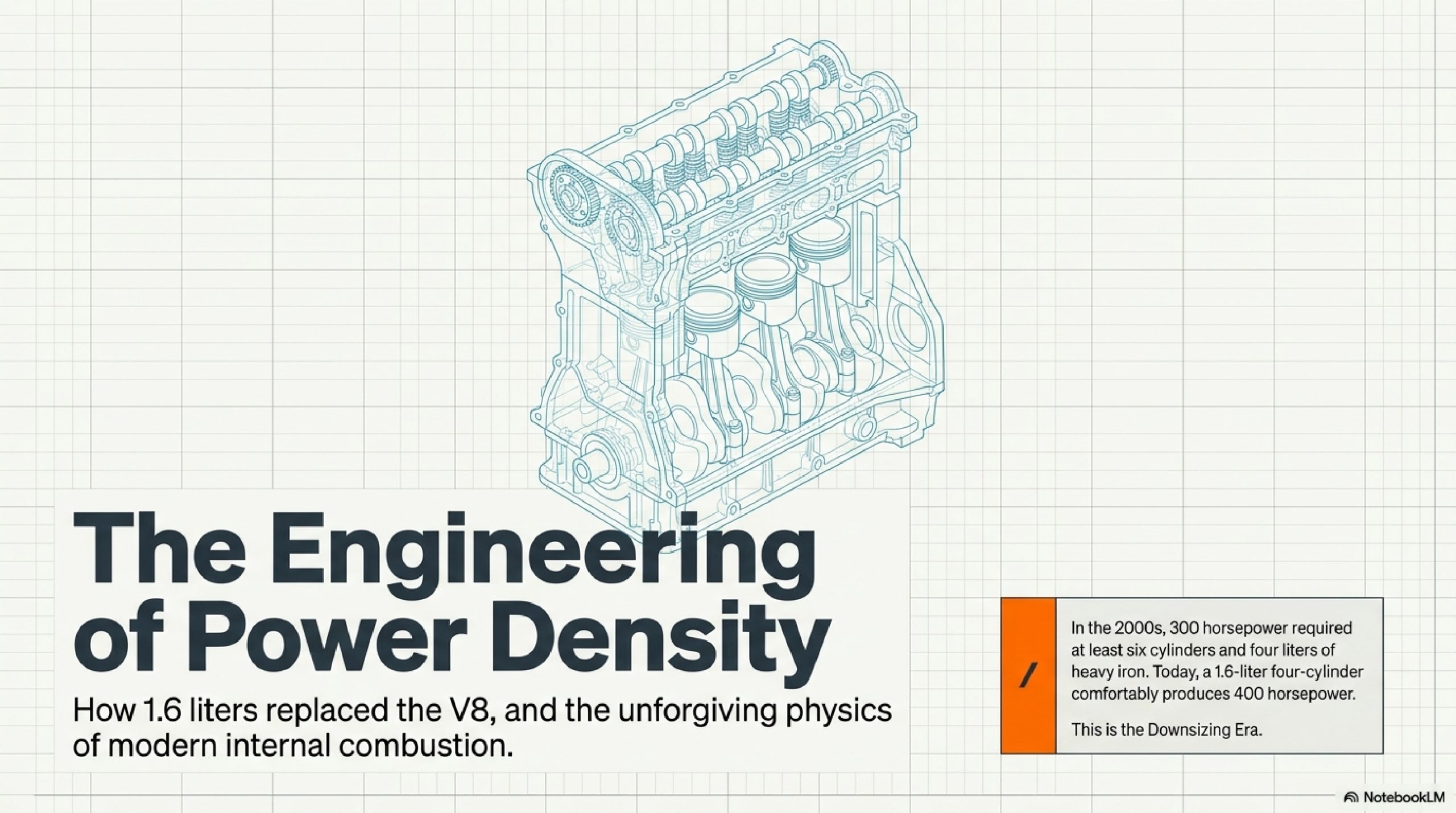
In the early 2000s, “there was no replacement for displacement.” If you wanted 300 horsepower, you needed at least six cylinders and four liters of heavy iron. Fast forward to 2026, and the automotive landscape has undergone a radical biological shift. Today, a 1.6-liter four-cylinder can comfortably produce 400 horsepower, and even luxury flagships are trading their V8s for electrified V6s or high-output four-pots.
This isn’t just a trend; it’s a global engineering imperative. Driven by stringent emissions regulations like Euro 7 and CAFE standards, and fueled by a revolution in materials science, the “Downsizing Era” is here. But how does a smaller engine actually become more powerful? Is this a recipe for mechanical disaster, or a triumph of modern physics? For global car owners, the impact is real: better fuel economy, lower taxes, but a far more sensitive relationship with maintenance.
Technical Explanation: The Engineering of Power Density
To understand why engines are shrinking, we have to look at the concept of Power Density, the amount of power an engine produces relative to its displacement.
1. The Forced Induction Revolution (Turbocharging)
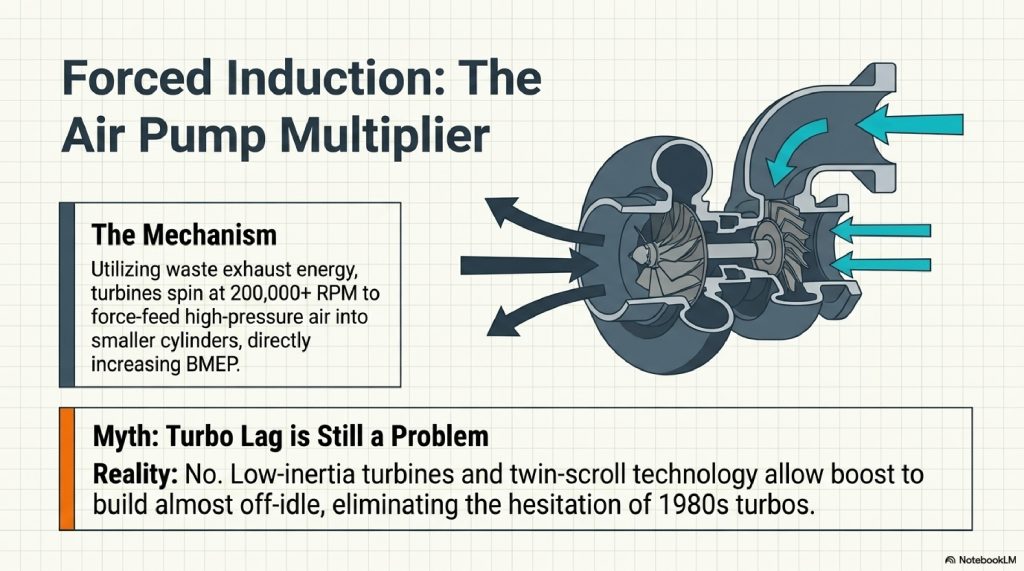
An engine is essentially a giant air pump. To make more power, you need more air to burn more fuel. In the past, we did this by making the “pump” bigger (increasing displacement). Today, we use Turbochargers.
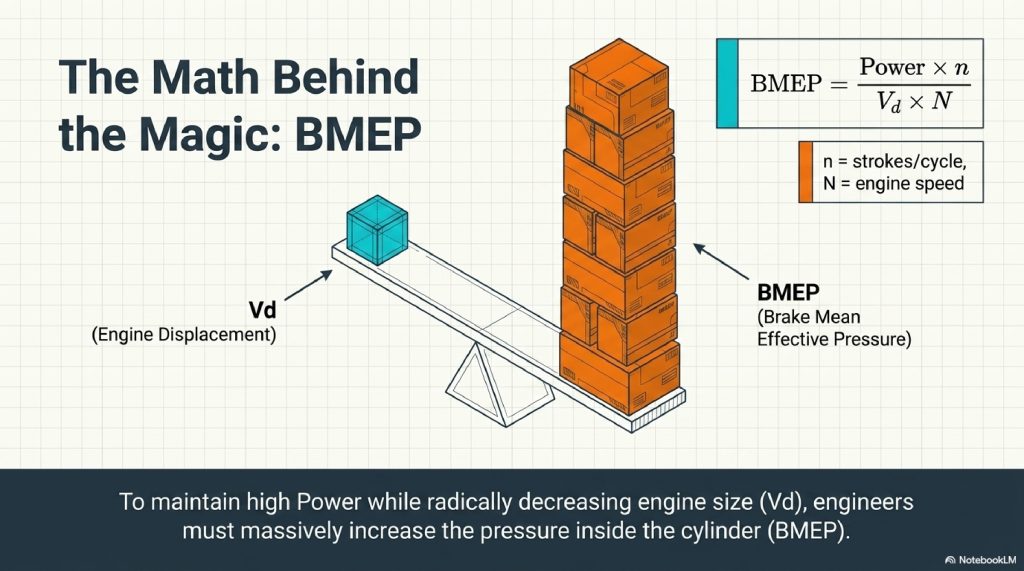
By utilizing waste energy from exhaust gases to spin a turbine, we force-feed the engine high-pressure air. This increases the Brake Mean Effective Pressure (BMEP).
Where is a constant, is displacement, and is RPM. By increasing the air density via a turbo, we can increase the numerator while decreasing the denominator .
2. Gasoline Direct Injection (GDI)
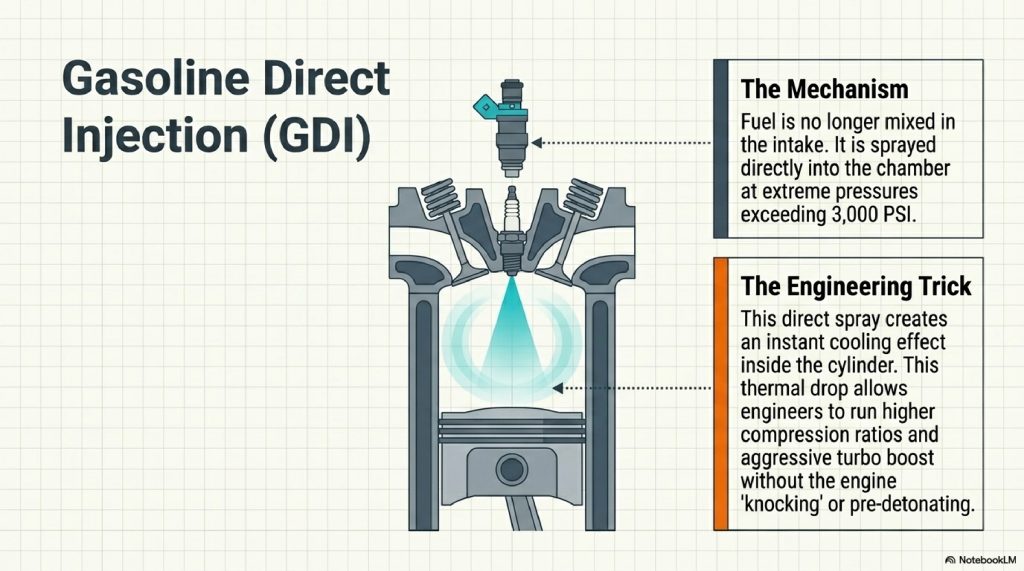
In older engines, fuel was mixed with air before entering the cylinder. In modern downsized engines, fuel is sprayed directly into the combustion chamber at pressures exceeding 3,000 PSI. This provides a cooling effect, allowing engineers to run higher compression ratios and more aggressive turbo boost without the engine “knocking” or pre-detonating.
3. Reducing Parasitic Loss
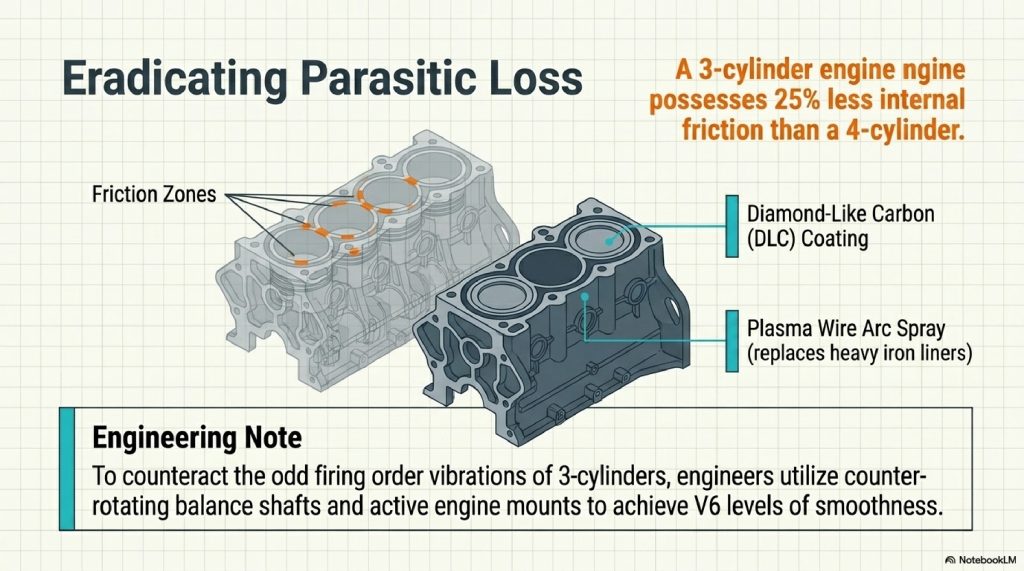
Smaller engines have fewer moving parts. A 3-cylinder engine has 25% less internal friction than a 4-cylinder. Pistons are now coated with Diamond-Like Carbon (DLC), and cylinder bores utilize Plasma Wire Arc Spray instead of heavy iron liners. This means less energy is lost to heat and friction, and more is sent to the wheels.
Real-World Performance: The Efficiency vs. Stress Tightrope
The primary appeal of a downsized engine is its dual personality. Under light load (highway cruising), a 1.0L or 1.5L engine sips fuel like a subcompact. Under heavy acceleration, the turbo kicks in, and it pulls like a larger engine.
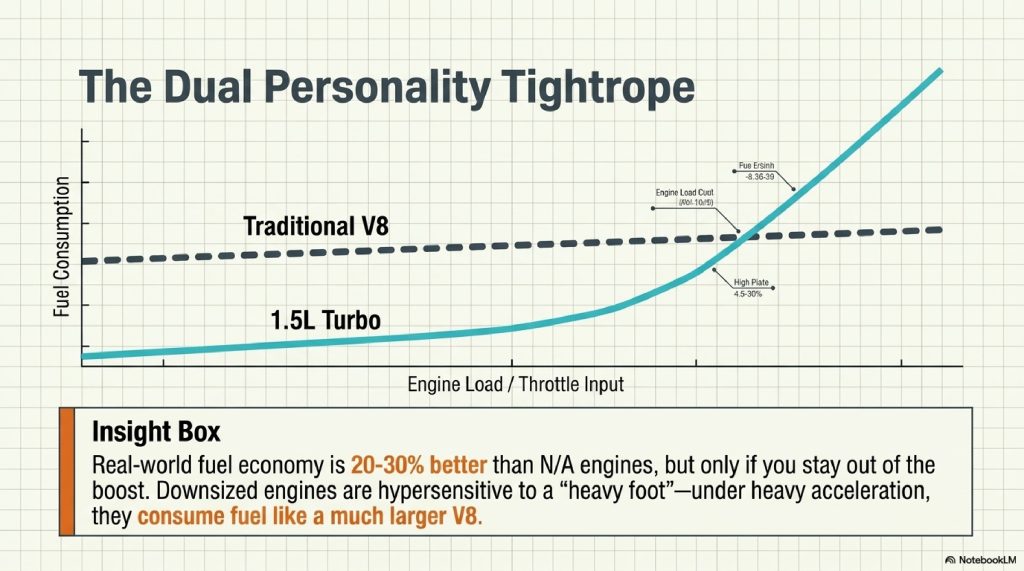
- Fuel Economy: Real-world gains are significant, often 20-30% better than the N/A (Naturally Aspirated) engines they replaced.
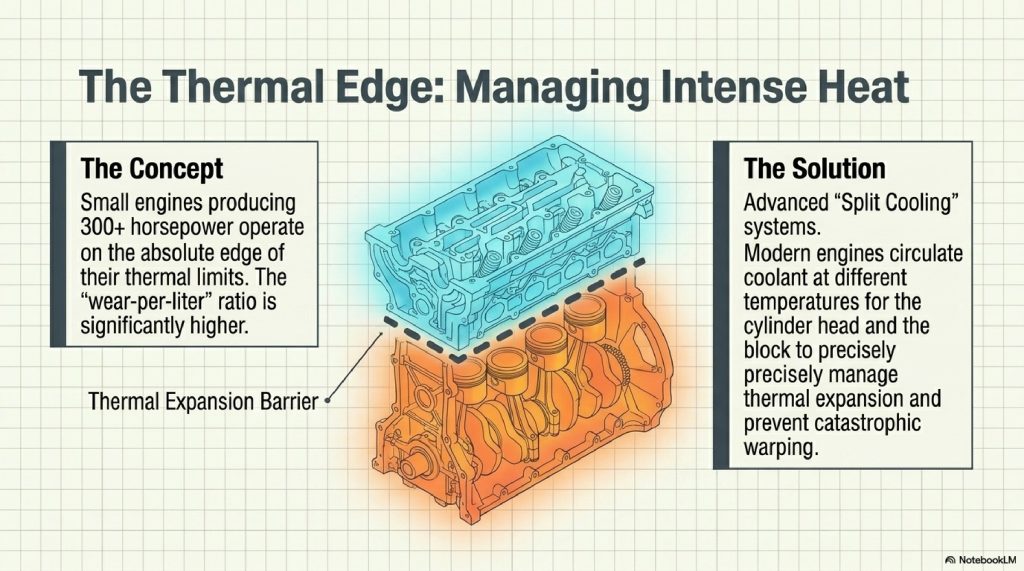
- Heat Management: This is the challenge. Small engines producing high power generate immense heat. Modern cooling systems are now “split,” with different temperatures for the cylinder head and the block to manage thermal expansion.
- Longevity: A 2.0L engine making 300hp is under significantly more mechanical stress than a 5.0L making the same power. The “wear-per-liter” is higher, meaning tolerances must be tighter and fluids must be cleaner.
Common Problems: The Achilles’ Heel of Small Turbos
While brilliant, these engines have specific engineering flaws that owners must respect.
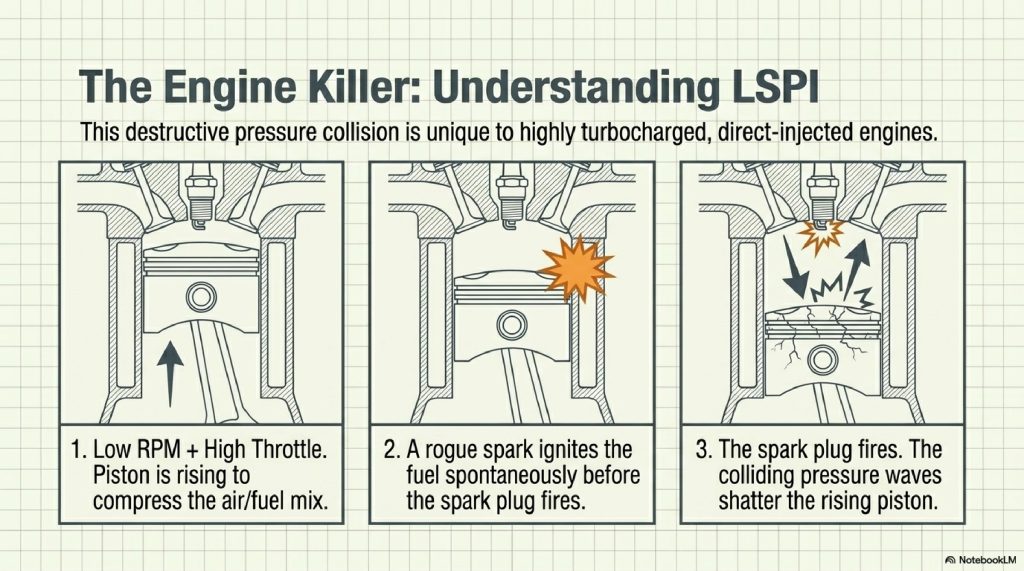
- LSPI (Low-Speed Pre-Ignition): This is the “Engine Killer.” In small, turbocharged GDI engines, the fuel can ignite spontaneously before the spark plug fires, usually when you floor the throttle at low RPMs. This creates a pressure wave that can literally shatter a piston.
- Carbon Buildup: Because fuel is sprayed directly into the cylinder, the intake valves are never “washed” by gasoline. Over 50,000 miles, oil vapors from the crankcase bake onto the valves, choking the engine’s breathing.
- Turbocharger Wear: Turbos spin at 200,000+ RPM. Using the wrong oil or skipping changes leads to bearing failure.
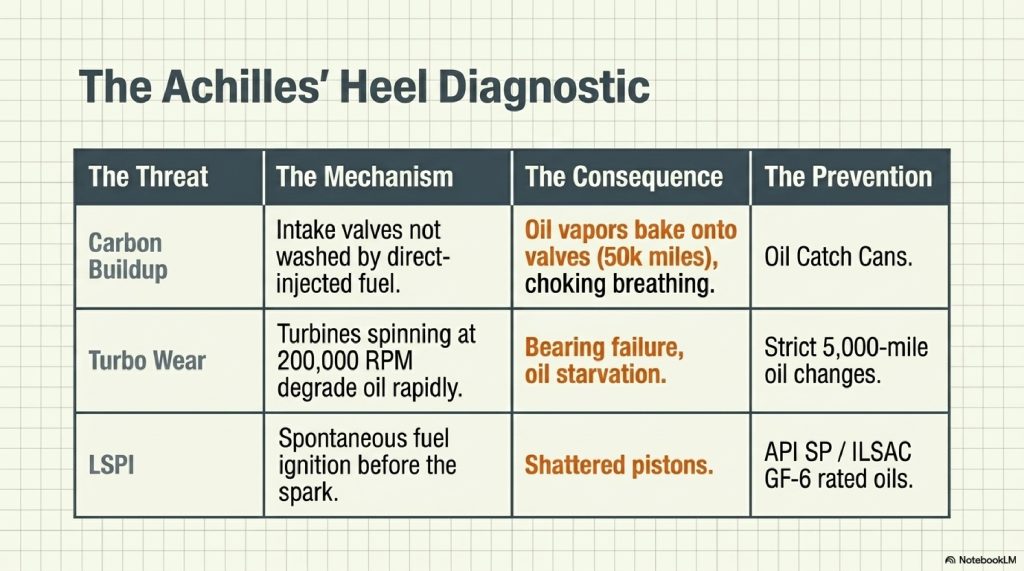
Prevention: Use a high-quality Oil Catch Can to intercept carbon-forming vapors.
Servicing & Maintenance: The “New Rules” for Owners
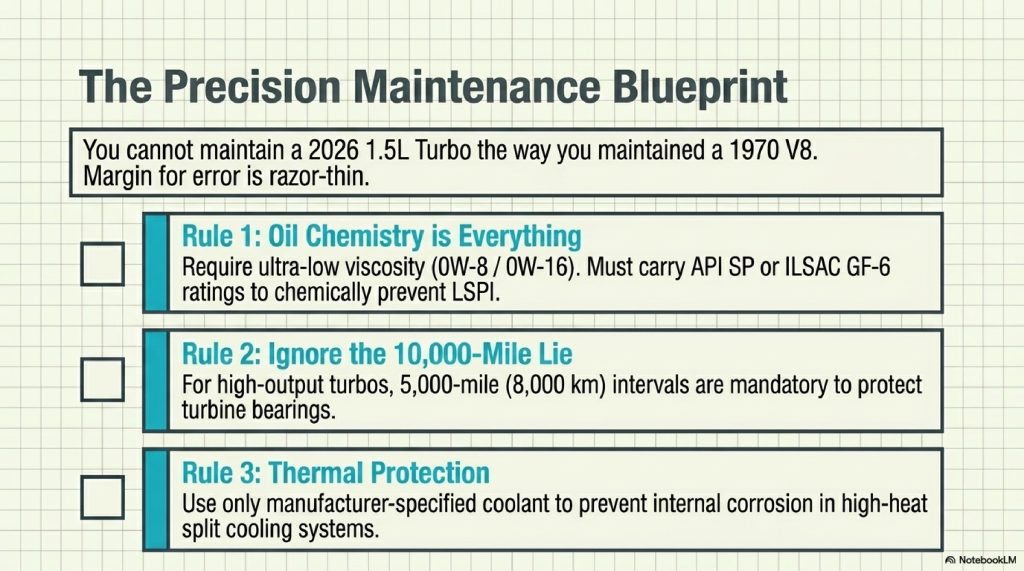
You cannot maintain a 2026 1.5L Turbo the way your grandfather maintained his 1970 Chevy V8.
- Oil is Everything: Downsized engines require ultra-low viscosity oils (like 0W-8 or 0W-16) with specific additives to prevent LSPI. Always look for the API SP or ILSAC GF-6 rating.
- Maintenance Intervals: Ignore the “10,000-mile” marketing lie. For high-output small engines, 5,000-mile (8,000 km) intervals are essential for turbo health.
- Coolant is Critical: These engines operate on the edge of thermal limits. Use only the manufacturer-specified coolant to prevent internal corrosion.
Comparison Section: Displacement vs. Boost
| Feature | Large Displacement (Naturally Aspirated) | Downsized (Turbocharged/GDI) |
| Torque Delivery | Linear, predictable. | Massive low-end torque, “Turbo Lag.” |
| Complexity | Low (fewer sensors/pipes). | High (intercoolers, wastegates, sensors). |
| Weight | Heavy (Cast iron/large alloy blocks). | Lightweight (Compact, modular designs). |
| Fuel Economy | Consistent, but lower. | Variable (Excellent cruising, poor under boost). |
| Maintenance | Forgiving. | Unforgiving. |
The Verdict: Small engines are superior for 90% of daily driving, but they require an owner who understands the “tax” of performance, rigorous maintenance.
Future Technology: What’s After Downsizing?
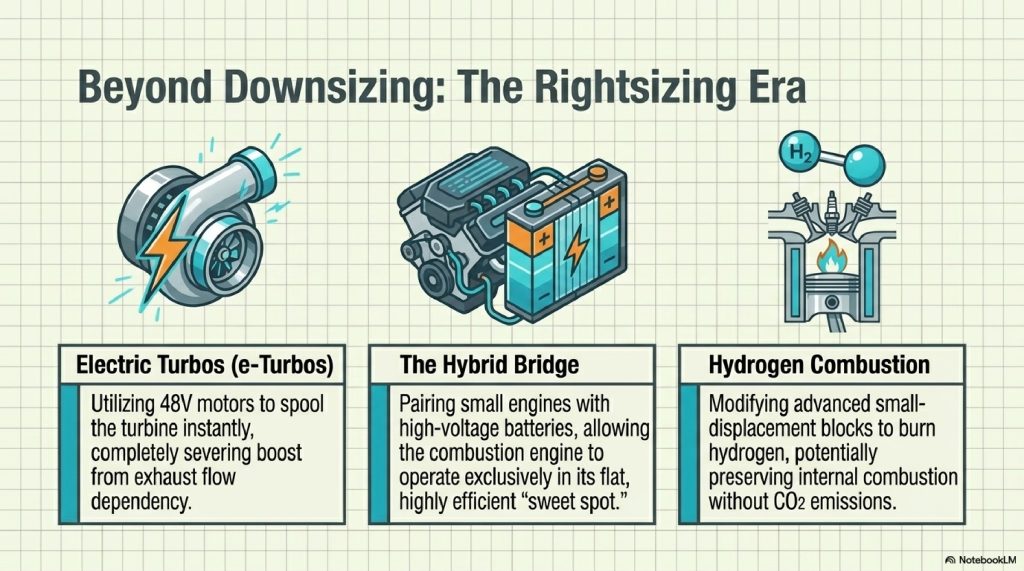
The industry is now moving into “Rightsizing.” Engineers realized that a 1.0L engine in a large SUV was actually less efficient because it was always under 100% load.
- Electric Turbos (e-Turbos): Using a 48V motor to spin the turbo instantly, eliminating lag and allowing for even more power from smaller blocks.
- Hydrogen Combustion: Small-displacement engines are being modified to burn hydrogen, potentially saving the internal combustion engine from extinction.
- The “Hybrid Bridge”: Pairing a downsized engine with a high-voltage battery allows the engine to operate only in its “Efficiency Sweet Spot.”
Historical Background: Why Now?
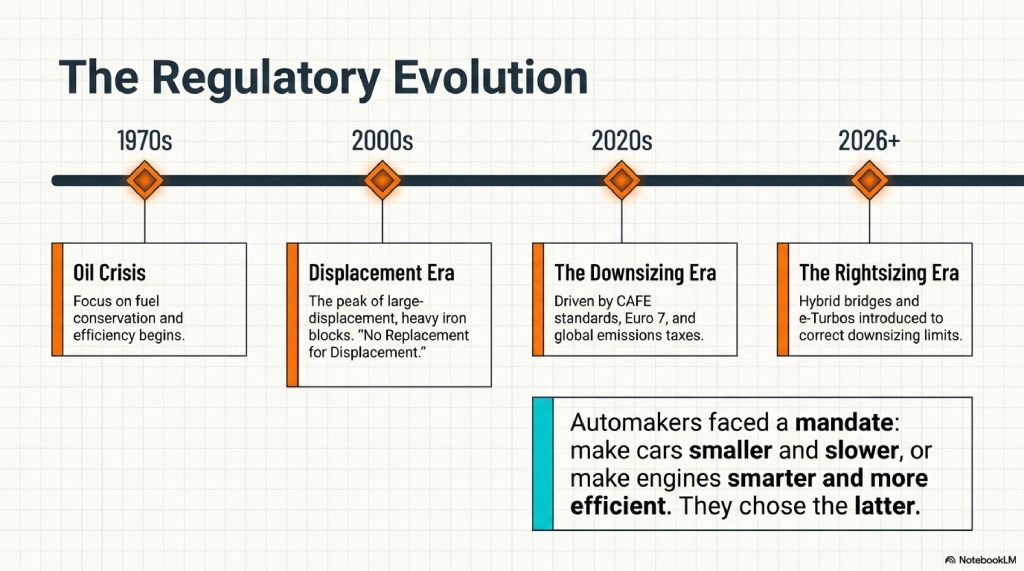
The shift wasn’t a choice; it was a response to the 1970s Oil Crisis and, more recently, the Paris Agreement. Governments globally began taxing vehicles based on emissions and displacement. Automakers had a choice: make cars smaller and slower, or make engines smarter and more efficient. They chose the latter. The evolution from the 1980s “Turbo Lag” monsters to today’s seamless power units is one of the greatest leaps in automotive history.
Expert Insights: Long-Term Durability Analysis
As an automotive engineer, the most common question I get is: “Will these tiny engines last 200,000 miles?”
The answer is yes, but with conditions. The metallurgical quality of modern engines (forged rods, hardened crankshafts) is actually better than it was 30 years ago. However, the margin for error is razor-thin. If you neglect a coolant leak or use cheap oil, the engine will fail catastrophically and quickly. If you treat it like a precision instrument, it will reward you with performance that would have been unthinkable in a family car a decade ago.
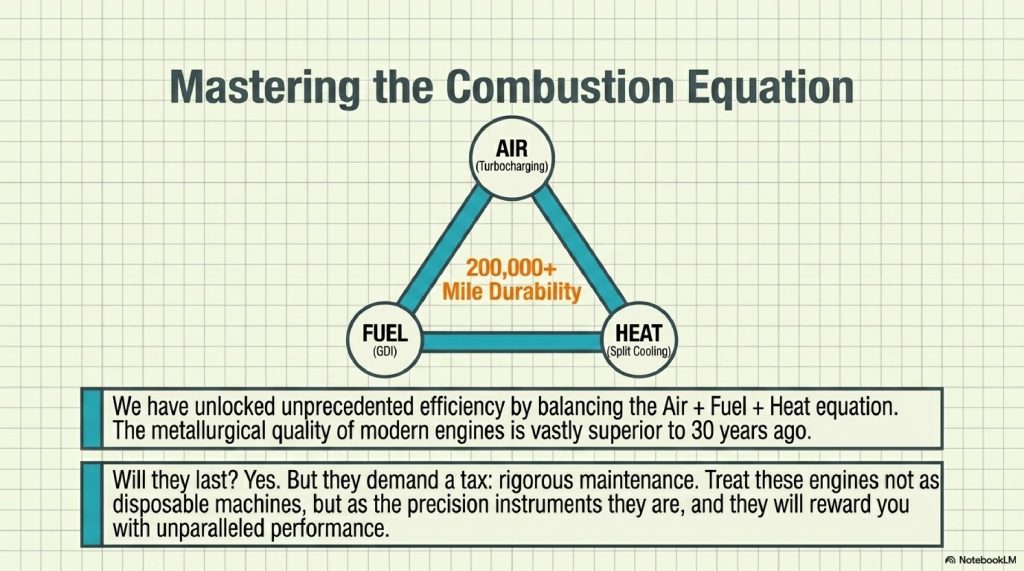
Smaller engines are becoming more powerful because we have finally mastered the “Air + Fuel + Heat” equation. By using turbocharging to provide the air, GDI to manage the fuel, and advanced sensors to control the heat, we have unlocked a level of efficiency that honors both the driver’s desire for speed and the planet’s need for lower emissions.
Want to keep your small engine running like new? Check out our related guides on:
- Why Modern Turbocharged Engines Fail So Often: The Hidden Engineering Problem
- Why Modern Cars Burn Oil? Engineers Explain the Consumption Problem
- Why Diesel Engines Produce More Torque Than Petrol (Engineering Explained)
FAQ Section (People Also Ask)
Q: Do 3-cylinder engines vibrate more?
A: Naturally, yes, due to the odd firing order. However, modern engineers use counter-rotating balance shafts and active engine mounts to make them feel as smooth as a V6.
Q: Is “Turbo Lag” still a problem?
A: In 2026, turbo lag is largely a thing of the past. Small, low-inertia turbines and twin-scroll technology allow boost to build almost off-idle.
Q: Why is my fuel economy lower than the sticker says?
A: Downsized engines are highly sensitive to driving style. If you have a “heavy foot,” the turbo stays active, and the engine consumes fuel like a much larger V8.
Product Name: Pennzoil Ultra Platinum Full Synthetic 0W-20
Why it is useful: Formulated specifically for GDI and turbocharged engines to protect against LSPI and keep intake valves cleaner.
Best use case: Every oil change for modern downsized engines.
Click Here To Shop: [Shop Pennzoil Ultra Platinum on Amazon]
Product Name: BlueDriver Bluetooth Pro OBD2 Scanner
Why it is useful: Modern downsized engines are managed by complex ECU maps. If a turbo sensor or an injector starts to drift, you need to know before it causes a “melted piston” scenario.
Best use case: Monthly health checks to monitor “Fuel Trims” and “Boost Pressure.”
Click Here to Shop: [Check the latest price for the BlueDriver Pro on Amazon]
Placement: Inside the “Real-World Performance” section.
Comments (3)