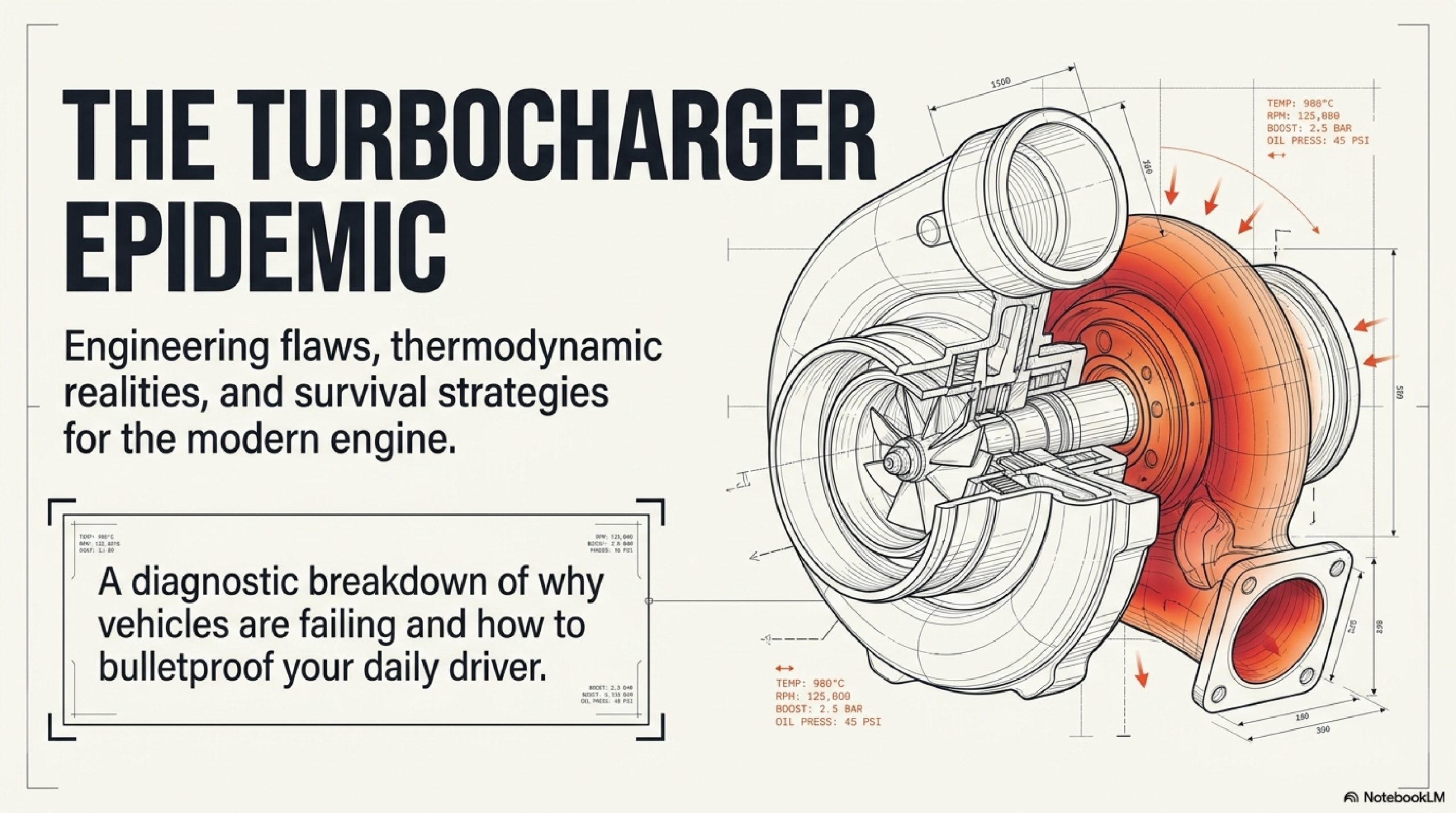
If you have purchased a car anywhere in the world during the last decade, there is a massive probability that a turbocharger is bolted to your engine. From heavy-duty pickup trucks in the United States to compact hatchbacks in Europe and fuel-sipping sedans in Asia, the naturally aspirated engine is on life support.
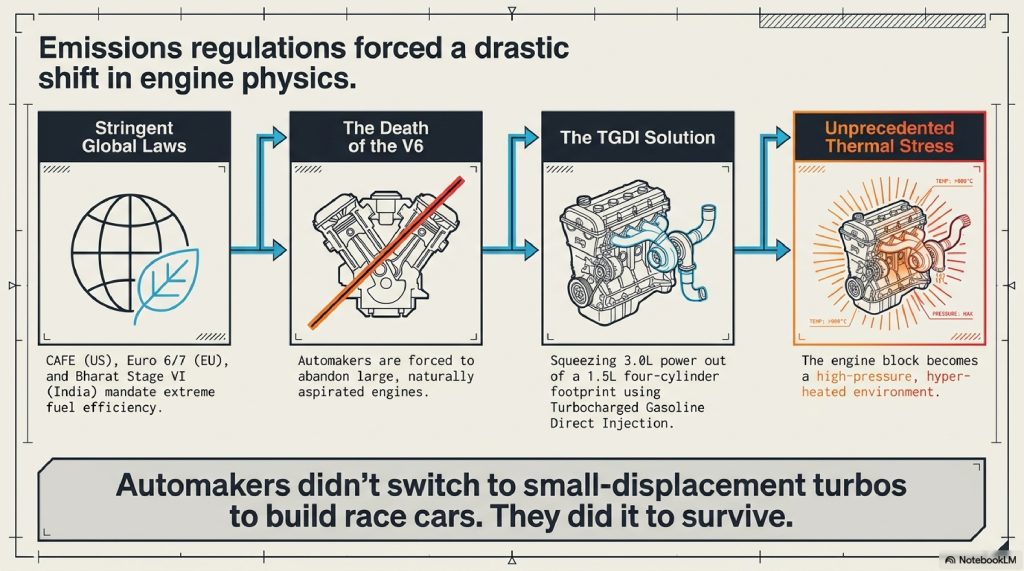
Automakers didn’t switch to small-displacement turbocharged engines because they suddenly wanted to build race cars. They did it to survive. Squeezed by stringent global emissions regulations, like CAFE in the US, Euro 6/7 in Europe, and Bharat Stage VI in India, engineers had to find a way to make a 1.5-liter four-cylinder engine perform like a 3.0-liter V6, but sip fuel like a hybrid.
Their solution? Turbocharged Gasoline Direct Injection (TGDI).
On paper, it’s a brilliant engineering triumph. In the real world, however, it has created a hidden epidemic of catastrophic engine failures, chronic oil consumption, and massive repair bills for everyday owners. Here is the deep technical breakdown of why modern turbocharged engines are failing, and exactly what you can do to protect your investment.
The Technical Explanation: Anatomy of a Stressed Engine
To understand why these engines fail, we must first look at the thermodynamic and mechanical violence happening beneath the hood.
A turbocharger is essentially an air compressor driven by exhaust gases. As the engine combusts fuel, the exiting exhaust spins a turbine up to 300,000 RPM. This turbine is connected by a shaft to a compressor wheel, which forces densely packed, pressurized oxygen (boost) back into the engine. More oxygen means the engine can burn more fuel, creating a massive explosion and subsequent power output from a very small footprint.
The Physics of Heat Density
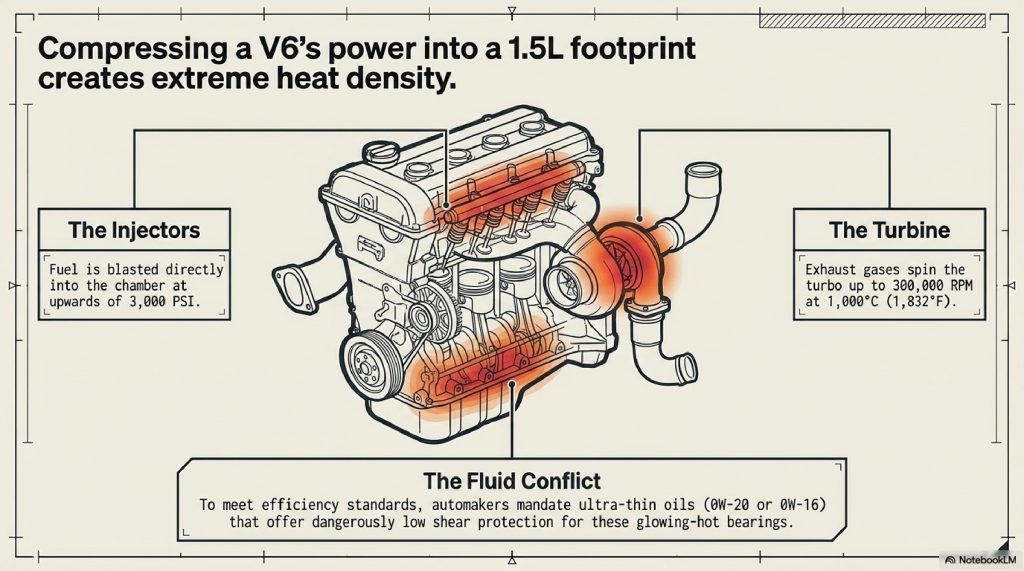
The first engineering problem is heat density. When you compress air, it gets exponentially hotter. When you force a 1.5-liter engine to produce 200 horsepower, the internal cylinder pressures and temperatures skyrocket compared to an older, lazier naturally aspirated engine.
The Direct Injection Dilemma
To prevent the engine from destroying itself under this immense pressure, engineers use Direct Injection (GDI). Instead of mixing fuel and air in the intake manifold, fuel is sprayed directly into the combustion chamber at upwards of 3,000 PSI. The evaporating fuel instantly cools the cylinder, preventing premature detonation.
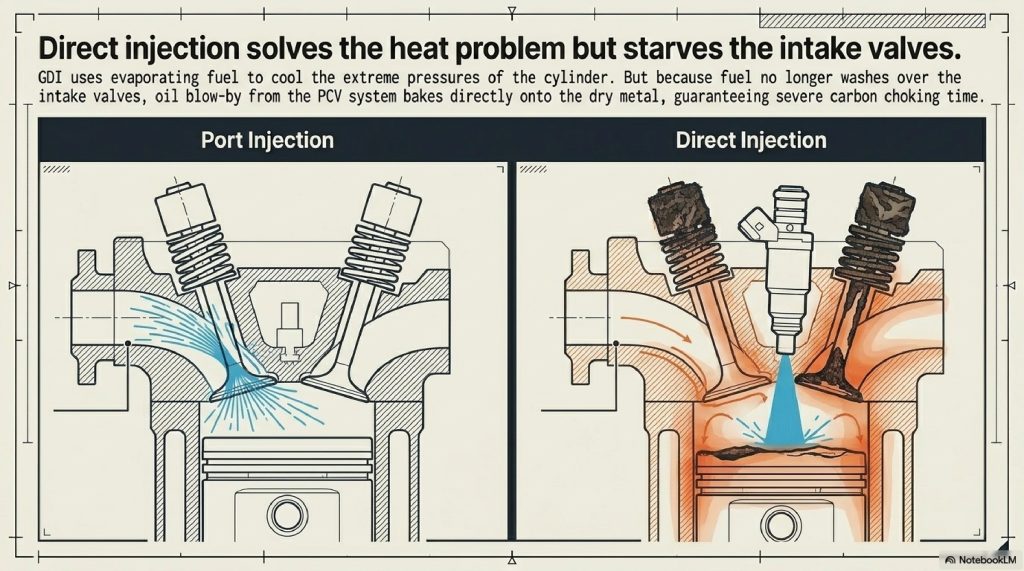
However, this creates the ultimate “catch-22” of modern automotive engineering. Because fuel no longer washes over the back of the intake valves, oil vapors from the crankcase ventilation system bake onto the dry, hot valves. This creates severe carbon buildup, choking the engine over time.
Real-World Performance: The Gap Between Lab and Asphalt
When these engines are brand new, they run flawlessly. They deliver torque low in the RPM range, making heavy SUVs feel lightweight. However, the ownership experience drastically shifts past the 60,000-mile (100,000 km) mark.
- Fuel Economy vs. Reality: Small turbos require a rich air-fuel mixture under heavy load to keep internal temperatures down. If you drive aggressively, a 2.0L turbo will often consume more fuel than an older V6.
- The Oil Viscosity Compromise: To meet efficiency standards, manufacturers specify incredibly thin engine oils, such as 0W-20 or even 0W-16. While these oils reduce internal friction and save a fraction of a mile per gallon, they offer less shear protection for a turbocharger bearing spinning at 300,000 RPM at 1,000°C (1,832°F).
- Thermal Degradation: The sheer amount of heat trapped in modern engine bays cooks plastics, rubber hoses, and gaskets at an accelerated rate, leading to early coolant and oil leaks.
Common Problems: The 3 Killers of Modern Turbos
If you own a modern TGDI vehicle, you are in a battle against three specific engineering flaws.
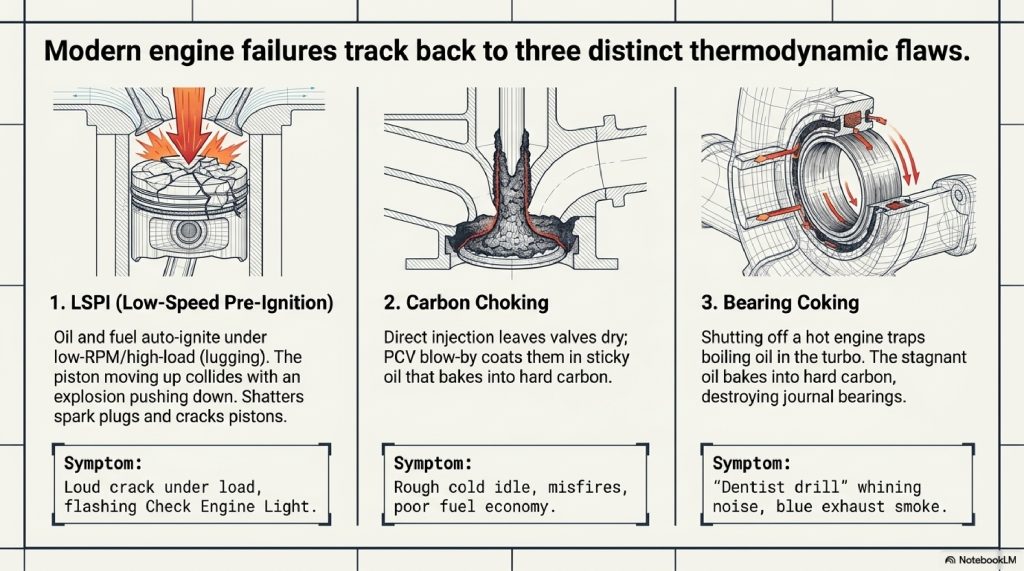
1. LSPI (Low-Speed Pre-Ignition)
LSPI is the silent killer of modern engines. It occurs when a driver heavily accelerates at low RPMs (e.g., lugging the engine up a hill in a high gear). A mixture of engine oil droplets and fuel auto-ignites in the cylinder before the spark plug fires.
The resulting explosion collides with the piston while it is still moving upward. This immense counter-force shatters spark plugs, cracks pistons, and blows out piston ring lands.
- Symptom: A sudden, loud “crack” or rattling noise under load, followed by a total loss of power and a flashing Check Engine Light.
- Prevention: Never floor the throttle at low RPMs. Downshift first.
2. Catastrophic Carbon Buildup
As mentioned, direct injection leaves intake valves dry. Blow-by gases from the PCV system coat these valves in sticky oil, which bakes into hard carbon.
- Symptom: Rough idle on cold starts, random misfires, hesitation, and a slow decline in fuel economy.
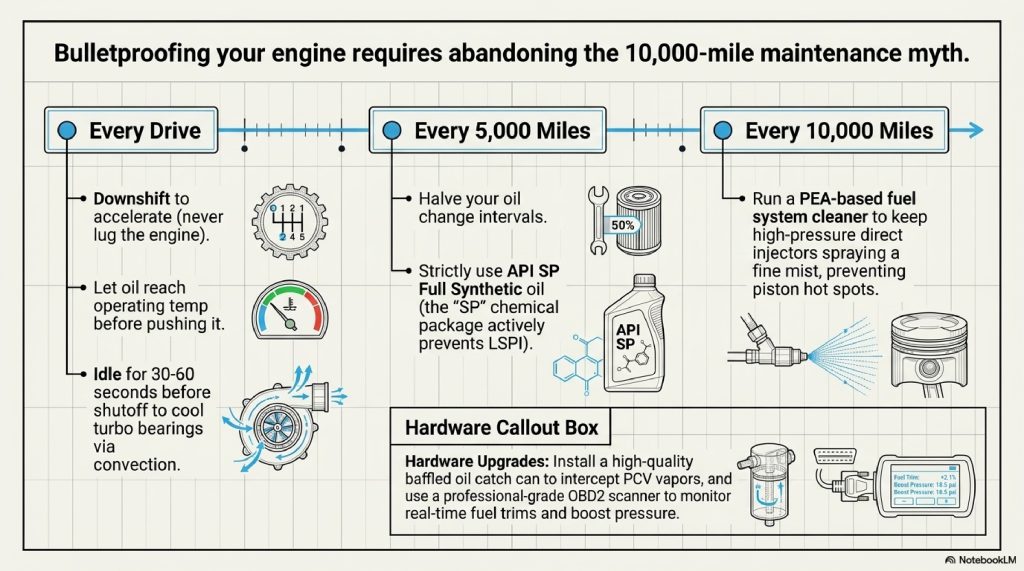
- Prevention: Installing a high-quality baffled oil catch can intercepts these oil vapors before they reach your intake manifold.
3. Oil Starvation and Bearing Coking
When you shut off a turbocharged car immediately after driving hard, the oil inside the incredibly hot turbocharger stops flowing. It literally boils and turns into hard carbon deposits (coking). Over time, this starves the turbo’s journal bearings of lubrication.
- Symptom: Whining or “dentist drill” noises under acceleration, thick blue smoke from the exhaust, and underboost engine codes.
Servicing & Maintenance: Bulletproofing Your Engine
You cannot treat a modern turbocharged engine like a 1990s Honda Civic. Manufacturer-recommended maintenance schedules are often designed to make the car look cheap to own on a dealership brochure, not to make the engine last 200,000 miles.
1. Halve Your Oil Change Intervals
Ignore the “10,000-mile” oil change myth. For a turbocharged engine, oil is the lifeblood that cools the turbine. Change it every 5,000 miles (8,000 km). Furthermore, strictly use an API SP rated full synthetic oil. The API “SP” formulation specifically contains chemical packages designed to prevent LSPI.
2. Use Top-Tier Fuel
Turbo engines require high-octane fuel to prevent detonation. Furthermore, running a PEA-based fuel system cleaner every 10,000 miles keeps the direct injectors spraying a fine mist rather than a sloppy stream, preventing hot spots on the piston crown.
3. Let it Breathe, Let it Cool
Allow the engine oil to reach operating temperature before driving aggressively. More importantly, let the car idle for 30 to 60 seconds before shutting it off after a long highway drive. This allows oil to circulate and cool the turbo bearing.
4. Advanced Diagnostics
Do not wait for the dealer to tell you something is wrong. Enthusiasts and smart owners use a professional-grade OBD2 scanner to monitor real-time data like fuel trims, knock retard, and boost pressure. Catching a failing PCV valve early can save your turbo seals.
Comparison: Turbocharged vs. Naturally Aspirated
How does the modern TGDI engine stack up against the traditional Naturally Aspirated (NA) engine?
| Feature | Modern Turbocharged (TGDI) | Naturally Aspirated (Port Injected) |
| Torque Delivery | Massive low-end torque. | Builds progressively with RPM. |
| Complexity | High (Turbos, intercoolers, high-pressure pumps). | Low (Fewer moving parts). |
| Maintenance Sensitivity | Extremely high. Forgiving of zero neglect. | Highly forgiving. Can handle minor neglect. |
| Carbon Buildup | High risk (Due to Direct Injection). | Low risk (Fuel washes the valves). |
| Longevity (Average) | 100k – 150k miles before major servicing. | 200k+ miles easily. |
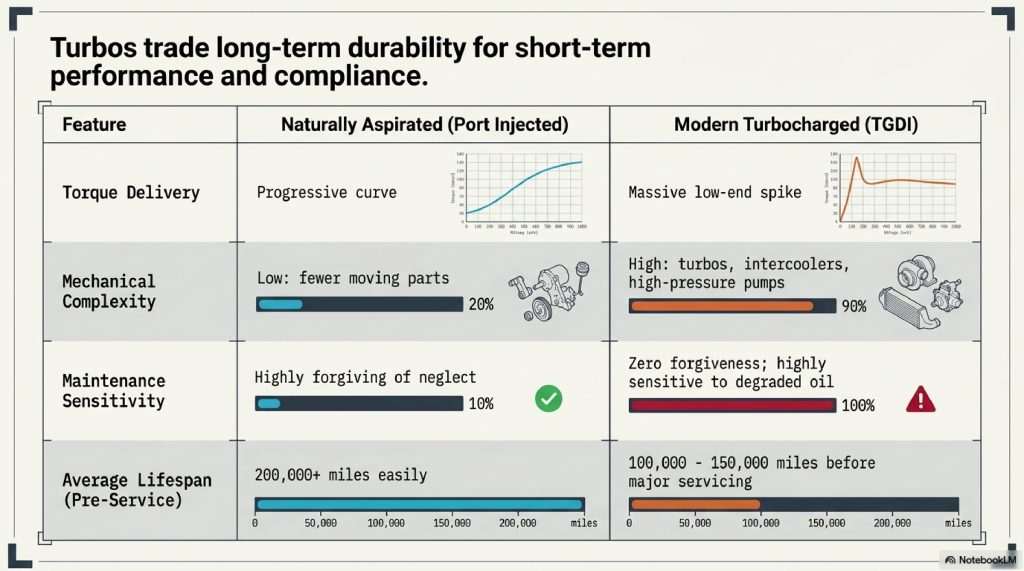
While turbos provide superior driving dynamics and emissions compliance, they fundamentally trade long-term durability for short-term performance.
Future Technology: What Comes Next?
Engineers are painfully aware of these flaws, and the next generation of internal combustion is actively addressing them.
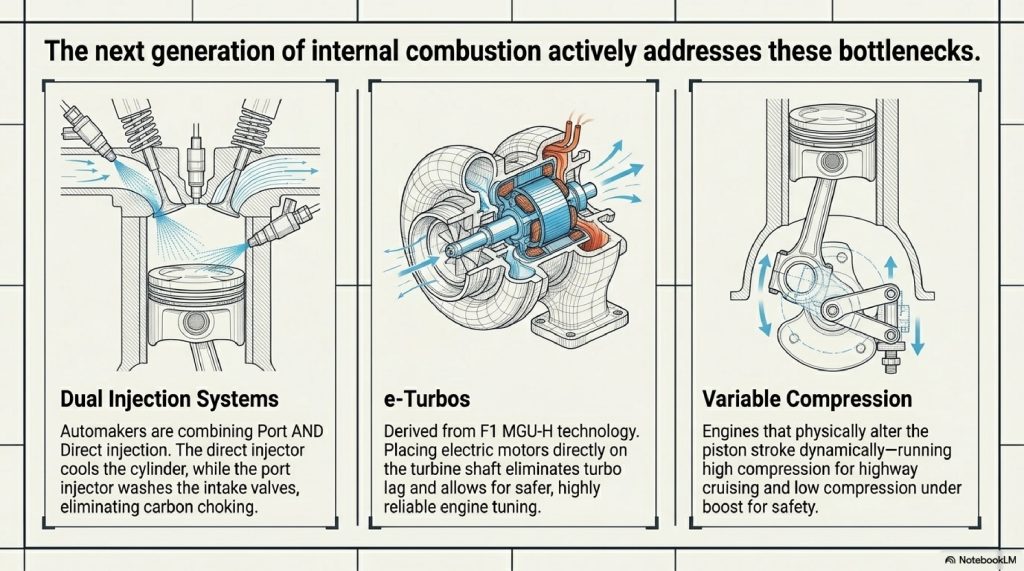
- Dual Injection Systems: Automakers like Toyota and Ford are now utilizing both Direct Injection AND Port Injection simultaneously. The direct injector cools the cylinder for performance, while the port injector washes the intake valves to prevent carbon buildup.
- Electric Turbochargers (e-Turbos): Derived from Formula 1’s MGU-H technology, future turbos will feature electric motors on the turbine shaft. This eliminates turbo lag entirely and allows the engine to run more conservative, reliable tuning maps without sacrificing responsiveness.
- Variable Compression Engines: Infiniti and Nissan have pioneered engines that physically alter the piston stroke dynamically, offering high compression for cruising (efficiency) and low compression for boost (safety).
Historical Background: How We Got Here
Turbocharging is not new. In the 1970s and 80s, cars like the Porsche 930 Turbo and Saab 99 pioneered forced induction for the street. However, these were performance anomalies. In the 1990s, Japanese automakers (Toyota, Nissan, Subaru) mastered turbocharging for sports cars, but they relied on massive amounts of fuel to cool the engines, yielding terrible emissions.
The current “Downsizing Era” began in earnest around 2010. Ford’s EcoBoost marketing campaign convinced the world that turbos were for everyday family cars. The rest of the industry followed suit, leading to the highly stressed, micro-displacement engines we drive today.
Expert Insights: The Engineer’s Perspective
From a strictly mechanical standpoint, thermal management is the ultimate limiting factor of the modern engine.
As an automotive engineer, the observation is clear: Automakers are designing engines for the first owner. The engineering tolerances are tighter than ever, and the metallurgical quality is brilliant. However, the systems strapped to the engine block (EGR, PCV, TGDI) are essentially “wear items.”
If you view sensors, PCV valves, and even the turbocharger itself as items that require replacement at 100,000 miles, just like a timing belt or a clutch, the modern engine is actually a marvel. The failure comes from the consumer expectation that an engine should be maintenance-free outside of fluid changes.
Conclusion
The modern turbocharged engine is a spectacular feat of engineering, capable of extracting immense power from a microscopic footprint while passing the strictest emissions laws in human history. But that performance comes at a steep cost in complexity and thermal stress.
Engine failures are not random. They are the result of LSPI, carbon choking, and thermal degradation. By understanding the physics under your hood, ditching the 10,000-mile oil change myth, using the right synthetic fluids, and adjusting your driving habits, you can easily push your modern turbo engine well past the 200,000-mile mark.
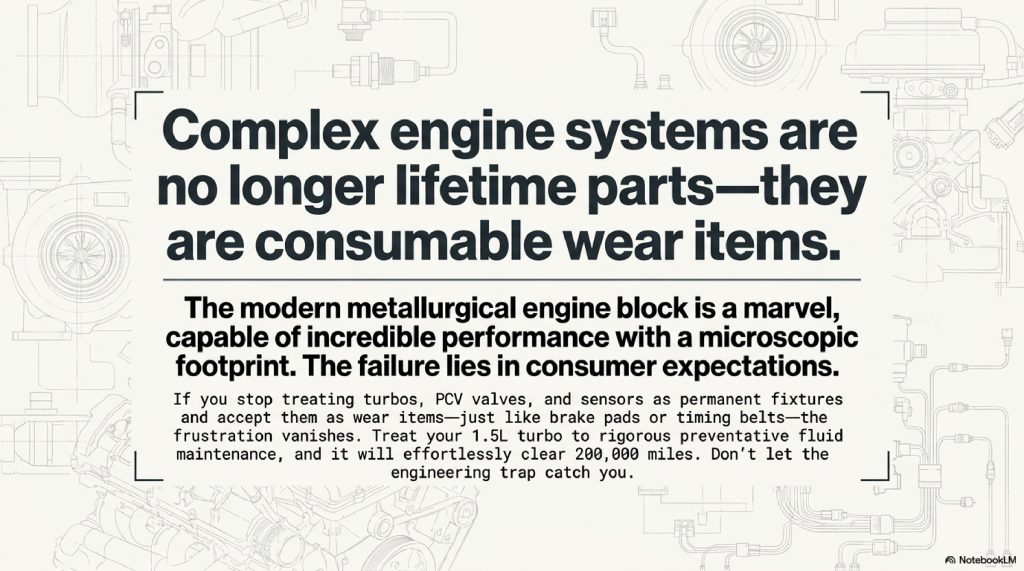
Don’t let the engineering trap catch you. Stay proactive, monitor your engine’s vitals, and invest in preventative maintenance.
Frequently Asked Questions (FAQ)
Q: Do turbo engines burn more oil than normal engines?
A: Yes. Because turbos rely on engine oil to lubricate bearings spinning at incredibly high speeds under massive heat, a small amount of oil vaporization (blow-by) is normal. Check your oil dipstick every 1,000 miles.
Q: Can I put regular unleaded gas in my turbocharged car?
A: Unless your owner’s manual explicitly states that 87 octane is acceptable, you should avoid it. Low-octane fuel drastically increases the risk of engine knock and catastrophic LSPI in forced-induction engines.
Q: What is a turbo cool-down period, and do I need to do it?
A: It is the practice of letting your engine idle before turning it off. While modern water-cooled turbos use convection to keep coolant flowing after shutoff, letting the car idle for 30 seconds after aggressive driving is still highly recommended to prevent oil coking in the bearings.
Q: Is it expensive to replace a blown turbocharger?
A: Yes. Depending on the make and model, replacing a failed turbocharger can cost anywhere from $1,500 to over $4,000 in parts and labor. Preventative maintenance is vastly cheaper than replacement.
Comments (2)