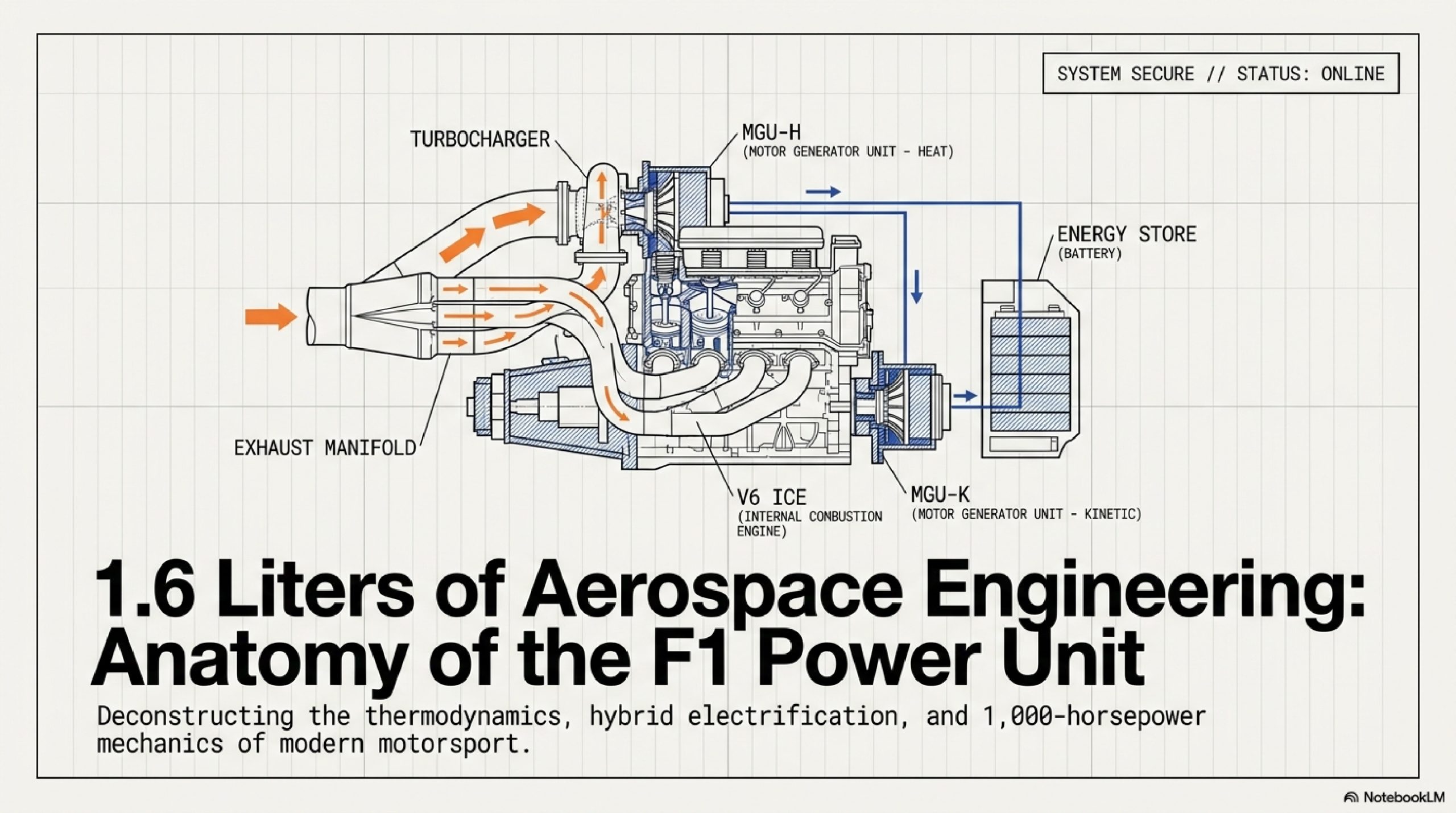
If you park a modern family sedan next to a Formula 1 car, the only thing their engines share is that they both consume fuel and air. Beyond that, the powertrain sitting behind the driver of an F1 car is closer to aerospace technology than anything found in a dealership.
Currently, Formula 1 cars are powered by a 1.6-liter turbocharged V6 engine. To put that into perspective, the engine displacement is barely larger than what you would find in a Honda Civic. Yet, this diminutive power plant produces over 1,000 horsepower, revs to 15,000 RPM, and achieves a thermal efficiency that literally rewrote the laws of internal combustion.
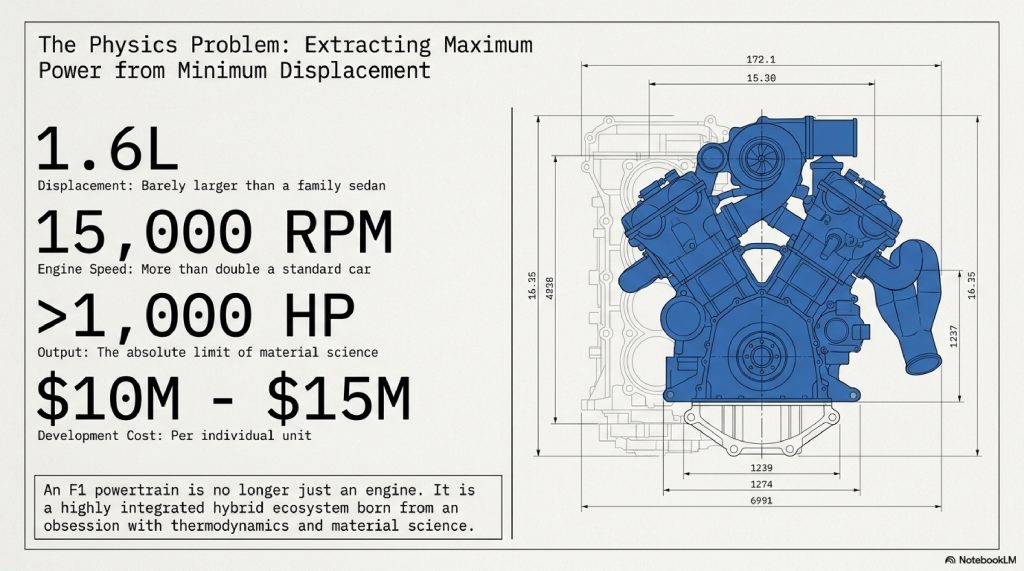
The modern F1 engine officially called a Power Unit (PU), is an engineering masterpiece. It is born from an obsession with thermodynamics, metallurgy, and hybrid electrification. Whether you are a casual race fan or a mechanical engineer, understanding how these engines breathe, fire, and recover energy is an absolute masterclass in human ingenuity.
Technical Explanation: Anatomy of a Power Unit
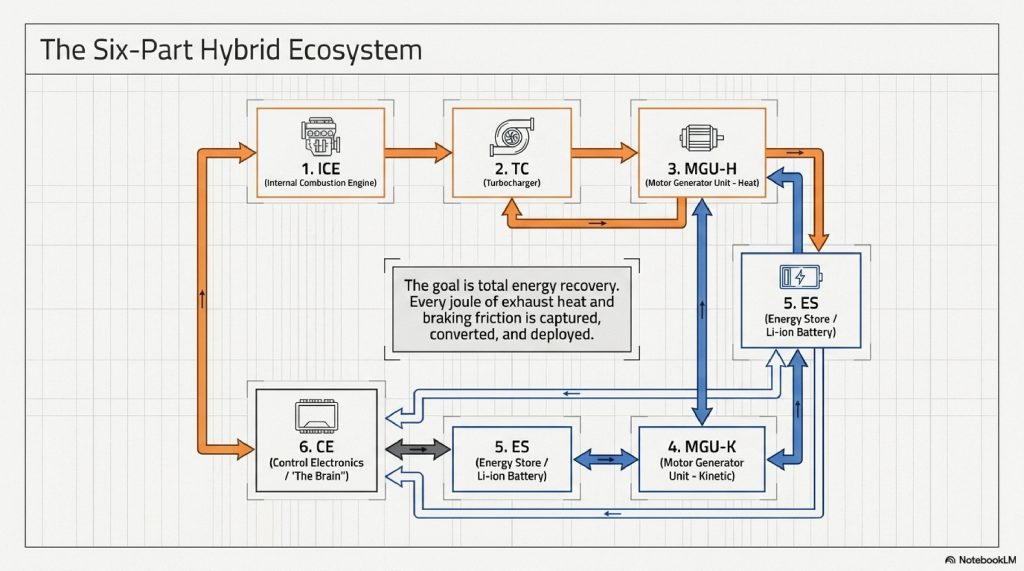
To understand the genius of the F1 Power Unit, we must break it down into its core components. Formula 1 does not use a traditional engine; it uses a highly integrated hybrid system divided into six distinct parts.
1. The Internal Combustion Engine (ICE)
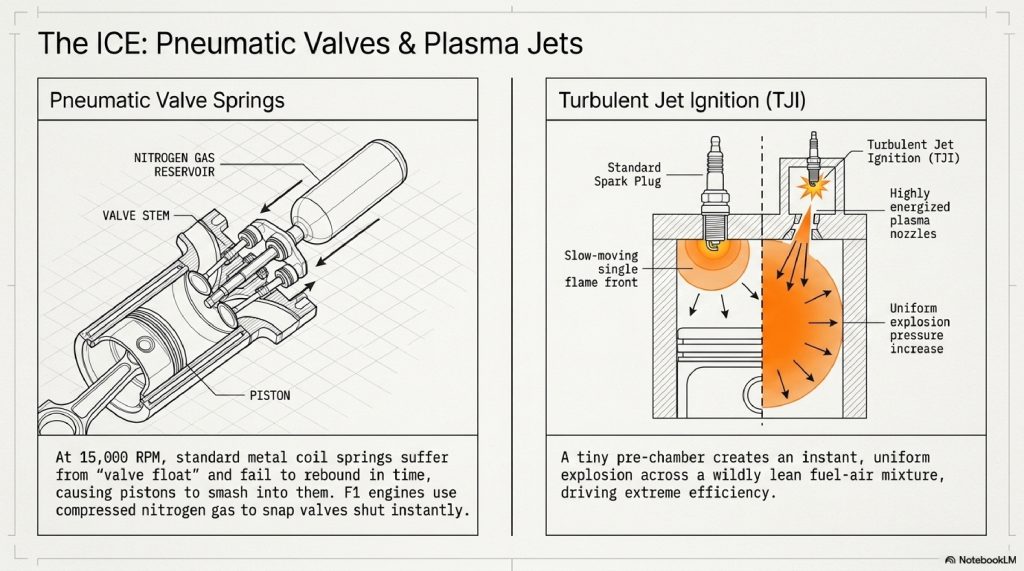
At the heart of the system is the 1.6-liter 90-degree V6. Unlike road cars that use metal coil springs to close their valves, an F1 ICE uses pneumatic valve springs (compressed nitrogen gas). At 15,000 RPM, metal springs would fail to rebound fast enough (valve float), causing the piston to smash into the valves.
Furthermore, F1 engines utilize Turbulent Jet Ignition (TJI), or pre-chamber ignition. A tiny amount of fuel is injected into a small chamber above the main cylinder and ignited by the spark plug. The resulting high-energy plasma jets shoot through tiny holes into the main cylinder, igniting a wildly lean fuel-air mixture almost instantly. This creates a massive, uniform explosion that drives extreme efficiency.
2. The Turbocharger (TC)
F1 turbos are heavily restricted but highly optimized. They force incredibly dense air into the engine to maximize combustion. However, traditional turbos suffer from “turbo lag”, the delay before exhaust gases spin the turbine fast enough to generate boost. F1 engineers solved this with the next component.
3. Motor Generator Unit – Heat (MGU-H)
The MGU-H is the most complex piece of engineering in modern motorsport. It is an electric motor connected directly to the shaft connecting the turbo’s turbine and compressor.
- When accelerating: The MGU-H acts as a motor, instantly spinning up the compressor wheel before the exhaust gases arrive, completely eliminating turbo lag.
- At high speeds: It acts as a generator, harvesting excess rotational energy from the exhaust-driven turbine and converting it into electricity to charge the battery.
4. Motor Generator Unit – Kinetic (MGU-K)
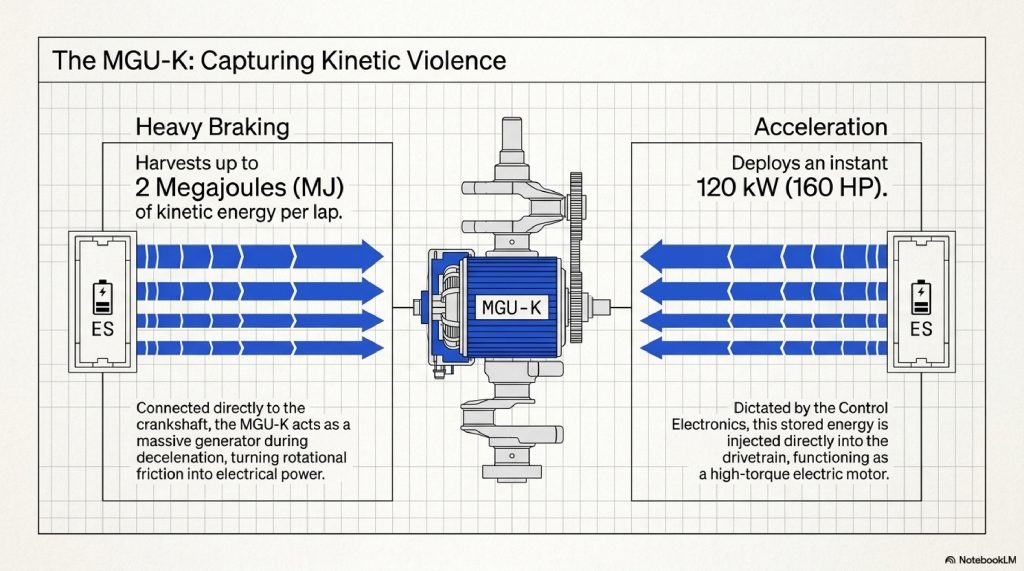
Similar to regenerative braking in road-going hybrids, the MGU-K connects to the engine’s crankshaft. Under heavy braking, it acts as a massive generator, harvesting up to 2 MJ of kinetic energy per lap. Under acceleration, it deploys that energy as an electric motor, injecting an instant 120 kW (160 horsepower) directly into the drivetrain.
5. Energy Store (ES) & Control Electronics (CE)
The ES is a specialized, ultra-lightweight lithium-ion battery pack. The CE is the “brain” that dictates when energy is harvested and when it is deployed, balancing the ICE, MGU-K, and MGU-H perfectly based on the driver’s throttle input and track layout.
Real-World Performance: The 50% Efficiency Miracle
The greatest triumph of the current F1 hybrid era (2014–present) is thermal efficiency.
In internal combustion, thermal efficiency is the percentage of energy in the fuel that is actually converted into forward motion. The rest is lost as heat through the exhaust or cooling systems.
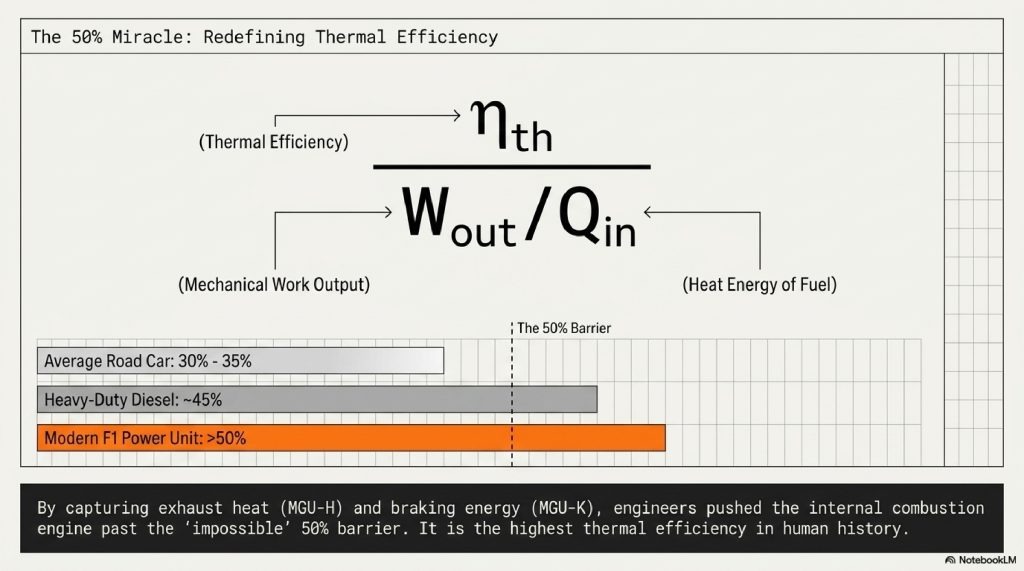
- An average road car sits around 30% to 35% thermal efficiency.
- A heavy-duty diesel engine might reach 45%.
- A modern Formula 1 Power Unit exceeds 50%.
Mathematically, this is expressed as:
Where is the mechanical work output and is the heat energy of the fuel. By capturing exhaust heat via the MGU-H and braking energy via the MGU-K, F1 engineers have achieved the highest thermal efficiency of any internal combustion engine in human history.
Common Problems: The Knife’s Edge of Reliability
Extracting 1,000 horsepower from a 1.6-liter block means operating on the absolute limit of material science.
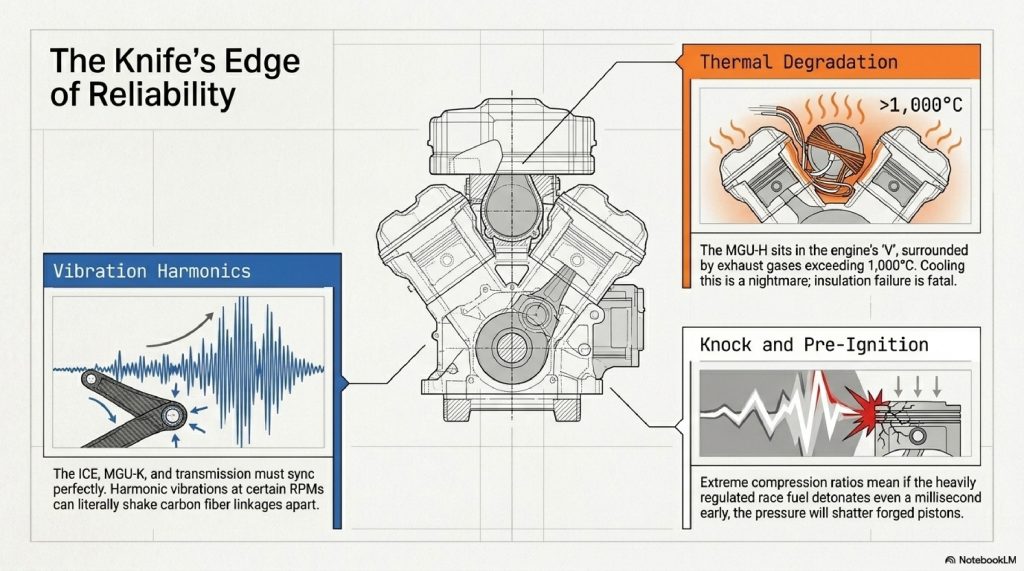
- Thermal Degradation: The MGU-H sits nestled in the “V” of the engine block, surrounded by exhaust gases exceeding 1,000°C. Cooling this electric motor is a nightmare. Insulation failure in the MGU-H wiring is a common cause of terminal failure.
- Knock and Pre-Ignition: Because of the extreme compression ratios and boost pressures, if the fuel-air mixture detonates even a millisecond early, the resulting pressure spike will shatter the forged aluminum pistons.
- Vibration Harmonics: The ICE, MGU-K, and transmission must all sync perfectly. Harmonic vibrations at specific RPMs can literally shake carbon fiber linkages and electrical connectors apart.
Servicing & Maintenance: NASA-Level Precision
You don’t just “change the oil” on an F1 car. Starting an F1 engine cold would seize it immediately because the internal tolerances are so tight that the pistons are physically jammed in the cylinders at room temperature.
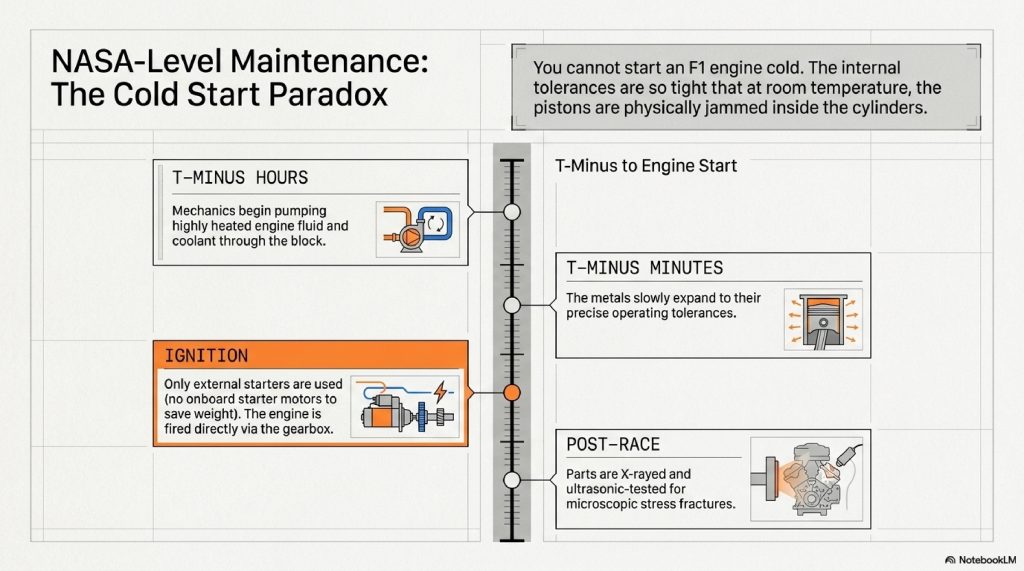
Before the engine is started, mechanics must pump pre-heated engine fluid and coolant through the block for hours to expand the metals to their operating tolerances. When rebuilding road cars, professionals use a highly calibrated digital torque wrench to ensure perfection. In F1, parts are meticulously X-rayed and ultrasonic-tested for microscopic stress fractures after every race.
For road car enthusiasts looking to emulate this level of care, adopting a strict maintenance schedule using an ester-based motorsport synthetic oil and monitoring engine health with a professional bi-directional OBD2 scanner is the closest you can get to F1-level telemetry in your garage.
Comparison: F1 vs. Hypercars vs. Road Cars
How does F1 technology compare to what we drive?
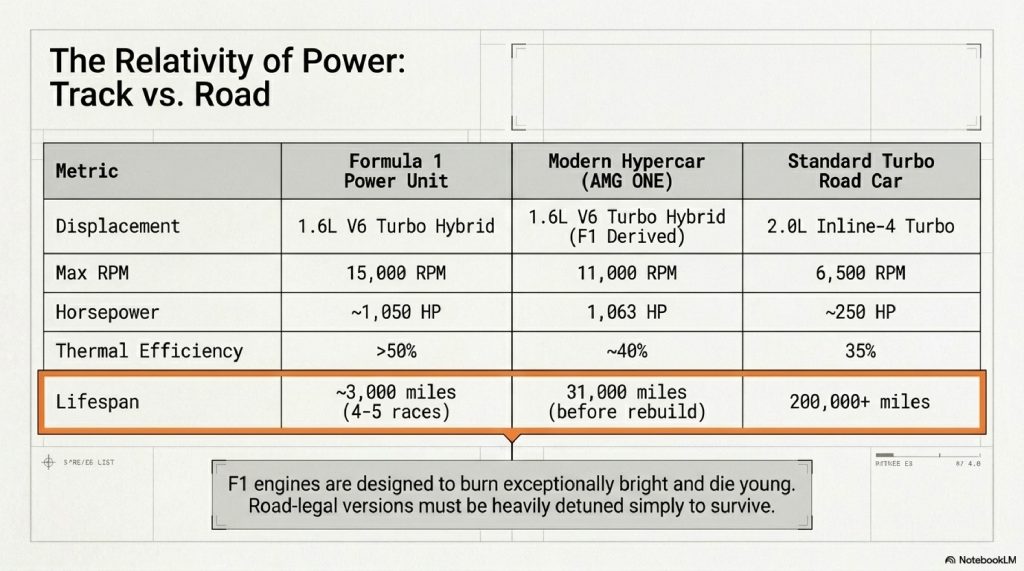
| Metric | Formula 1 Power Unit | Modern Hypercar (e.g., AMG ONE) | Standard Turbo Road Car |
| Displacement | 1.6L V6 Turbo Hybrid | 1.6L V6 Turbo Hybrid (F1 Derived) | 2.0L Inline-4 Turbo |
| Max RPM | 15,000 RPM | 11,000 RPM | 6,500 RPM |
| Horsepower | ~1,050 HP | 1,063 HP | 250 HP |
| Thermal Efficiency | >50% | ~40% | 35% |
| Lifespan | ~3,000 miles (4-5 races) | 31,000 miles (before rebuild) | 200,000+ miles |
Notice the lifespan. F1 engines are designed to burn exceptionally bright and die young. Bringing F1 tech to the road, as Mercedes did with the AMG ONE, requires heavily detuning the engine and lowering the redline just to make it last until its first major service.
Future Technology: The 2026 Regulation Overhaul
Formula 1 never stops evolving. In 2026, the FIA is introducing massive changes to the Power Unit regulations to make the sport more road-relevant and sustainable.
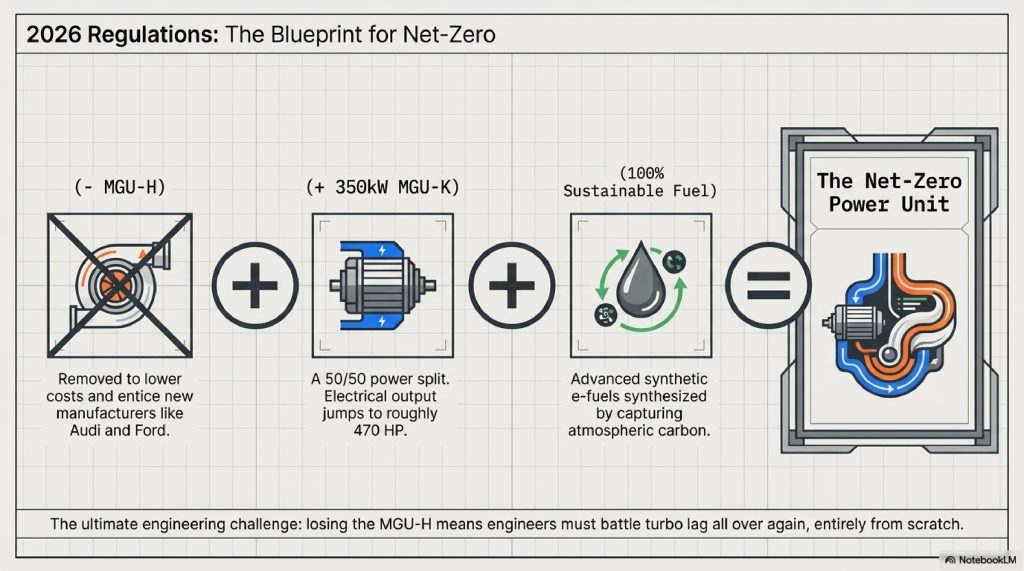
- The Death of the MGU-H: The MGU-H is incredibly expensive and has little relevance to road cars. It will be removed entirely in 2026. This means engineers must find new ways to battle turbo lag.
- 50/50 Power Split: To compensate for the loss of the MGU-H, the MGU-K will be massively upgraded. Electrical output will jump from 120 kW to 350 kW (roughly 470 HP). The engine will rely equally on internal combustion and battery power.
- 100% Sustainable Fuels: F1 will abandon fossil fuels entirely, moving to advanced synthetic fuels (e-fuels). These fuels are synthesized by capturing carbon from the atmosphere, creating a net-zero carbon footprint. This research is crucial for keeping ICE road cars alive in a zero-emissions future.
Historical Background: The Pursuit of Power
To appreciate the current V6 hybrids, we must look backward.
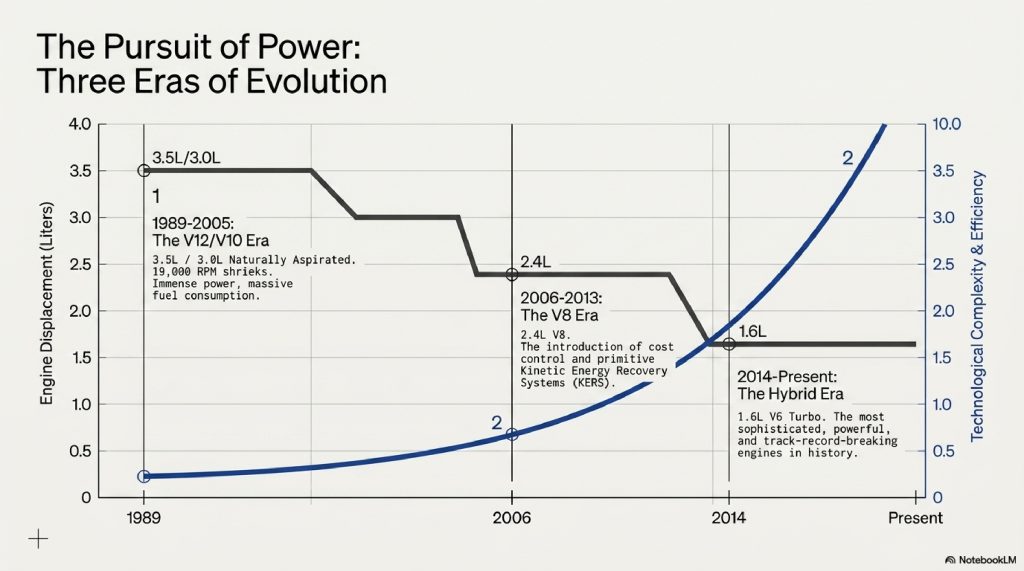
- The V12 and V10 Eras (1989–2005): Characterized by deafening 19,000 RPM shrieks, these naturally aspirated 3.5L and 3.0L engines produced immense power but burned fuel at an alarming rate.
- The V8 Era (2006–2013): A step toward cost control. 2.4L V8s were introduced, alongside the first primitive kinetic energy recovery systems (KERS).
- The Hybrid Era (2014–Present): The shift to 1.6L V6 turbos. Initially mocked for their quieter sound, they quickly proved to be the most powerful and sophisticated engines in F1 history, breaking track records globally.
Expert Insights: Why This Matters to You
Why spend hundreds of millions of dollars developing a 1.6-liter hybrid race engine? Because motorsport is the ultimate crucible for automotive R&D.
The aerodynamic fluid dynamics software developed in F1 is now used to design quieter, more efficient road cars. The thermal management required for the MGU-K battery is directly influencing the thermal efficiency of next-generation electric vehicles (EVs). If you want to dive deeper into the mathematics behind this, the legendary engineering handbook Race Car Vehicle Dynamics is the required reading for any aspiring automotive engineer.
Conclusion
The modern Formula 1 engine is a testament to human perseverance. By combining microscopic mechanical tolerances, pre-chamber ignition, and mind-bending electrical energy recovery, engineers have created a machine that extracts every possible ounce of energy from a drop of fuel.
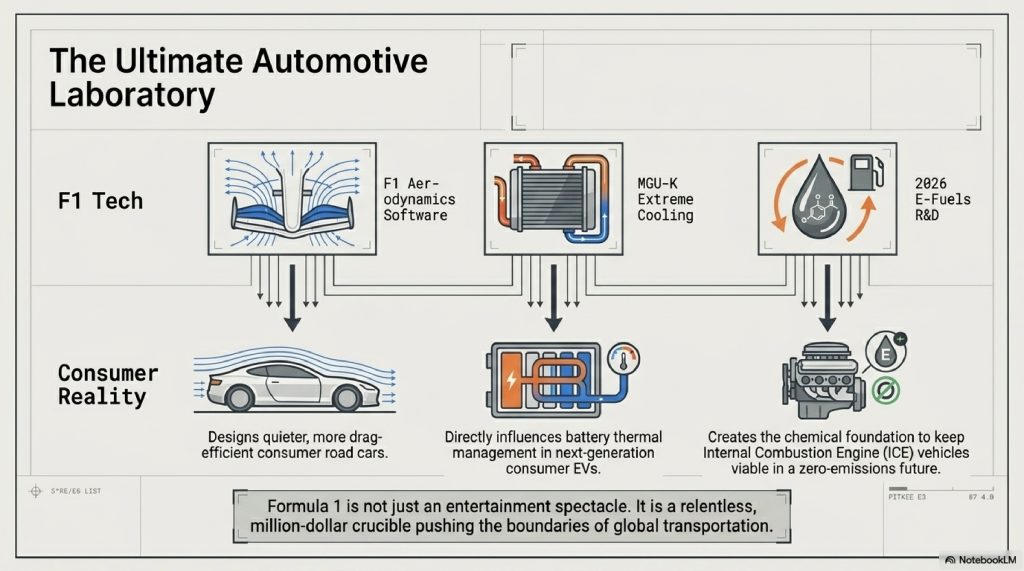
As we look toward the 2026 regulations and the shift to sustainable synthetic fuels, Formula 1 continues to prove that it is not just an entertainment spectacle; it is the ultimate laboratory for the future of global transportation.
Frequently Asked Questions (FAQ)
Q: Do Formula 1 cars use normal gasoline?
A: No. F1 cars use heavily regulated, high-octane race fuel that is chemically close to premium road-car gasoline but strictly refined for maximum energy density and anti-knock properties. By 2026, they will run on 100% sustainable synthetic fuels.
Q: Why don’t F1 cars have starter motors?
A: To save weight, F1 cars do not have onboard starter motors. They are started in the garage or on the grid using an external starter spun up by mechanics, which engages directly with the gearbox or engine.
Q: What is “Turbo Lag” and how does F1 prevent it?
A: Turbo lag is the delay between pressing the throttle and the turbocharger spinning fast enough to provide power. F1 prevents this using the MGU-H, an electric motor that instantly spins the turbo compressor before exhaust gases even reach the turbine.
Q: How much does a Formula 1 engine cost?
A: While exact figures are kept secret, the research, development, and manufacturing of a single F1 Power Unit is estimated to cost between $10 million and $15 million.
Q: Why is the MGU-H being removed in 2026?
A: Despite being an engineering marvel, the MGU-H is incredibly complex, vastly expensive, and has almost zero crossover applicability to consumer road cars. Removing it lowers costs and entices new engine manufacturers (like Audi and Ford) to enter the sport.
Comment