Why Toyota Engines Last Forever: The Engineering Secrets Behind 500,000-Mile Reliability
Posted on
By Pranjal Netam
Introduction
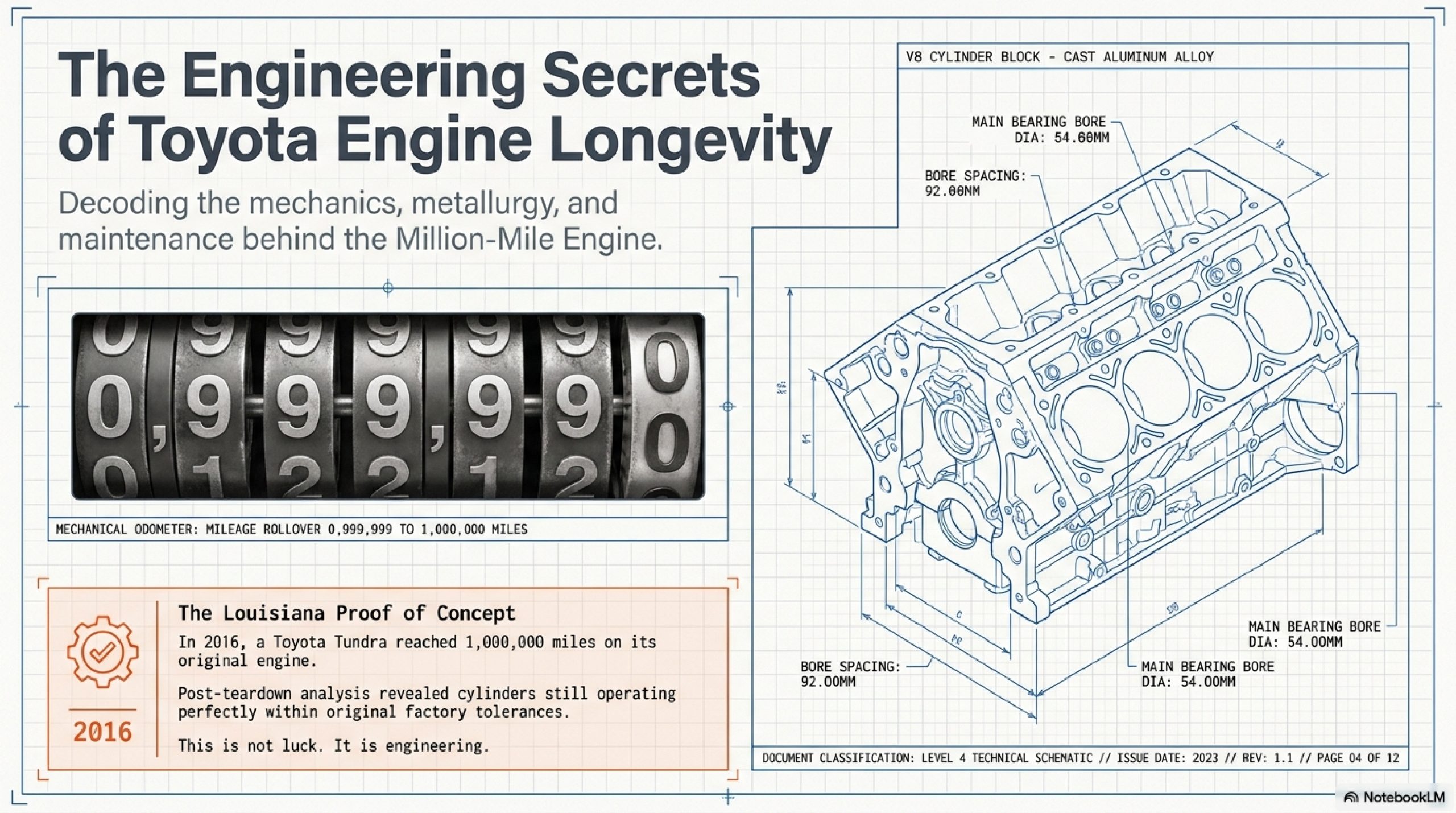
In 2016, a Toyota Tundra owner in Louisiana hit a milestone that sounds like automotive folklore: one million miles on the original engine. When Toyota engineers disassembled that engine, they found the cylinders were still within factory tolerances.
This isn’t an anomaly; it is the result of a specific, rigorous engineering ethos. Globally, Toyota has become the benchmark for reliability, often outlasting competitors by decades. But what is the “secret sauce”? Is it better metal? Is it magic?
The truth is found in a combination of conservative mechanical stress, advanced metallurgy, and a manufacturing philosophy known as Kaizen. For the global car owner, understanding these principles isn’t just about brand loyalty, it’s about understanding how to make any vehicle last a lifetime.
Technical Explanation: The Engineering of “Under-Stressing”
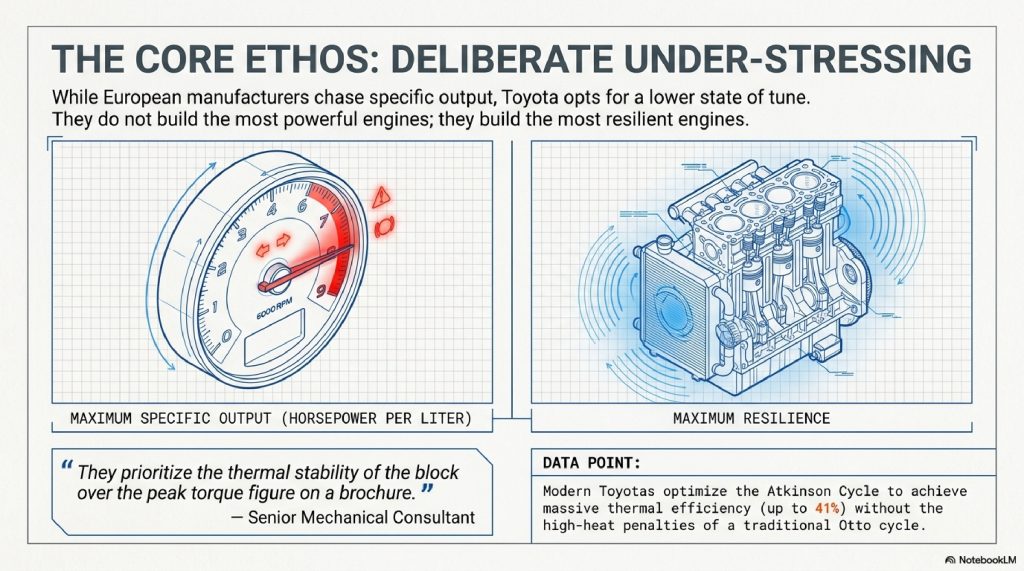
At the core of Toyota’s reliability is the concept of under-stressing. While many European manufacturers chase “specific output” (maximizing horsepower per liter of displacement), Toyota often opts for a lower state of tune.
1. Mechanical Load and BMEP
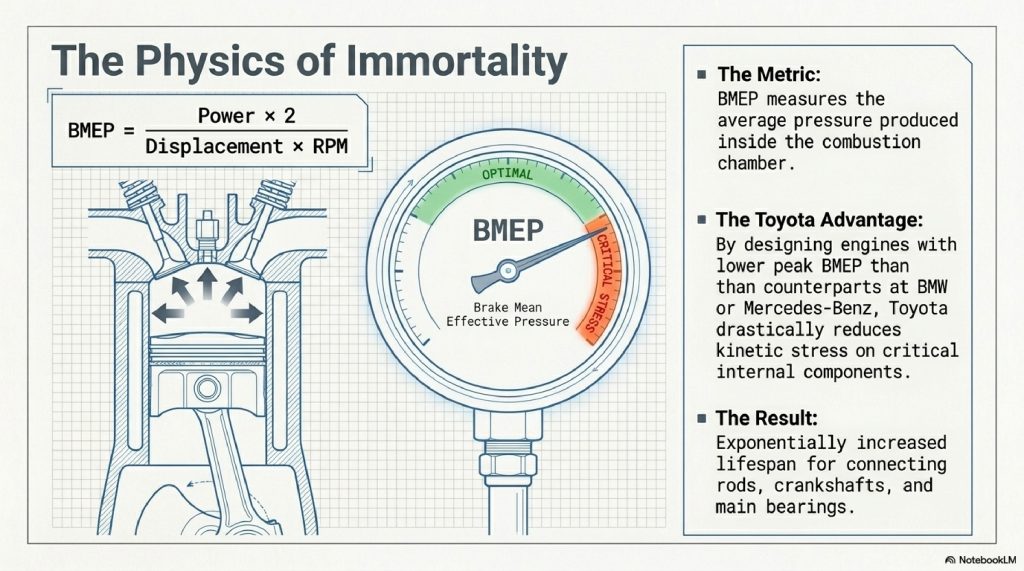
Brake Mean Effective Pressure is a key metric in engine design. It represents the average pressure produced in the combustion chamber.
Toyota typically designs engines with lower peak than their counterparts at BMW or Mercedes-Benz. By keeping internal pressures lower, they reduce the stress on the connecting rods, crankshaft, and main bearings.
2. Piston and Ring Design
Toyota’s “Dynamic Force” engines utilize a laser-pit clad valve seat and a specific skirt design that reduces friction. More importantly, they often use slightly thicker piston rings compared to performance-oriented brands. This might result in a tiny loss of efficiency, but it drastically reduces the “blow-by” gases that contaminate engine oil over time.
3. Over-Engineered Cooling Gallies
Toyota engines are famous for their cooling system redundancy. The oil gallies (the “veins” of the engine) are often larger than strictly necessary. This ensures that even if a user neglects an oil change, the increased viscosity of dirty oil won’t immediately starve the top end of the engine of lubrication.
Expert Insight: “Toyota doesn’t build the most powerful engines; they build the most ‘resilient’ engines. They prioritize the thermal stability of the block over the peak torque figure on a brochure.” Senior Mechanical Consultant
Real-World Performance: The “Kaizen” Effect
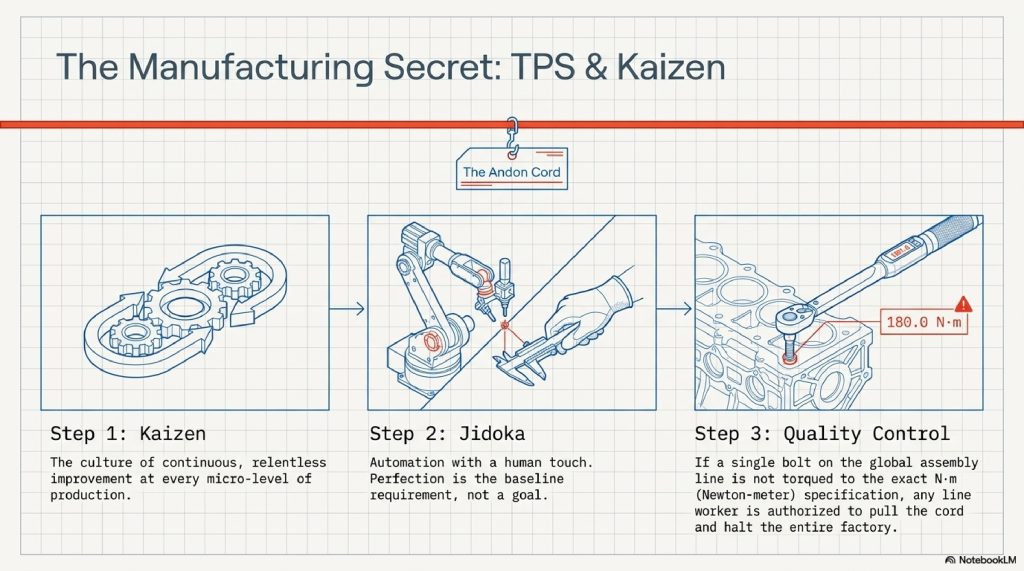
Toyota’s reliability isn’t just about the parts; it’s about the Toyota Production System (TPS).
Jidoka (Automation with a human touch): If a single bolt on the assembly line isn’t torqued to the exact (Newton-meter) specification, any worker can stop the entire factory line.
Fuel Economy vs. Longevity: Modern Toyotas achieve high thermal efficiency (up to 41%) not by pushing the engine to its breaking point, but by optimizing the Atkinson Cycle. This allows for great fuel economy without the high-heat penalties of a traditional Otto cycle engine.
Heat Management: Toyota’s use of plastic and rubber components is notoriously conservative. While other brands might use thin plastics that crack after 5 years of heat cycles, Toyota uses high-grade polymers and EPDM rubber that remain pliable for a decade.
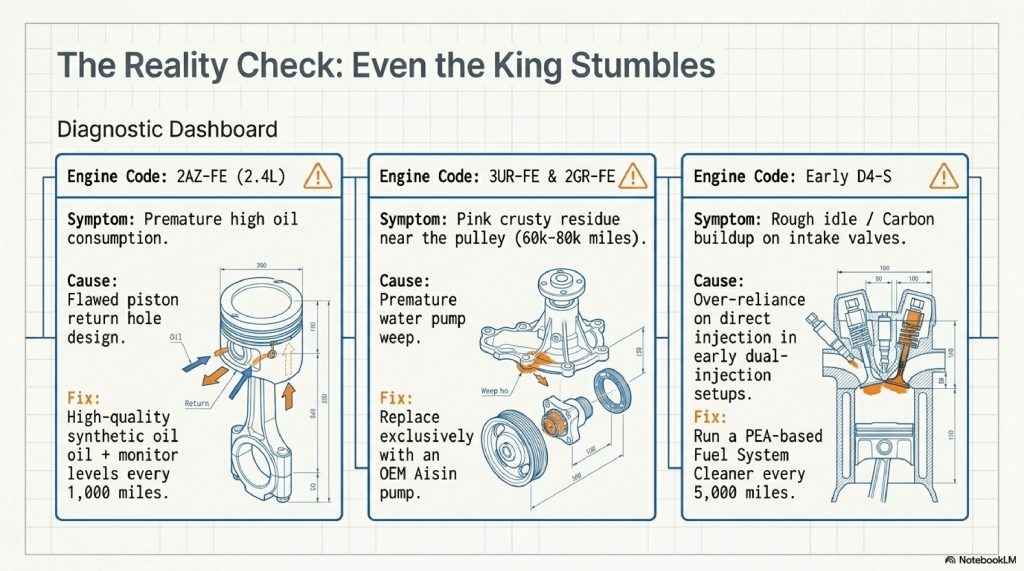
Common Problems: Even the King Has Flaws
No engine is perfect. To maintain authority, we must address where Toyota has stumbled.
1. Oil Consumption (The 2AZ-FE Saga)
In the mid-2000s, certain 2.4L engines suffered from premature piston ring wear, leading to high oil consumption.
Cause: A flaw in the return hole design in the piston.
Prevention: Use high-quality synthetic oil and monitor levels every 1,000 miles.
2. Water Pump Failures (3UR-FE & 2GR-FE)
Certain V6 and V8 models had water pumps that would weep coolant around 60,000–80,000 miles.
Symptom: Pink crusty residue near the pulley.
Fix: Replace with an OEM Aisin pump.
3. Carbon Buildup (Early D4-S)
While Toyota pioneered D4-S (Dual Injection), early versions relied too heavily on direct injection, causing carbon buildup on intake valves.
Prevention: Use a PEA-based Fuel System Cleaner every 5,000 miles to keep injectors and valves clean.
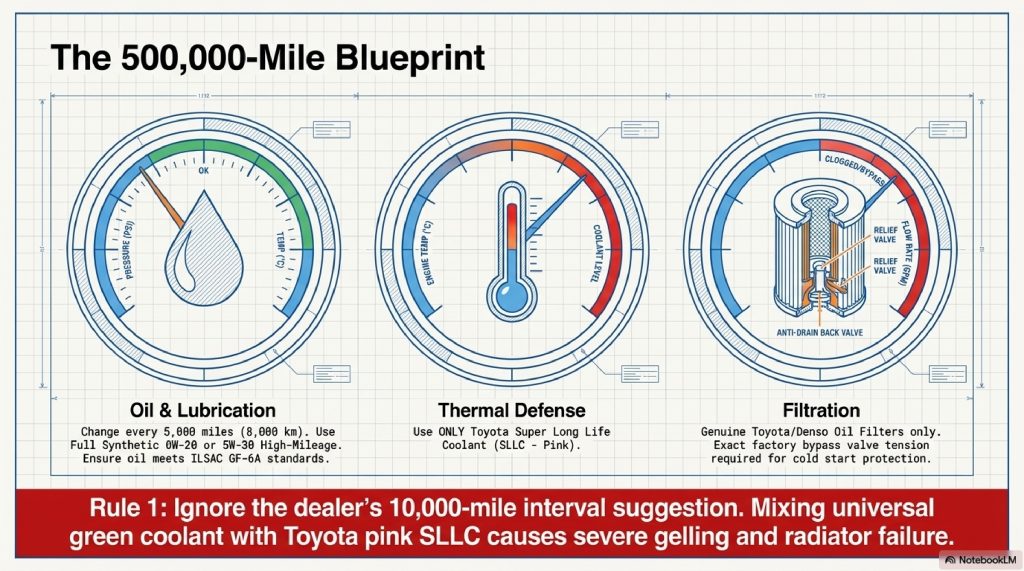
Servicing & Maintenance: The 500,000-Mile Blueprint
If you want your Toyota to reach the “Million Mile” club, following the dealer’s 10,000-mile oil change interval is often not enough for long-term ownership.
Recommended Servicing Methods:
Oil Changes: Every 5,000 miles (8,000 km) using a full synthetic 0W-20 or 5W-30 High-Mileage Oil].
Coolant: Stick strictly to Toyota Super Long Life Coolant (SLLC). Mixing “universal” green coolant with Toyota’s pink coolant can lead to gelling and radiator failure.
Filters: Always use Genuine Toyota/Denso Oil Filters. These contain a specific bypass valve tension that ensures oil flow during cold starts in harsh climates like Canada or Northern Europe.
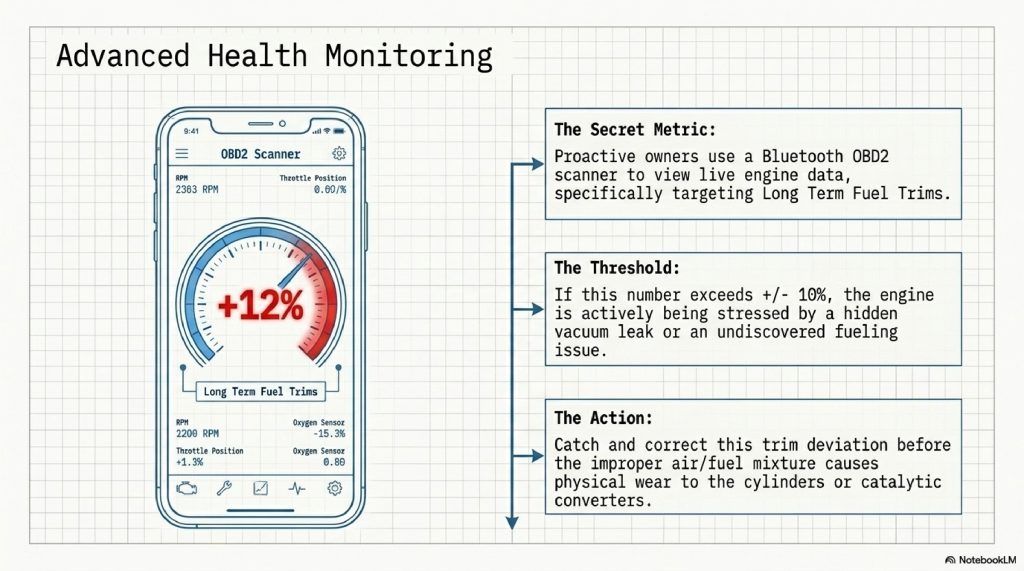
Maintenance Tip: Use a Bluetooth OBD2 Scanner to monitor “Long Term Fuel Trims.” If this number exceeds +/- 10%, you have a vacuum leak or fueling issue that is stressing the engine.
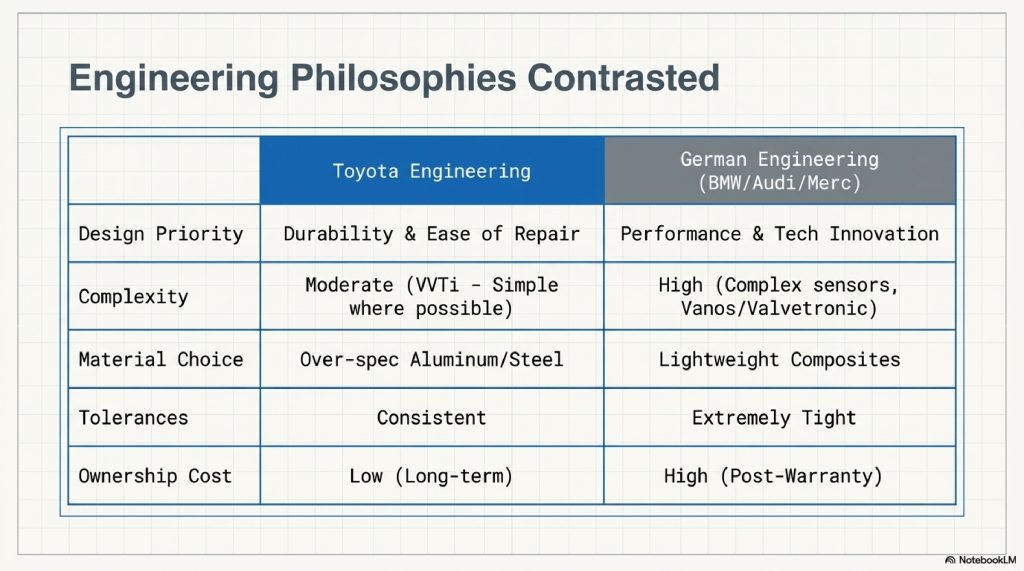
Comparison: Toyota vs. German Engineering
Feature
Toyota Engineering
German (BMW/Audi/Merc) Engineering
Design Priority
Durability & Ease of Repair
Performance & Tech Innovation
Complexity
Moderate (Simple where possible)
High (Complex sensors & actuators)
Material Choice
Over-spec Aluminum/Steel
Lightweight Composites
Tolerances
Consistent
Extremely Tight
Ownership Cost
Low (Long-term)
High (Post-Warranty)
While a BMW might offer a more “spirited” drive, the complexity of its Vanos or Valvetronic systems introduces more failure points compared to Toyota’s VVTi.
Future Technology: Can Reliability Survive the EV Shift?
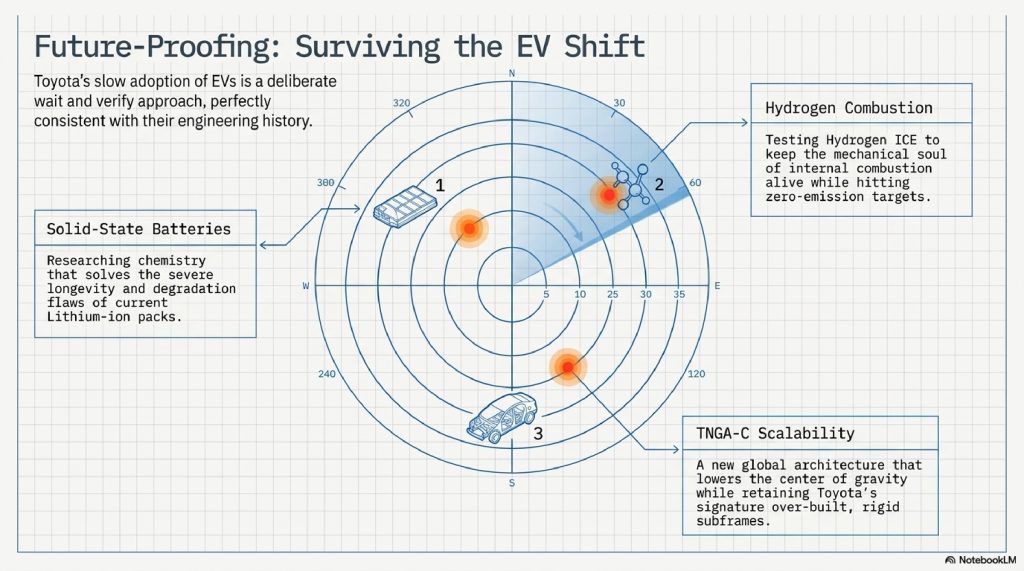
Toyota has been criticized for being “slow” to adopt EVs. However, from an engineering perspective, this is consistent with their “wait and verify” approach.
Solid-State Batteries: Toyota is currently researching solid-state tech to solve the longevity issues of current Lithium-ion batteries.
Hydrogen Combustion: Instead of just Fuel Cells, Toyota is testing ICE engines that burn Hydrogen. This could keep the “mechanical soul” of the car alive while hitting zero-emission targets.
TNGA-C Scalability: The new global architecture allows for better rigidity and lower centers of gravity without compromising the “over-built” nature of the subframes.
Historical Background: From Looms to Legacies
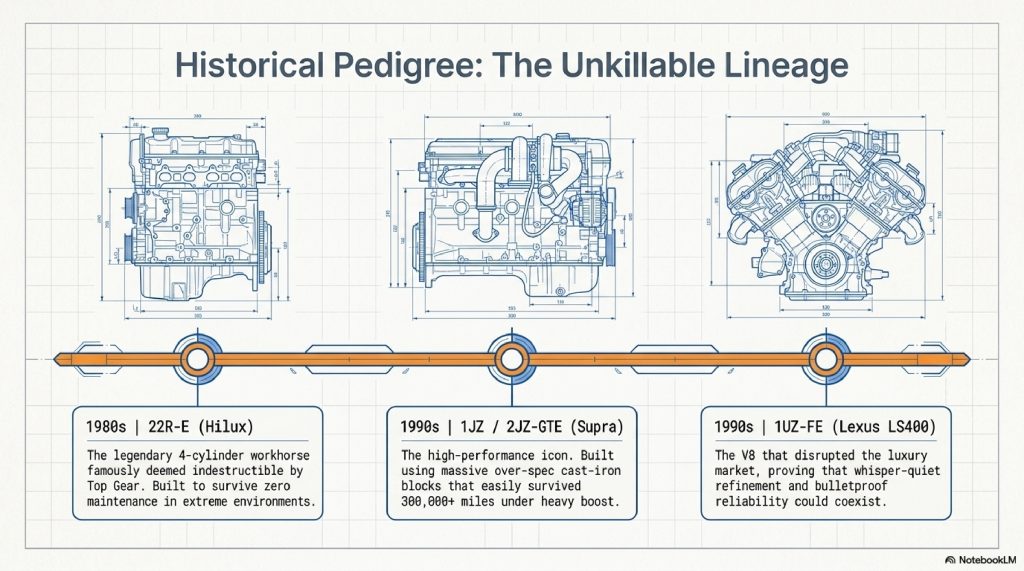
The Toyota engine legacy started with the Type A in 1935, but it was the post-WWII era that defined them. The 22R-E (found in 80s Hilux trucks) became the engine that “Top Gear” famously couldn’t kill.
The 2JZ-GTE (Supra) and 1UZ-FE (Lexus LS400) proved that Toyota could build high-performance engines that still lasted 300,000 miles. This history of “over-specifying” parts, making them stronger than the engine’s power output requires, remains the backbone of the company today.
Expert Insights: The Ownership Recommendation
To maximize a Toyota’s life:
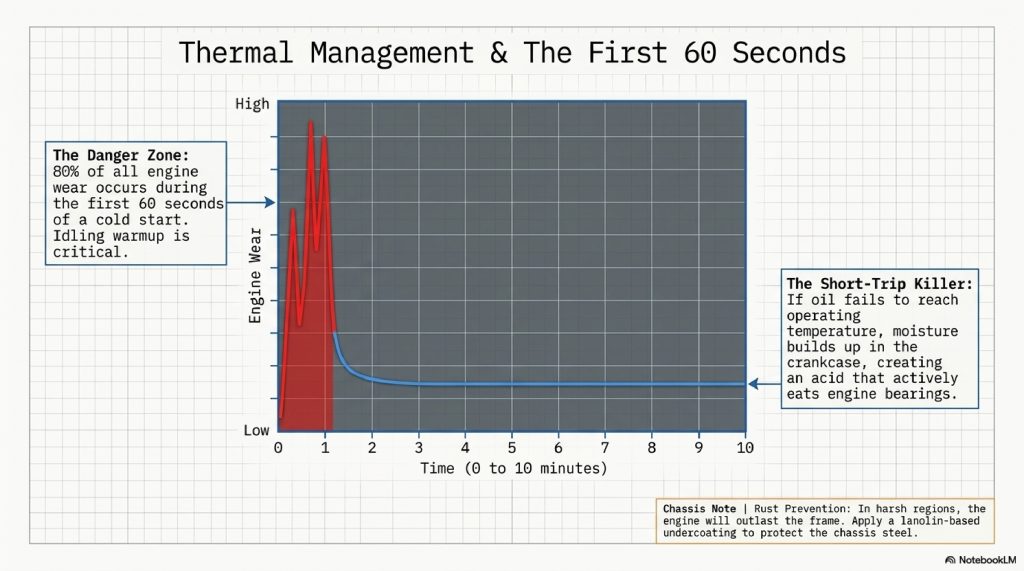
Warm-up is critical: Even with modern tolerances, the first 60 seconds of a cold start are where 80% of engine wear occurs.
Avoid “short-tripping”: If the oil doesn’t reach operating temperature, moisture builds up in the crankcase, creating acid that eats bearings.
Rust Prevention: In many regions (USA Northeast, UK, SE Asia), the Toyota engine will outlast the chassis. Use a lanolin-based undercoating to protect the frame.
Conclusion
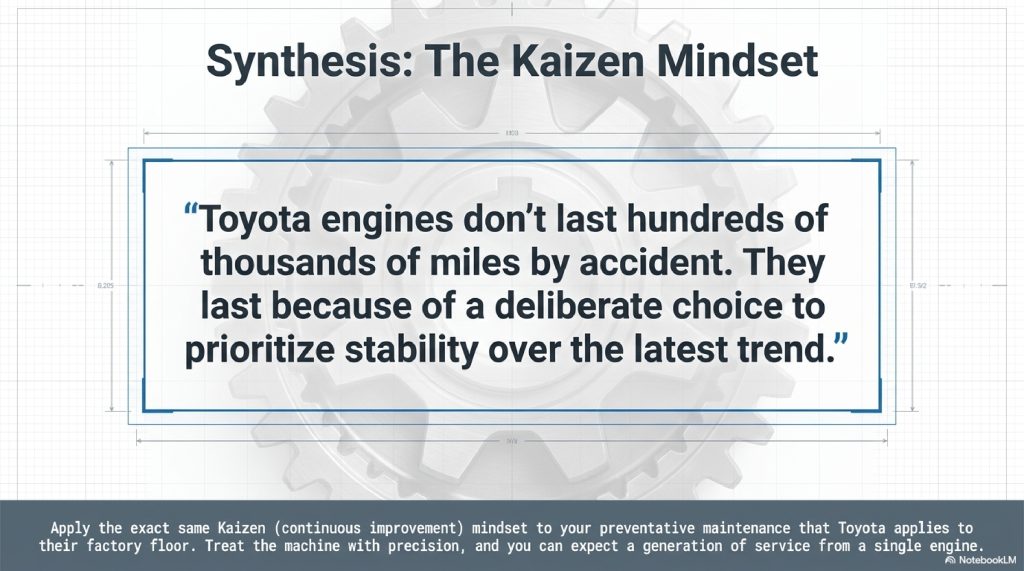
Toyota engines don’t last hundreds of thousands of miles by accident. They last because of a deliberate engineering choice to prioritize thermal stability, lower mechanical stress, and manufacturing perfection over the latest trendy gadget.
By treating your vehicle with the same “Kaizen” (continuous improvement) mindset that Toyota uses to build it, through diligent maintenance and high-quality parts, you can easily expect a generation of service from a single machine.
A: All manufacturers use high-grade polymers to reduce weight and improve fuel economy. However, Toyota’s “resin” intake manifolds are designed with thicker walls to resist warping under heat.
Q: Is it true that Toyota engines are “boring”?
A: To a racer, perhaps. To a commuter or an engineer, “boring” means “it starts every single morning without fail.” Reliability is its own form of excitement.
Q: Should I only use Toyota brand oil?
A: No, but you should ensure the oil meets the ILSAC GF-6A standard or higher. Toyota’s own “Genuine Motor Oil” (TGMO) often has a high concentration of Molybdenum, an anti-wear additive.
Amazon Affiliate Product Integration
Product Name:Mobil 1 High Mileage Full Synthetic Motor Oil
Why it is useful: Contains extra seal conditioners to prevent leaks in Toyotas with 75k+ miles.
Best Use Case: Routine oil changes for Camrys, Corollas, and RAV4s.
Comment