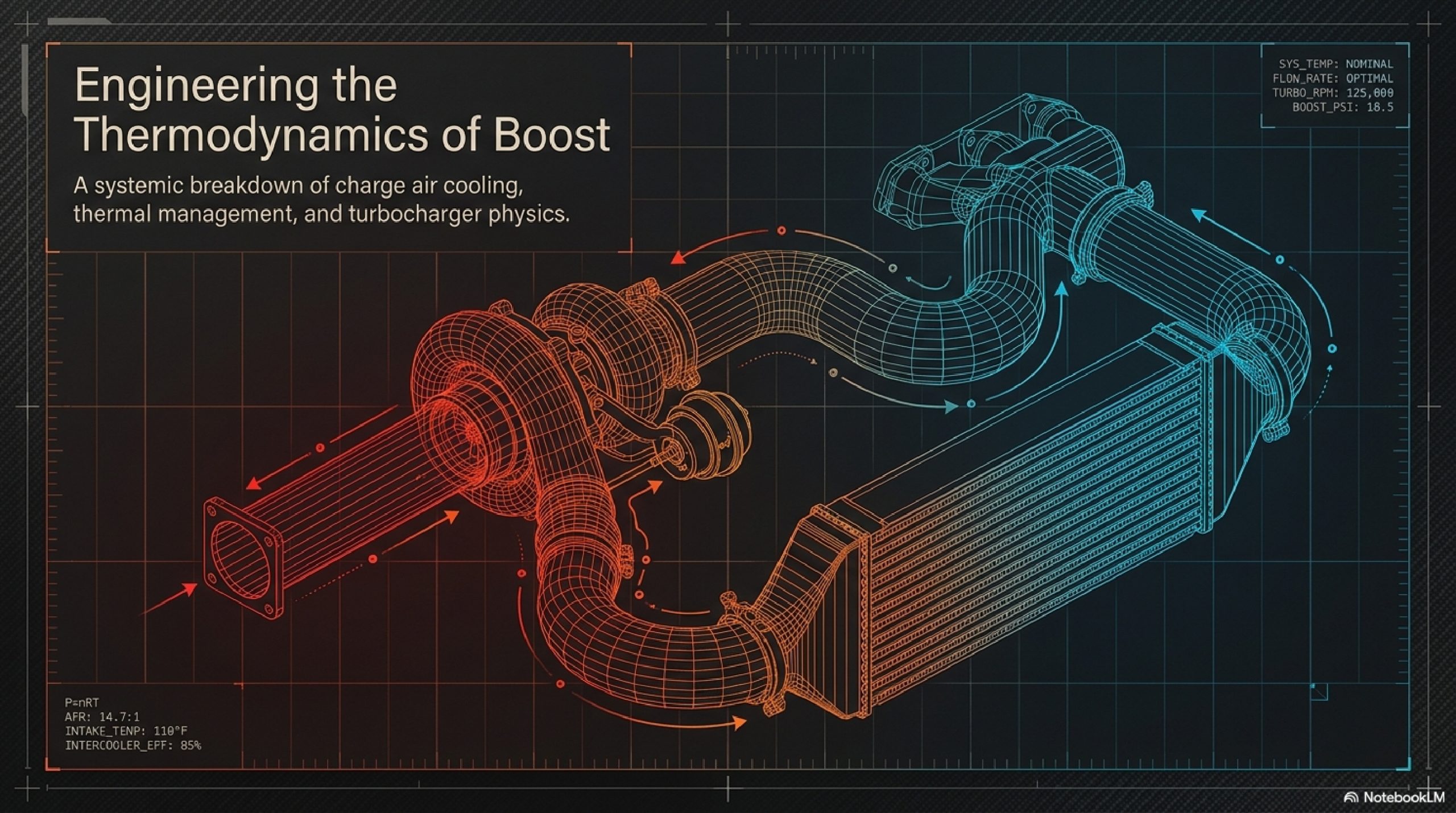
Introduction
If you own a modern turbocharged car, you might have noticed a frustrating phenomenon: your car feels like a rocket on a crisp, 50°F (10°C) autumn morning, but feels sluggish and unresponsive on a sweltering 100°F (38°C) summer afternoon.
This isn’t your imagination. It is a fundamental law of thermodynamics playing out under your hood. Compressing a gas generates immense heat, and hot air is the arch-nemesis of engine performance. To combat this, automotive engineers rely on a critical piece of hardware: the Charge Air Cooler, universally known as the intercooler.
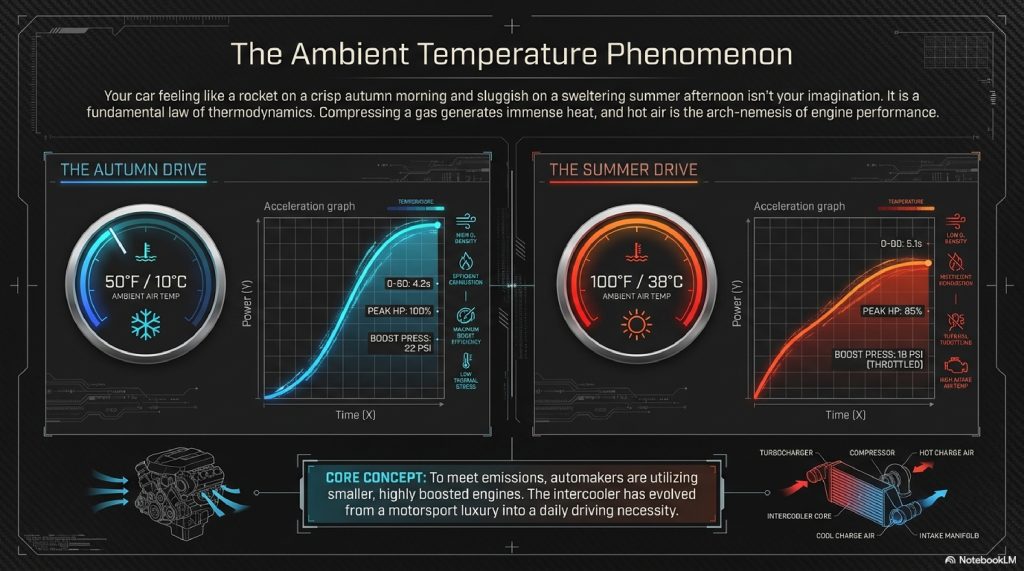
As automakers globally shift toward smaller, highly boosted turbocharged engines to meet stringent emissions standards, the intercooler has evolved from a niche motorsport upgrade into an absolute necessity for daily driving reliability. Here is the deep engineering breakdown of exactly how intercoolers improve turbo engine performance, why they fail, and how to maintain them for maximum efficiency.
Technical Explanation: The Thermodynamics of Boost
How do intercoolers improve turbo engine performance? An intercooler improves performance by cooling the hot, compressed air exiting the turbocharger before it enters the engine. Cooling the air increases its density, packing more oxygen molecules into each cylinder. This allows the engine to burn more fuel safely, generating more power while preventing engine knock.
To truly understand this, we must look at the mechanical reasoning and the physics involved.
Step 1: The Heat of Compression
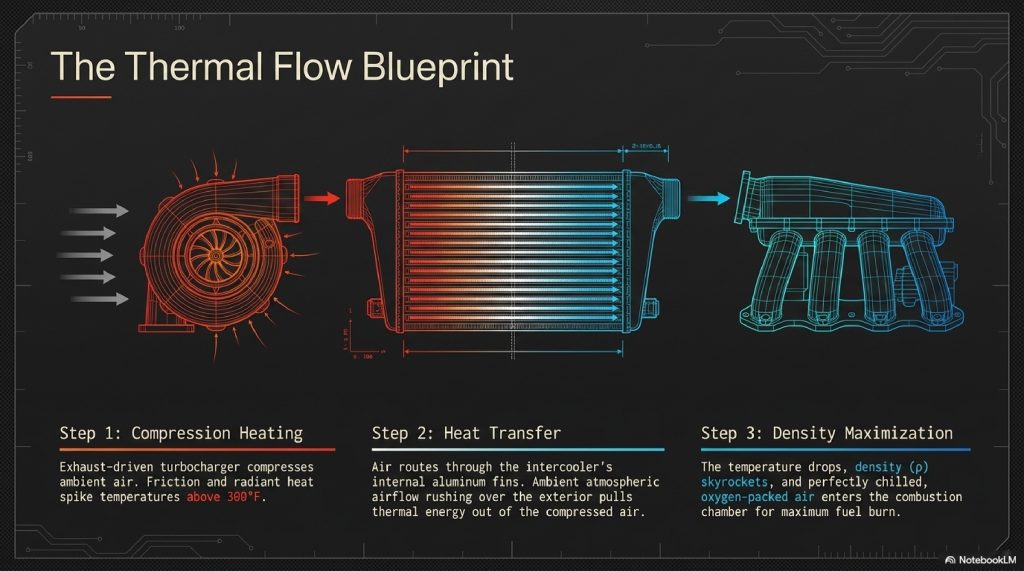
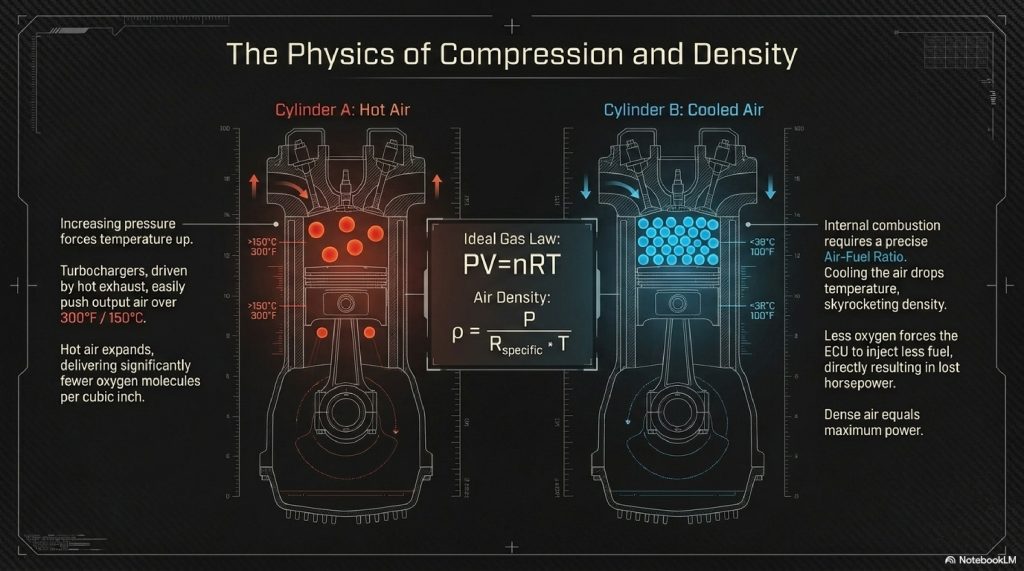
A turbocharger forces ambient air into the engine by compressing it. According to the Ideal Gas Law , when you increase the pressure of a gas in a confined volume , the temperature inevitably rises. Furthermore, the turbocharger itself is driven by scorching exhaust gases, which transfer additional radiant heat to the compressor housing. The air exiting a turbocharger can easily exceed 300°F (150°C).
Step 2: The Density Problem
Hot air expands, meaning the oxygen molecules spread further apart. If you feed 300°F air into an engine, you are getting significantly fewer oxygen molecules per cubic inch compared to ambient air. Because internal combustion requires a precise Air-Fuel Ratio (AFR), less oxygen means the engine computer must inject less fuel, resulting in less power.
We calculate the density of the air using the formula:
By routing this hot, compressed air through the aluminum fins of an intercooler (reducing ), the density skyrockets.
Step 3: Preventing Detonation (Engine Knock)
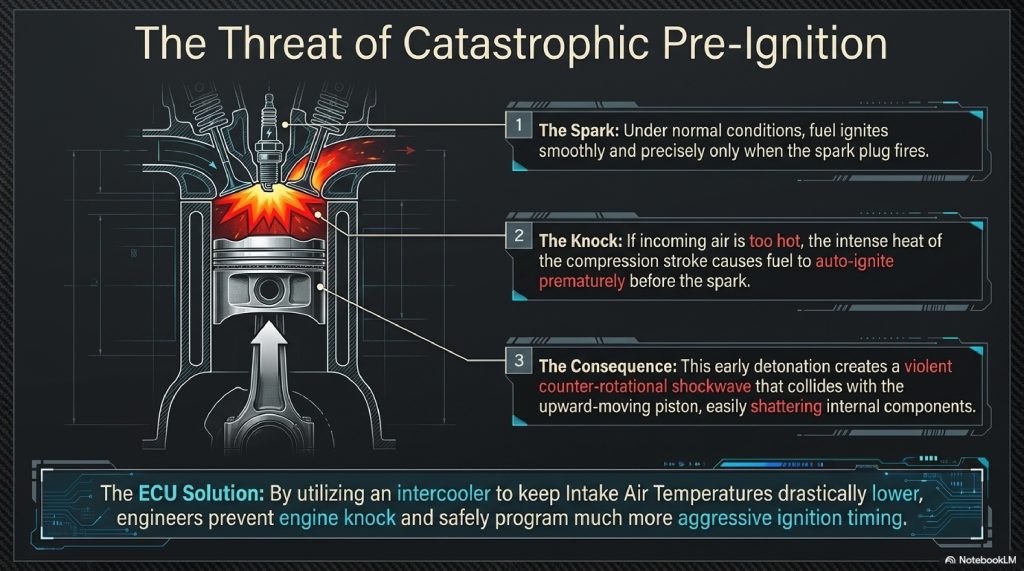
If air entering the combustion chamber is too hot, the heat of the compression stroke can cause the fuel to auto-ignite before the spark plug fires. This is called pre-ignition or engine knock. It creates a counter-rotational shockwave that can shatter pistons. An intercooler keeps Intake Air Temperatures (IAT) low enough to prevent this catastrophic failure, allowing engineers to program more aggressive ignition timing.
Real-World Performance: Heat Soak and Daily Driving
In a laboratory environment, an intercooler is perfect. On the asphalt, it battles real-world variables.
The Phenomenon of Heat Soak
During aggressive driving, back-to-back acceleration runs, or towing heavy loads, the intercooler absorbs heat faster than the ambient airflow can carry it away. The aluminum core becomes saturated with thermal energy. This is called Heat Soak. Once heat soaked, the intercooler stops cooling the intake air and effectively becomes an intake heater.
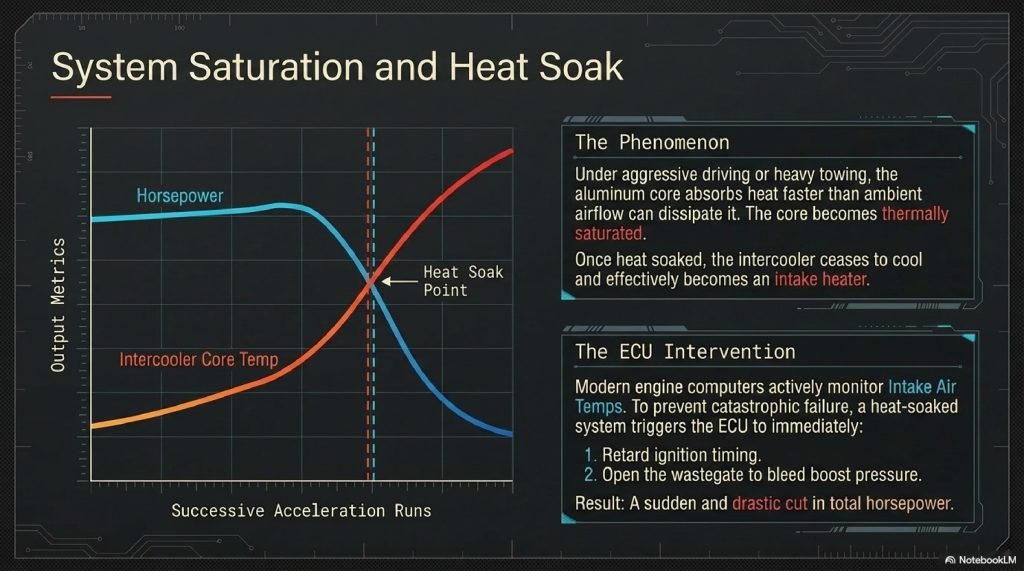
- The ECU Response: Modern engines are smart. When the ECU detects high IATs due to heat soak, it immediately pulls ignition timing and opens the wastegate to lower boost pressure, saving the engine but drastically cutting horsepower.
Fuel Economy and Longevity
A highly efficient intercooler doesn’t just make a car faster; it makes it more efficient. Because cooler air reduces the thermal stress on the cylinder head and exhaust valves, the engine does not need to run a “rich” fuel mixture to cool the cylinders. This improves long-term fuel economy and extends the life of the catalytic converter.
Common Problems: The Hidden Robbers of Horsepower
Intercoolers are incredibly durable since they have no moving parts, but they are highly susceptible to environmental and systemic contamination.

1. Internal Oil Fouling
Modern engines utilize a Positive Crankcase Ventilation (PCV) system that routes blow-by gases back into the intake. Over time, oily vapors condense inside the intercooler. Because oil is a thermal insulator, a thick coating of sludge on the inside of your intercooler acts like a blanket, completely ruining its heat transfer efficiency.
2. Boost Leaks
The intercooler is connected to the turbo and throttle body via rubber hoses. Under high boost pressures and constant heat cycling, these hoses degrade, expand, and tear. A boost leak forces the turbocharger to over-spin to compensate for the lost pressure, ultimately leading to premature turbo failure.
3. External Fin Damage
Front-Mounted Intercoolers (FMIC) sit directly behind the front bumper. They are constantly bombarded by rocks, bugs, and road debris. Bent cooling fins restrict ambient airflow, severely reducing the core’s ability to dissipate heat.
Servicing & Maintenance: Keeping the Core Efficient
Maintaining an intercooler is straightforward but frequently overlooked by casual car owners.
- Internal Flushing: Every 60,000 miles, it is highly recommended to remove the intercooler and flush the inside with a solvent (like brake cleaner or a dedicated degreaser) to remove PCV oil sludge.
- Fin Straightening: Use a specialized radiator fin comb to gently straighten any external aluminum fins that have been bent by road debris.
- Upgrading Couplers: Replace factory rubber hoses with multi-ply silicone couplers. Use T-bolt clamps instead of standard worm-gear clamps to ensure the hoses do not blow off under peak boost.
Comparison Section: Air-to-Air vs. Air-to-Water
Automotive engineers generally choose between two primary intercooler architectures.
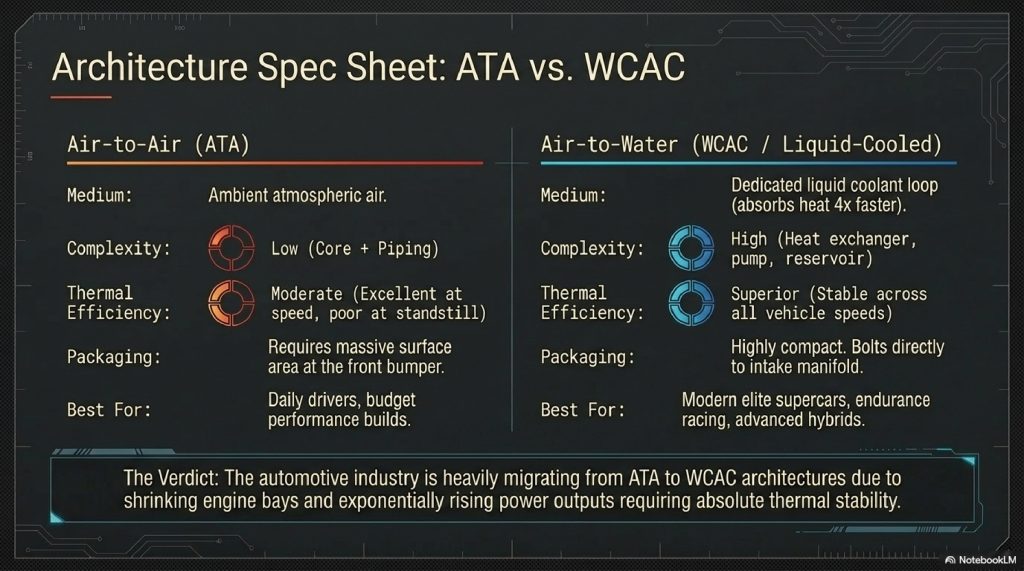
| Feature | Air-to-Air (ATA) | Air-to-Water (WCAC / Liquid-Cooled) |
| Cooling Medium | Ambient atmospheric air. | A dedicated liquid coolant loop. |
| Complexity | Low. Just a core and some piping. | High. Requires a heat exchanger, water pump, and reservoir. |
| Thermal Efficiency | Excellent at high speeds; poor at a standstill. | Superior across all speeds. Liquid absorbs heat 4x faster than air. |
| Packaging / Space | Requires a large surface area at the front of the car. | Highly compact. Can be bolted directly to the intake manifold. |
| Best Use Case | Daily driven cars, budget performance builds. | Modern elite supercars, endurance racing, advanced hybrids. |
The Verdict: Air-to-Air is the standard for simplicity and cost. However, because engine bays are shrinking and power outputs are rising, the modern industry is heavily migrating toward Air-to-Water systems (WCAC) for their unmatched thermal stability.
Future Technology: Additive Manufacturing and Sub-Cooling
The intercooler is currently undergoing a massive technological renaissance.
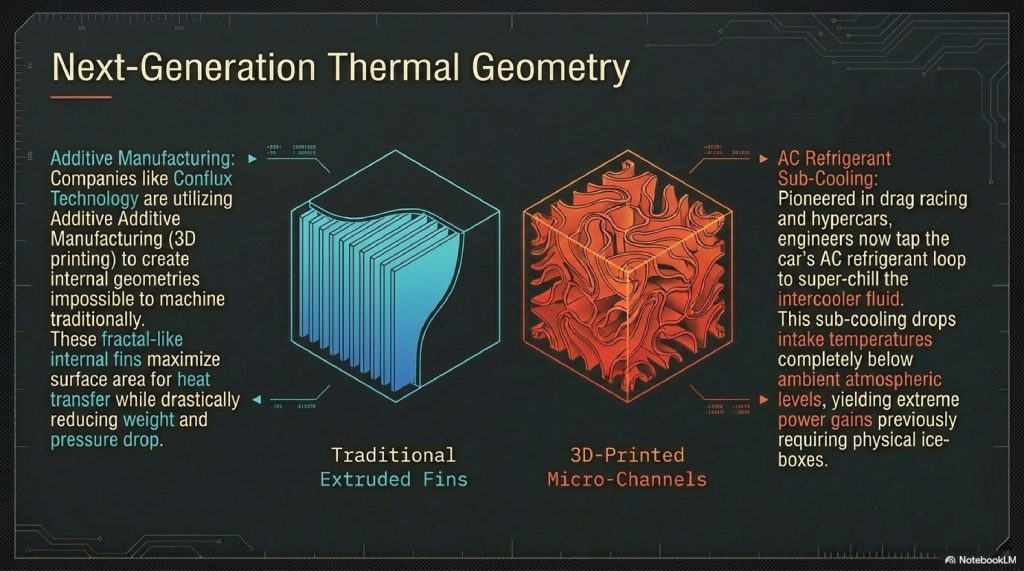
- 3D-Printed Micro-Channels: Companies like Conflux Technology are utilizing Additive Manufacturing (3D printing) to create water charge air coolers (WCAC) with internal geometries that are impossible to machine traditionally. These fractal-like internal fins maximize surface area while drastically reducing weight and pressure drop.
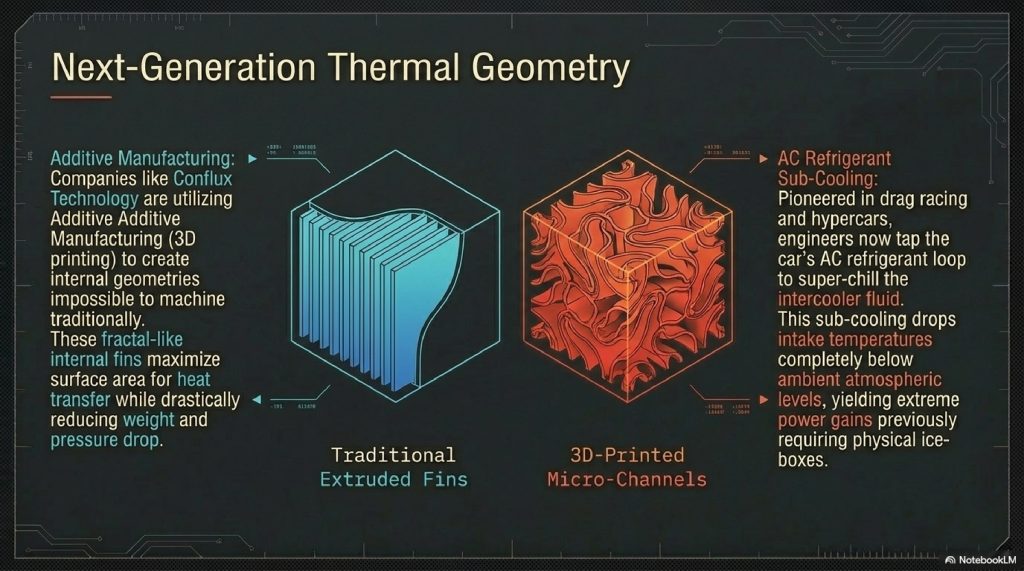
- AC Refrigerant Sub-Cooling: Pioneered heavily in the drag racing and hypercar world, engineers are tapping the car’s air conditioning refrigerant loop to super-chill the intercooler fluid. This allows the intercooler to drop intake temperatures below ambient atmospheric temperatures, resulting in extreme power gains previously only possible with ice-boxes.
Historical Background: From the Skies to the Streets
The intercooler was not born on the racetrack; it was born in the sky. During World War II, fighter planes like the P-38 Lightning utilized superchargers and turbochargers to maintain engine power at high altitudes where the air was extremely thin. Engineers quickly realized that cooling the compressed air was mandatory to keep the engines from tearing themselves apart under combat stress.
It took several decades for this technology to trickle down to passenger cars. The watershed moment arrived in the late 1970s when Porsche introduced an intercooler to the iconic 911 Turbo (the 930 generation). It solved the car’s lethal turbo lag and overheating issues, cementing the intercooler as a mandatory component for forced induction.
Expert Insights: Tuning and Upgrading
As an automotive engineer, the most common mistake I see enthusiasts make is upgrading their turbocharger or flashing a Stage 2 ECU tune without upgrading their intercooler.
You cannot tune away heat.
The factory intercooler is designed with a very specific thermal capacity. If you increase the boost pressure from 15 PSI to 22 PSI, you are pushing the factory core far beyond its thermal limits. You will experience a massive surge of power for exactly one acceleration pull, after which the core will heat soak, the ECU will pull timing, and the car will feel slower than it was stock.
When upgrading, do not just buy the largest intercooler you can find. An overly large core will cause a pressure drop, increasing turbo lag. You must match the core volume to your turbocharger’s CFM (Cubic Feet per Minute) output to maintain crisp throttle response.
Conclusion
Intercoolers are the unsung heroes of the modern horsepower wars. By leveraging the laws of thermodynamics, they turn blistering, engine-destroying heat into cool, dense, power-producing airflow.
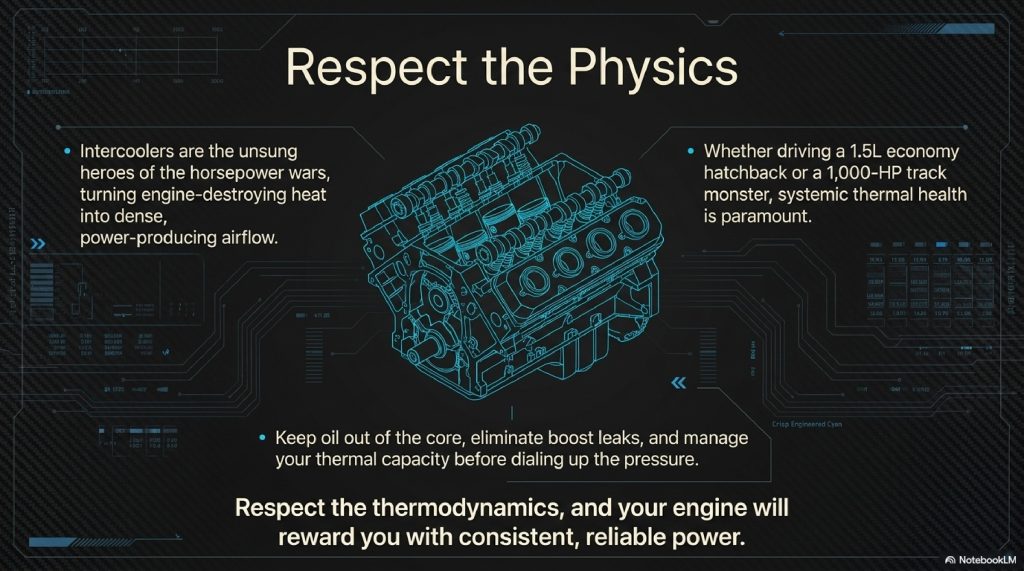
Whether you are driving a 1.5L economy hatchback or a 1,000-horsepower track monster, maintaining the health of your charge air cooling system is paramount. Check your hoses for boost leaks, keep oil out of the core, and monitor your intake temperatures. Respect the physics, and your turbo engine will reward you with consistent, reliable power for years to come.
Keep Learning:
- Stage 1 vs Stage 2 ECU Tuning Explained (An Engineer’s Guide)
- Why Modern Engines Are Becoming Smaller and More Powerful | Engineering Deep Dive
- Why Diesel Engines Produce More Torque Than Petrol (Engineering Explained)
Frequently Asked Questions (FAQ)
Q: Can I put an intercooler on a naturally aspirated (non-turbo) engine?
A: No. An intercooler only works to remove the heat added by a compressor (turbocharger or supercharger). If you put an intercooler on a naturally aspirated car, it will simply restrict airflow and reduce power.
Q: What is the difference between a bar-and-plate and a tube-and-fin intercooler?
A: Tube-and-fin cores are lightweight and allow good airflow to the radiator behind them, making them great for OEM applications. Bar-and-plate cores are significantly heavier and more robust, offering better heat-sink capabilities for high-boost, high-performance applications.
Q: Does a bigger intercooler increase turbo lag?
A: It can. If the internal volume of the intercooler is vastly larger than what the turbocharger can efficiently fill, it will take longer for the system to pressurize when you step on the gas, resulting in noticeable turbo lag.
Q: Can a bad intercooler cause a Check Engine Light?
A: Yes. If your intercooler has a crack or a blown coupler, it creates a massive boost leak. The Mass Airflow Sensor (MAF) will read air that never makes it to the engine, causing a rich misfire and throwing codes for underboost (e.g., P0299).
Product Name: BlueDriver Bluetooth Pro OBDII Scan Tool
Why it is useful: It allows you to monitor live Intake Air Temperature (IAT) data directly from your ECU. If your IATs are climbing wildly under acceleration, your factory intercooler is failing to keep up.
Best use case: Diagnosing heat soak and monitoring engine health during spirited driving.
Suggested CTA: [Check the BlueDriver Price on Amazon]
Product Name: Mishimoto Universal Baffled Oil Catch Can
Why it is useful: It intercepts oil vapors from the PCV system before they can enter the intake tract, keeping the inside of your intercooler perfectly clean and thermally efficient.
Best use case: Preventative maintenance for any turbocharged, direct-injected (GDI) vehicle.
Suggested CTA: [Protect your intercooler – Shop Mishimoto on Amazon]
Product Name: HPS High Temp Reinforced Silicone Couplers & T-Bolt Clamps
Why it is useful: Factory rubber hoses expand and leak under high pressure. Silicone couplers reinforced with polyester prevent expansion, and stainless steel T-bolt clamps provide superior 360-degree clamping force.
Best use case: Upgrading aging factory intercooler piping or building a custom setup.
Suggested CTA: [Upgrade your boost plumbing on Amazon]