Introduction
Few sounds induce more anxiety in a driver than stepping on the accelerator and hearing what sounds like spray paint marbles rattling inside a tin can. This metallic pinging or rattling is universally known as engine knocking.
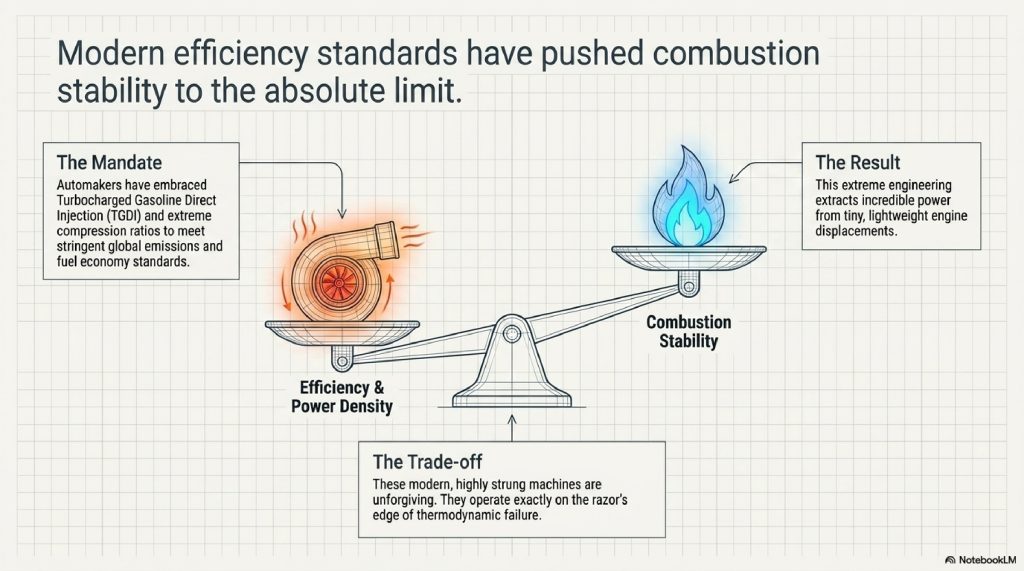
While older, low-compression engines from the 1990s were relatively forgiving of poor fuel and neglected maintenance, modern engines are highly strung thermodynamic machines. To meet stringent global fuel economy and emissions standards, automakers have embraced Turbocharged Gasoline Direct Injection (TGDI) and extreme compression ratios. While this yields incredible power from tiny displacements, it pushes the combustion chamber right to the absolute limit of stability.
When that stability breaks down, knocking occurs. If ignored, it will not just trigger a Check Engine Light; it will physically shatter pistons and bend connecting rods. Here is the deep engineering breakdown of what causes engine knocking, why modern cars are especially susceptible to it, and how to stop it.
Technical Explanation: The Physics of Detonation
What exactly is engine knocking? Engine knocking (detonation) occurs when the air-fuel mixture in the cylinder does not burn smoothly, but instead auto-ignites in multiple places simultaneously. These secondary explosions create supersonic shockwaves that collide with the primary flame front and the piston crown, causing a metallic “pinging” sound.
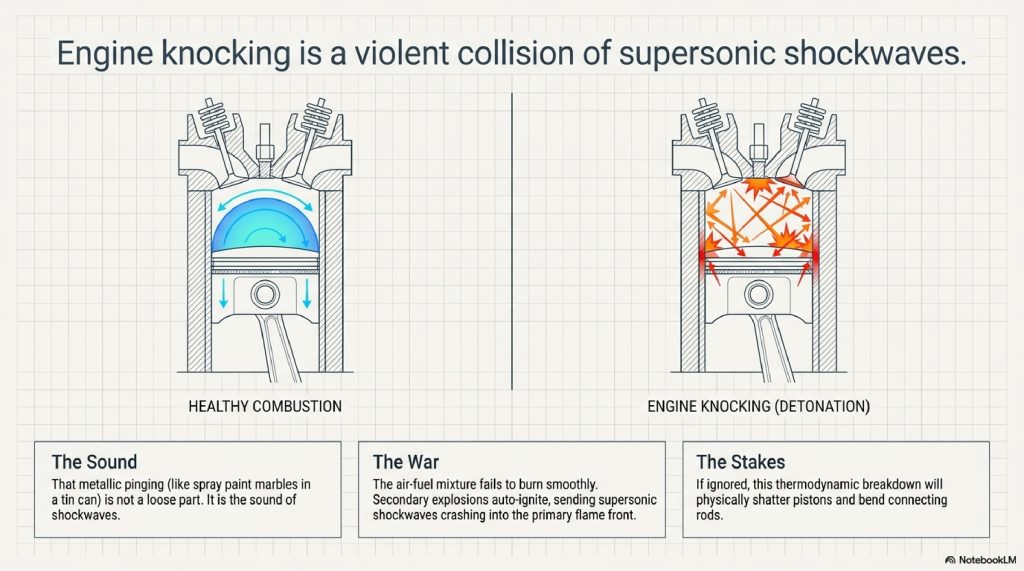
To understand this, we must look at the mechanics of a perfect combustion cycle versus a destructive one.
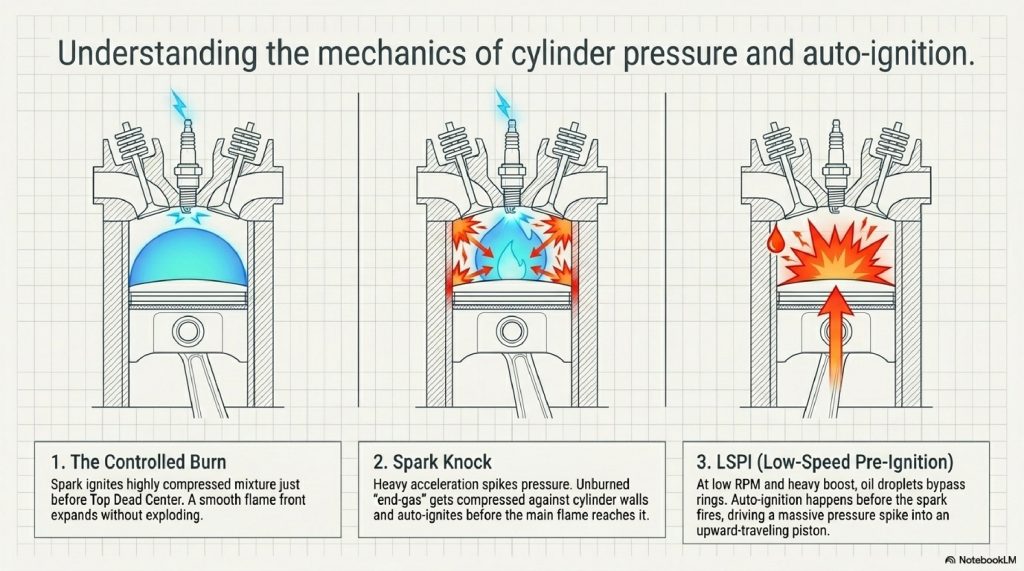
1. Normal Combustion (The Controlled Burn)
In a healthy engine, the spark plug fires just before the piston reaches Top Dead Center (TDC). This spark ignites the highly compressed air-fuel mixture. However, it does not “explode.” It burns outward in a smooth, expanding sphere called the flame front, pushing steadily down on the piston.
2. Detonation (Spark Knock)
During heavy acceleration, cylinder pressures and temperatures skyrocket. As the spark plug fires and the primary flame front expands, it compresses the remaining unburned air and fuel (the “end-gas”) against the cylinder walls. If the temperature and pressure exceed the fuel’s octane limit, that end-gas spontaneously auto-ignites before the main flame can reach it. The two flame fronts collide violently. This collision is the “knock.”
3. LSPI (Low-Speed Pre-Ignition)
Modern TGDI engines face a terrifying new phenomenon called LSPI. At low RPMs under heavy boost, microscopic droplets of oil bypass the piston rings and mix with the fuel. Because engine oil has a very low octane rating, these droplets ignite spontaneously before the spark plug even fires. This drives a massive pressure spike into the piston while it is still traveling upward. LSPI is the primary cause of cracked piston ring lands in modern turbo engines.
Real-World Performance: The Cost of Knock
How does engine knocking affect your daily commute and long-term ownership?
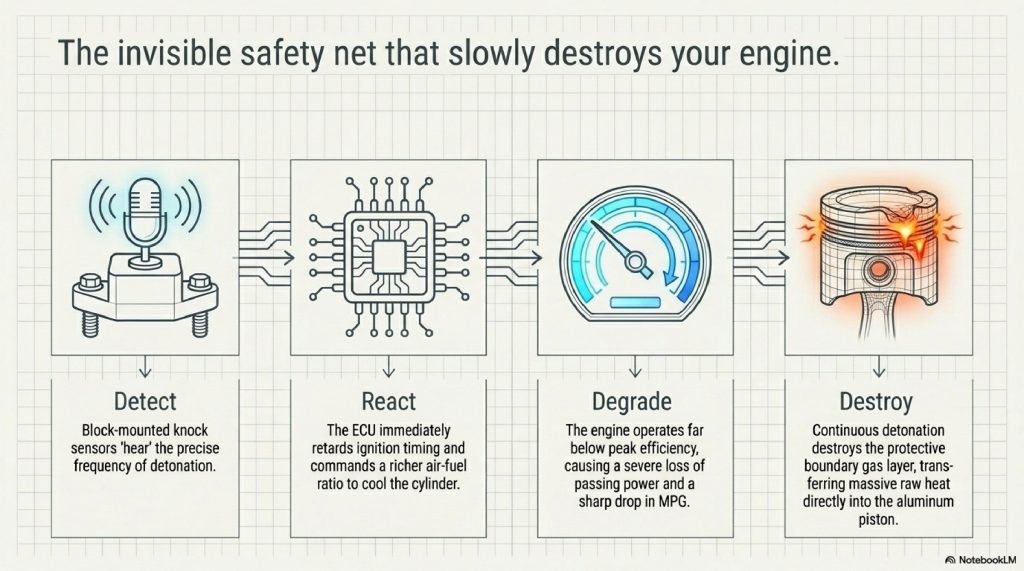
- The ECU Safety Net (Knock Retard): Modern engines are equipped with piezoelectric knock sensors bolted to the engine block. When they “hear” the frequency of detonation, the Engine Control Unit (ECU) immediately retards (delays) the ignition timing and commands a richer air-fuel ratio to cool the cylinder.
- Power and Fuel Economy Loss: Because the ECU is delaying the spark to save the engine, the engine operates far below its peak efficiency. You will experience a severe loss of passing power and a noticeable drop in MPG.
- Thermal Overload: Continuous detonation destroys the protective boundary layer of gas near the cylinder walls. This transfers massive amounts of raw heat directly into the aluminum piston, eventually melting it.
Common Problems: Symptoms and Root Causes
If you are experiencing knocking, one of the following mechanical or chemical parameters is compromised:
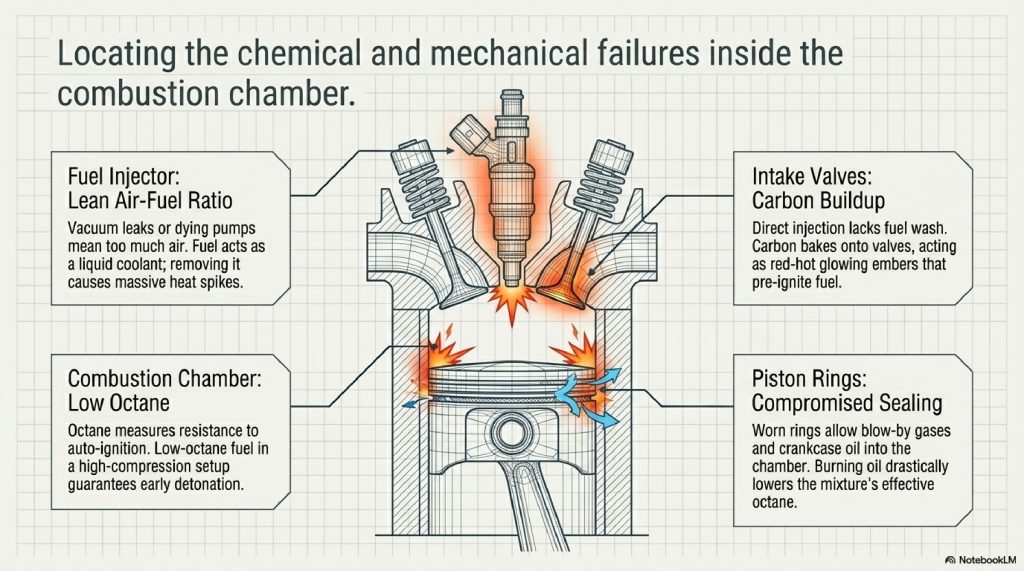
- Low Octane Fuel: Octane is not a measure of power; it is a measure of a fuel’s resistance to auto-ignition. Putting 87-octane fuel into a high-compression engine tuned for 93-octane will guarantee detonation.
- Carbon Buildup (GDI Engines): Direct injection engines do not have fuel washing over their intake valves. Carbon buildup accumulates on the valves and the piston crown. This carbon gets red-hot during driving and acts like a glowing ember, pre-igniting the fuel on the next stroke.
- Compromised Piston Ring Sealing: If your piston rings are worn, blow-by gases and crankcase oil enter the combustion chamber. As mentioned with LSPI, burning oil drastically lowers the effective octane rating of your fuel mixture.
- Lean Air-Fuel Ratio: If you have a vacuum leak, a failing mass airflow (MAF) sensor, or a dying fuel pump, the engine runs “lean” (too much air, not enough fuel). Fuel acts as a liquid coolant inside the cylinder; removing it causes combustion temperatures to spike, leading to knock.
Servicing & Maintenance: Bulletproofing Your Combustion
You can prevent and cure most forms of engine knocking by adhering to a strict, proactive maintenance schedule.
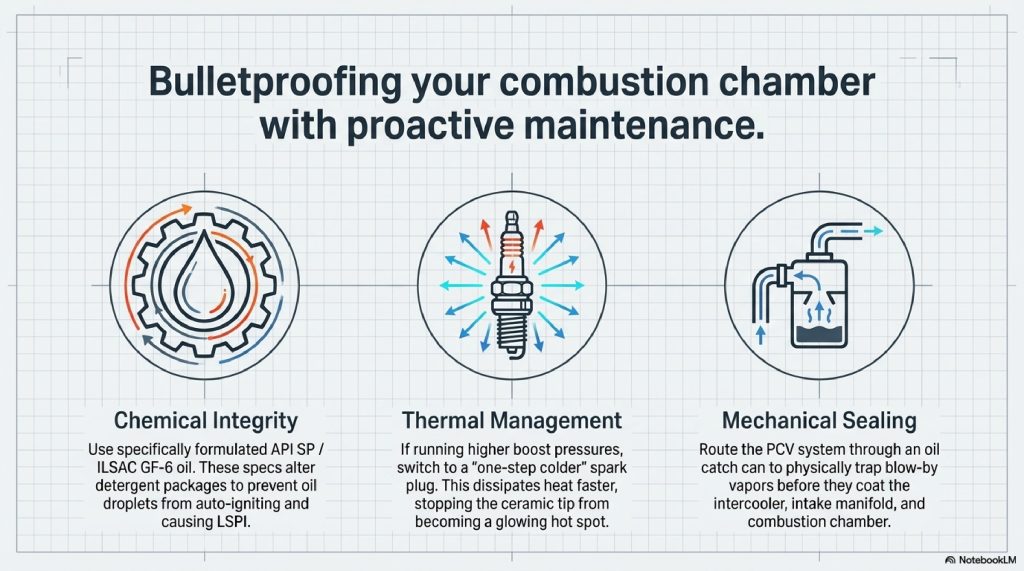
- Use API SP / ILSAC GF-6 Motor Oil: The automotive industry specifically formulated the “SP” oil standard to combat LSPI in modern turbo engines. It alters the calcium and magnesium detergent packages to prevent oil droplets from auto-igniting. Always use this spec.
- Colder Spark Plugs: If you have tuned your car (e.g., a Stage 1 or Stage 2 ECU flash), you are running higher boost pressures. You must switch to a “one-step colder” spark plug. This dissipates heat faster, preventing the ceramic tip from becoming a hot spot.
- Install an Oil Catch Can: To protect your piston rings and prevent oil blow-by from coating your intercooler and intake manifold, route your PCV system through a catch can.
Comparison Section: Diagnosing the Noise
Not all engine noises are created equal. It is critical to distinguish between combustion knock and mechanical failure.
| Feature | Detonation (Spark Knock) | Pre-Ignition | Mechanical “Rod Knock” |
| Sound | High-pitched pinging or rattling. | Silent until catastrophic failure. | Deep, rhythmic, heavy thudding. |
| When it Happens | Under heavy load / acceleration. | High RPMs / High load. | Constant; gets faster with RPMs. |
| Root Cause | Low octane, lean mixture, heat. | Glowing carbon deposits, wrong spark plug. | Worn out crankshaft/connecting rod bearings. |
| Fix | Higher octane fuel, ECU tuning, carbon cleaning. | Immediate engine shut-off, colder plugs. | Complete engine rebuild or engine swap. |
Note: If you are experiencing genuine rod knock, no oil additive will save the engine. The metal bearings have failed, and you will likely be pricing out an engine swap.
Future Technology: The Eradication of Knock
Automotive engineers are deploying fascinating technologies to permanently solve the knocking equation while maintaining high power density.
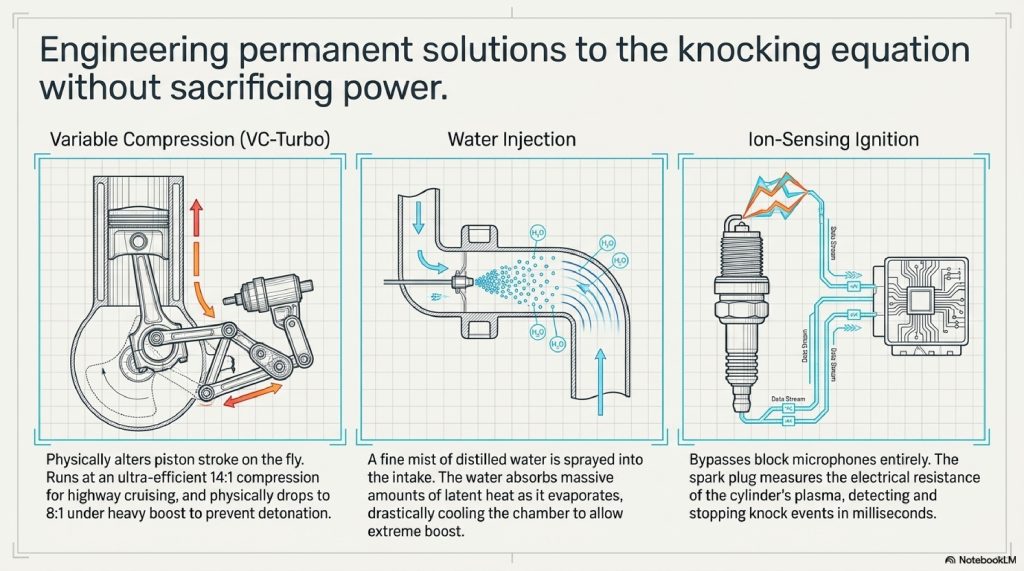
- Variable Compression Ratios (VC-Turbo): Nissan pioneered an engine that physically alters the stroke of the piston on the fly. It runs a high compression ratio (14:1) for highway cruising efficiency, and physically drops to a lower compression ratio (8:1) under heavy boost to prevent detonation.
- Water Injection: Seen on the BMW M4 GTS, this system sprays a fine mist of distilled water into the intake manifold. Water absorbs massive amounts of latent heat as it evaporates, drastically cooling the combustion chamber and virtually eliminating knock, allowing for extreme boost pressures.
- Ion-Sensing Ignition: Instead of using microphones on the block, future engines will use the spark plug itself to measure the electrical resistance of the plasma in the cylinder, detecting the precise moment a knock event begins and stopping it in milliseconds.
Historical Background: The Leaded Gas Era
In the early 20th century, as engineers tried to extract more power from engines, knocking became a massive barrier. In 1921, General Motors engineer Thomas Midgley Jr. discovered that adding Tetraethyllead (TEL) to gasoline completely eliminated engine knock.
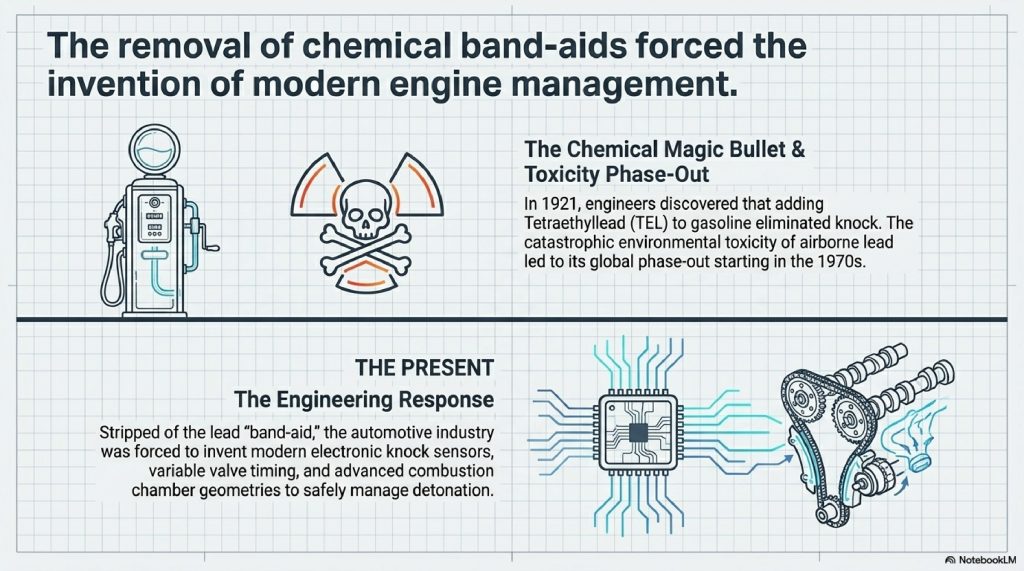
“Leaded gas” allowed for the high-compression muscle car era of the 1960s. However, the catastrophic environmental and neurological toxicity of airborne lead led to its global phase-out beginning in the 1970s. The removal of lead forced the automotive industry to invent modern electronic knock sensors, variable valve timing, and advanced combustion chamber geometries to control detonation safely.
Expert Insights: Engineering Observations
As an engineer, the most common mistake I see owners make is ignoring the owner’s manual regarding fuel grades.
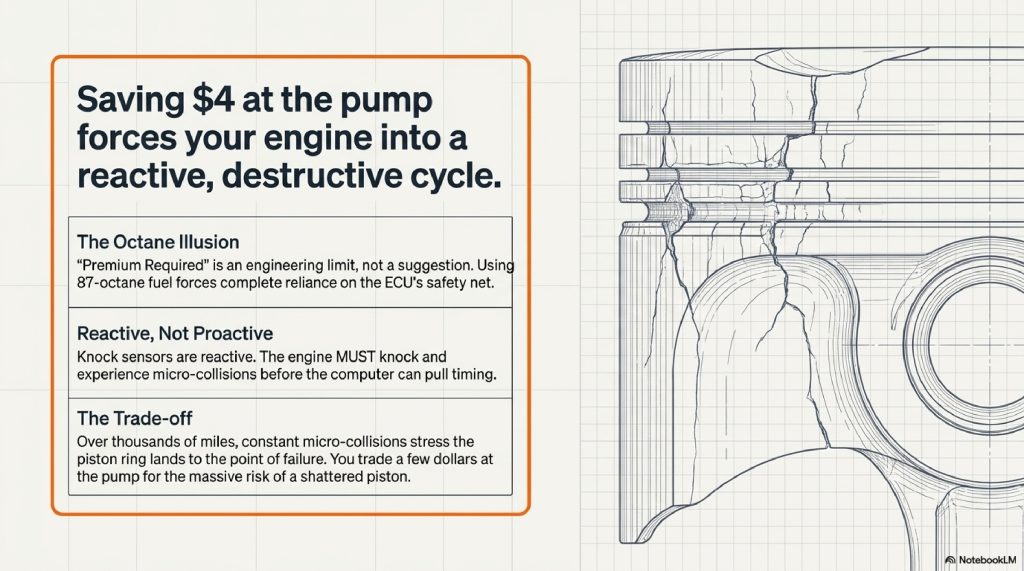
If your car’s fuel door says “Premium Required,” and you put in 87-octane to save $4 at the pump, you are relying entirely on the ECU’s knock sensors to save your engine. The sensors are reactive, not proactive. This means the engine must knock a few times before the computer pulls timing. Over thousands of miles, those micro-collisions stress the piston ring lands. You are trading a few dollars in fuel savings for a massive risk of a shattered piston.
Conclusion
Engine knocking is the sound of a thermodynamic war being lost inside your cylinders. It is a collision of flame fronts caused by excessive heat, immense pressure, inadequate octane, or oil contamination.
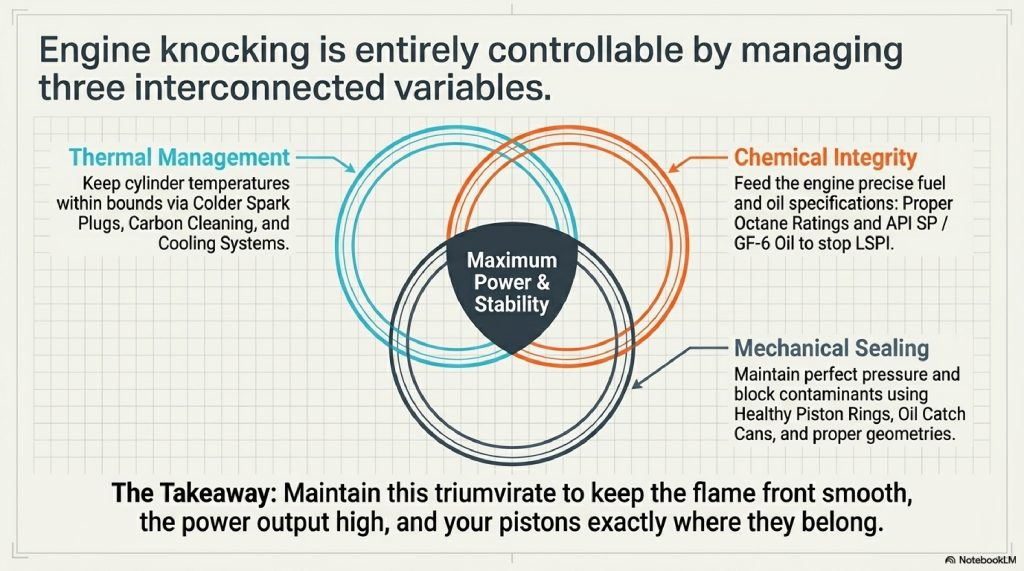
Modern engines are brilliant, but they are unforgiving. By using the correct API SP oil to prevent LSPI, keeping your combustion chambers clean of carbon, and feeding your car the octane it requires, you can keep the flame front smooth, the power output high, and your pistons exactly where they belong.
Keep Learning:
- How Intercoolers Improve Turbo Engine Performance
- Stage 1 vs Stage 2 ECU Tuning Explained (An Engineer’s Guide)
- Why Modern Engines Are Becoming Smaller and More Powerful | Engineering Deep Dive
- Why Diesel Engines Produce More Torque Than Petrol (Engineering Explained)
Frequently Asked Questions (FAQ)
Q: Will an octane booster stop my engine from knocking?
A: Yes, if the root cause is low-quality fuel. A high-quality octane booster can raise the fuel’s resistance to auto-ignition. However, if the knocking is caused by a lean air-fuel ratio or a failing knock sensor, additives will not fix the mechanical issue.
Q: Why does my car only ping when I drive up a steep hill?
A: Driving up a hill places a high “load” on the engine. High load at lower RPMs maximizes cylinder pressure and gives the unburned end-gas more time to absorb heat and auto-ignite. This is the exact scenario that triggers detonation.
Q: Is it safe to drive with engine knock?
A: A very brief, light pinging that immediately goes away under acceleration is generally handled by the ECU. However, sustained, loud knocking is highly destructive and can crack a piston in a matter of seconds. Do not drive aggressively if the engine is audibly knocking.
Q: What is the difference between a knock sensor and a camshaft position sensor?
A: A knock sensor is essentially a piezoelectric microphone bolted to the block that “listens” for the specific acoustic frequency of detonation. A camshaft position sensor magnetically reads the physical rotation of the camshaft to tell the ECU exactly when to fire the spark plugs and fuel injectors.
Product Name: Autel MaxiCOM MK808Z Bi-Directional OBD2 Scanner
Why it is useful: Modern ECUs rely on knock sensors to detect detonation. This scanner allows you to view live data for “Knock Retard” (KR) across individual cylinders, letting you diagnose which cylinder is pinging before catastrophic damage occurs.
Best use case: Deep diagnostics and monitoring ignition timing health.
Click here to Shop: [Diagnose engine knock safely – Shop Autel on Amazon]
Product Name: Red Line SI-1 Complete Fuel System Cleaner
Why it is useful: It contains the highest concentration of Polyether Amine (PEA), a chemical proven to dissolve hardened carbon deposits on piston crowns that cause pre-ignition.
Best use case: Add to a full tank of gas every 5,000 miles to restore combustion chamber volume and prevent hot-spots.
Click Here to Shop: [Buy Red Line on Amazon]
Product Name: Mishimoto Universal Baffled Oil Catch Can
Why it is useful: Intercepts oil vapors from the PCV system before they can enter the intake, effectively stopping the oil-ingestion that leads to LSPI and knocking.
Best use case: Mandatory preventative hardware for any modern turbocharged GDI engine.
Click Here to Shop: [Shop Mishimoto Catch Cans on Amazon]
Comments (3)