INTRODUCTION
The scene is familiar to anyone who has ever stood near a busy intersection. A massive, 18-wheel delivery truck idles at a red light. When the light turns green, the driver steps on the accelerator. You hear a deafening mechanical roar, the chassis shudders, and a thick, dark plume of black smoke erupts from the chrome exhaust pipe.
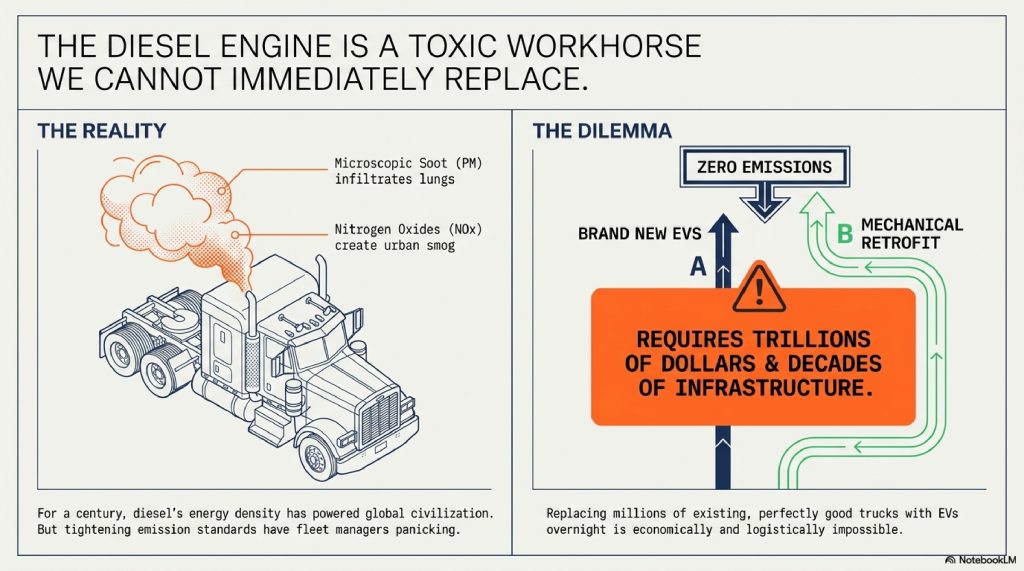
For over a century, the diesel engine has been the undisputed workhorse of global civilization. It powers the cargo ships that cross our oceans, the trains that cross our continents, and the trucks that deliver everything from fresh produce to the smartphone in your pocket. Diesel is incredibly energy-dense and famously reliable.
But it has a fatal flaw: it is notoriously, stubbornly dirty.
The exhaust from a traditional diesel engine is a toxic soup of nitrogen oxides (NOx) and fine particulate matter (PM) microscopic soot that infiltrates human lungs and blankets our cities in smog. As global emission standards tighten, governments and logistics companies are panicking. Replacing millions of existing, perfectly good diesel trucks with brand-new electric vehicles (EVs) would cost trillions of dollars and take decades. The infrastructure simply isn’t there yet.
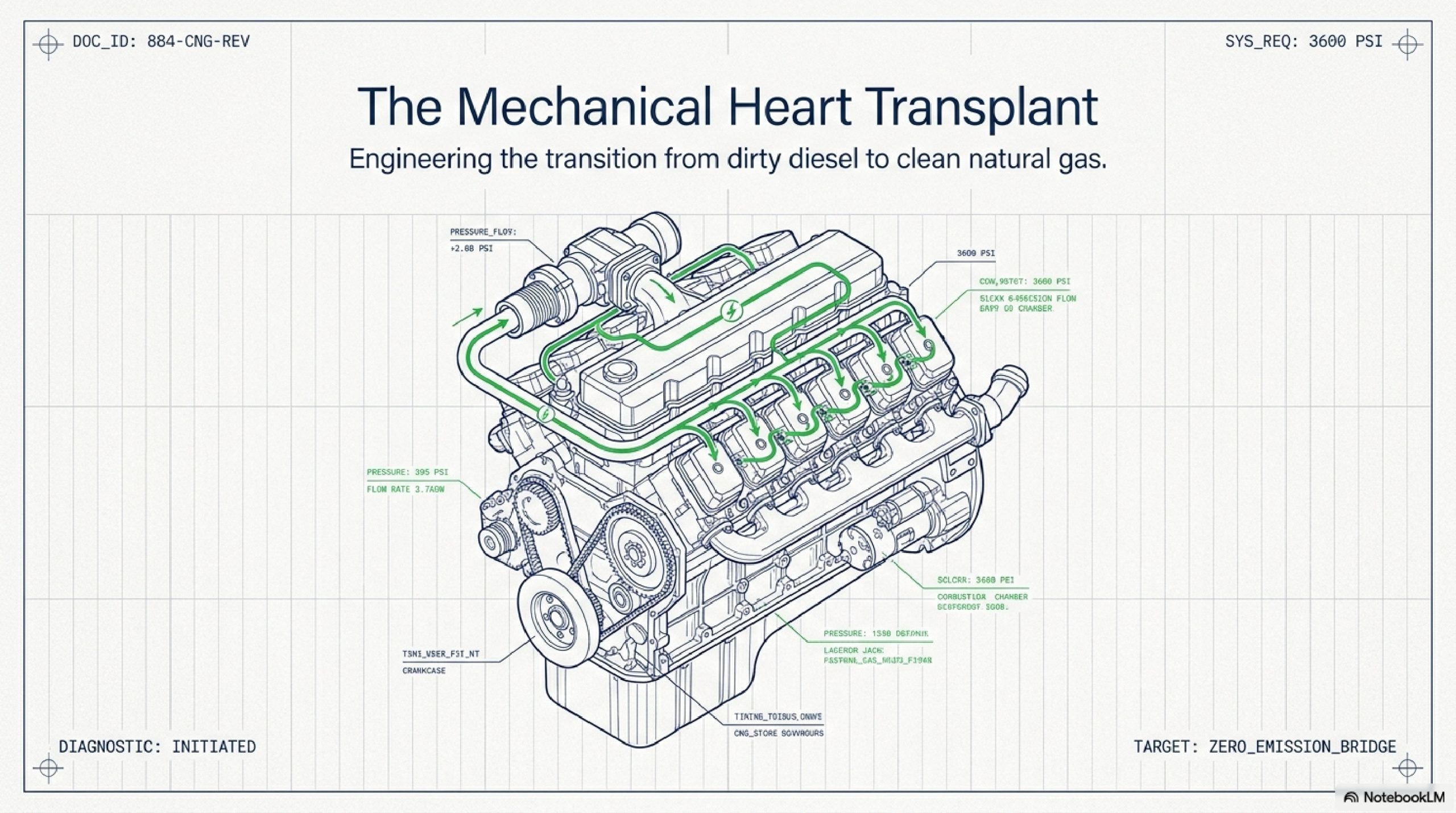
So, what do we do right now? What if there was a way to perform a mechanical “heart transplant” on these existing beasts? What if we could force a dirty diesel engine to breathe an invisible, cheap, and remarkably clean gas?
Enter the science of Compressed Natural Gas (CNG) Conversion.
In recent years, elite mechanical engineers and researchers have been publishing groundbreaking studies using advanced software like AVL Boost to map out exactly what happens when you strip a diesel engine of its heavy fuel and force it to run on CNG. They aren’t just looking at the environmental benefits; they are rigorously testing the technical performance (will the truck still have the power to climb a hill?) and the economic reality (will it actually save the fleet manager money?).
The results are nothing short of revolutionary. But forcing an engine designed for heavy, oily diesel to suddenly spark invisible gas is a masterpiece of complex engineering.
In this deep dive, we are going to open the hood. We will travel inside the combustion chamber to see the explosive difference between diesel and gas, break down the exact steps of a CNG conversion, and reveal the surprising economic math that is quietly transforming the global logistics industry.
Buckle up. We are about to clean up the dirtiest engine on Earth.
TABLE OF CONTENTS
- The Simple Explanation: The Wood Fire vs. The Gas Stove
- Step-by-Step Breakdown: The Mechanical Heart Transplant
- Real-World Example: Waking Up the City Bus
- The Advanced Technical Layer: The Physics of the Swap
- The Economics: Does It Actually Save Money?
- Common Myths About CNG Conversions
- The Future: Biogas and the Bridge to Zero
- Surprising Facts You Didn’t Know About CNG
- FAQs
- Other Blog Suggestions
- Conclusion
A. THE SIMPLE EXPLANATION: The Wood Fire vs. The Gas Stove
To understand why converting a diesel engine to CNG is such a big deal, you first have to understand how different these two fuels are.
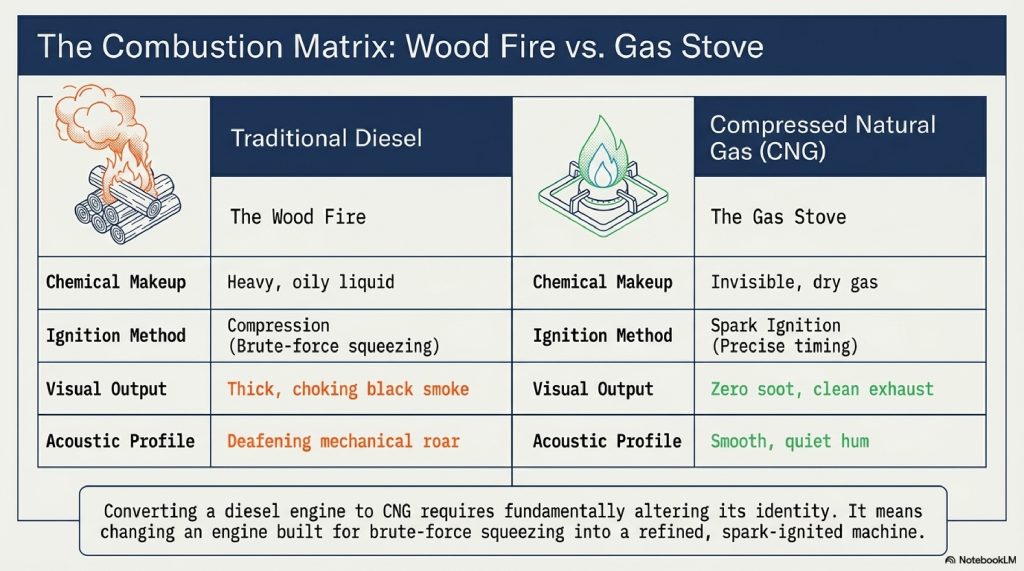
Think of a traditional Diesel Engine like a roaring campfire built with thick, heavy logs. When you burn heavy logs, they produce a massive amount of heat and energy, which is great for keeping you warm all night. However, they also produce a lot of popping, cracking, and thick, choking black smoke.
Now, think of Compressed Natural Gas (CNG) like the burner on your kitchen gas stove. When you turn on your stove, you don’t see thick black smoke. You see a perfectly clean, tight, blue flame. It burns incredibly efficiently, leaving almost no soot or ash behind.
The Engineering Problem:
A diesel engine is built specifically to burn those “heavy logs.” It operates through Compression Ignition. It doesn’t have spark plugs. Instead, it squeezes the air inside the cylinder so hard, and gets it so incredibly hot, that when the oily diesel fuel is sprayed in, it instantly explodes on its own.
CNG, on the other hand, is like the gas on your stove. It won’t just explode from being squeezed. It needs a spark to light it.
Therefore, converting a diesel engine to CNG isn’t just a matter of changing the fuel tank. It requires fundamentally altering the engine’s identity. You have to take an engine that relies on brute-force squeezing, and turn it into a refined, spark-ignited machine.
B. STEP-BY-STEP BREAKDOWN: The Mechanical Heart Transplant
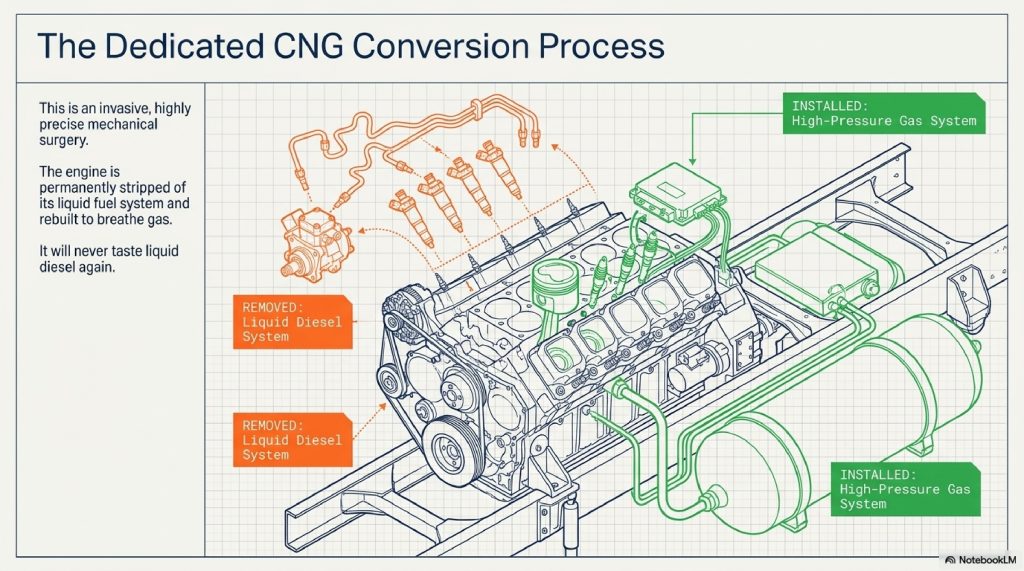
How do mechanics actually perform this conversion? It is an invasive, highly precise surgery known in the industry as a “Dedicated CNG Conversion.” Here is exactly what happens behind the garage doors:
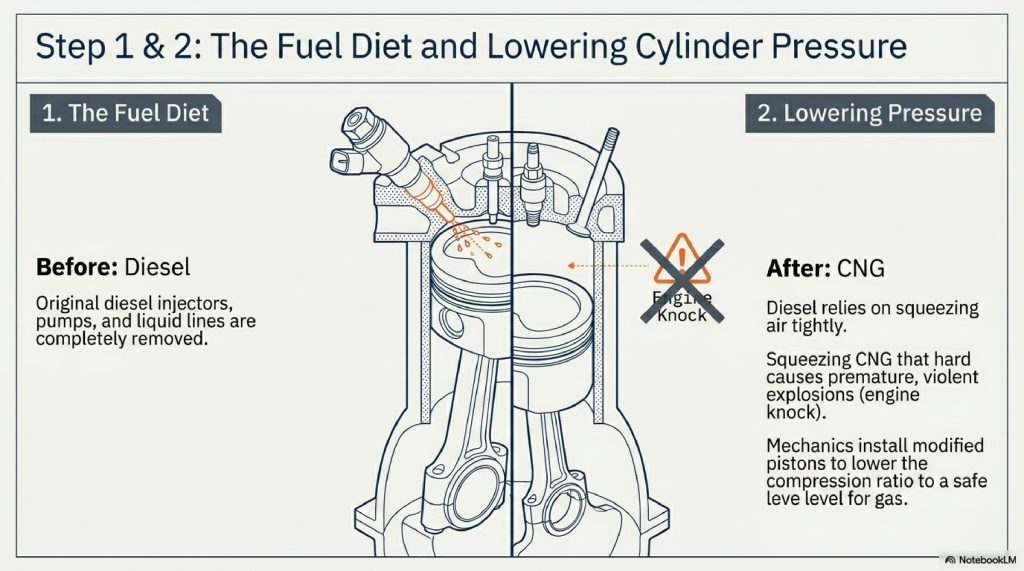
Step 1: The Fuel Diet (Removing the Diesel Gear)
First, the engine is stripped of its original fuel delivery system. The heavy-duty diesel fuel injectors, the high-pressure fuel pump, and the diesel fuel lines are completely removed. The engine will never taste liquid diesel again.
Step 2: Lowering the Pressure (Piston Modification)
Because diesel engines rely on squeezing air to create explosions, their pistons compress the air very tightly (a high “compression ratio”). If you squeeze CNG that tightly, it will explode prematurely and violently, destroying the engine, a phenomenon called “engine knock.” To fix this, mechanics usually swap out the pistons or modify the cylinder head to slightly enlarge the combustion chamber. This lowers the compression ratio to a safe level for gas.
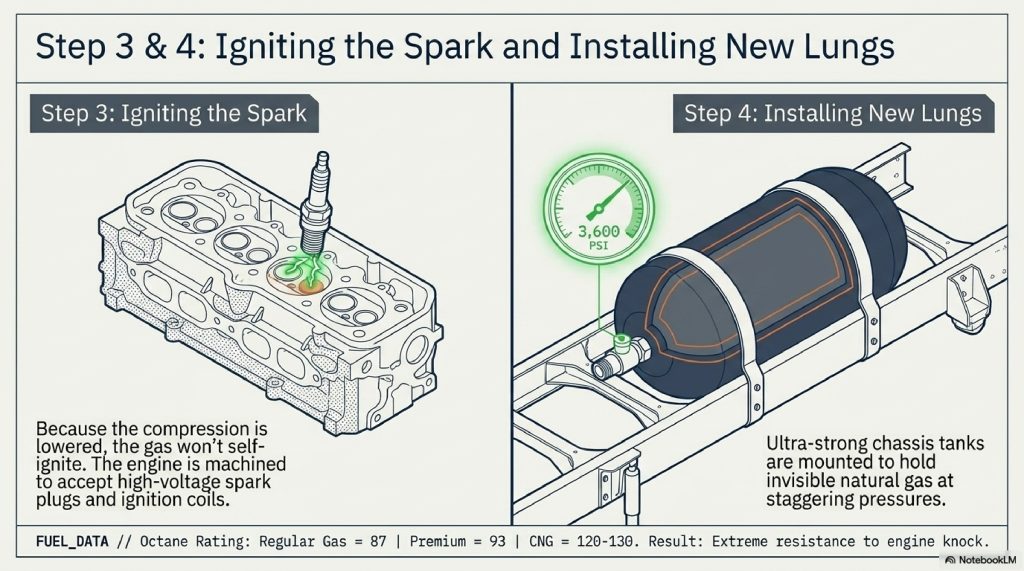
Step 3: The Spark of Life (Adding Spark Plugs)
Since the engine’s compression has been lowered, the CNG will no longer self-ignite. The engine now needs a spark. Mechanics drill and machine the cylinder head (usually right where the old diesel injectors used to be) to install high-voltage spark plugs and ignition coils.
Step 4: The New Lungs (Gas Injectors and Tanks)
New CNG fuel injectors are installed into the engine’s intake manifold. Meanwhile, massive, ultra-strong, bulletproof carbon-fiber or steel tanks are mounted to the chassis of the truck to hold the natural gas at a staggering 3,600 pounds per square inch (psi).
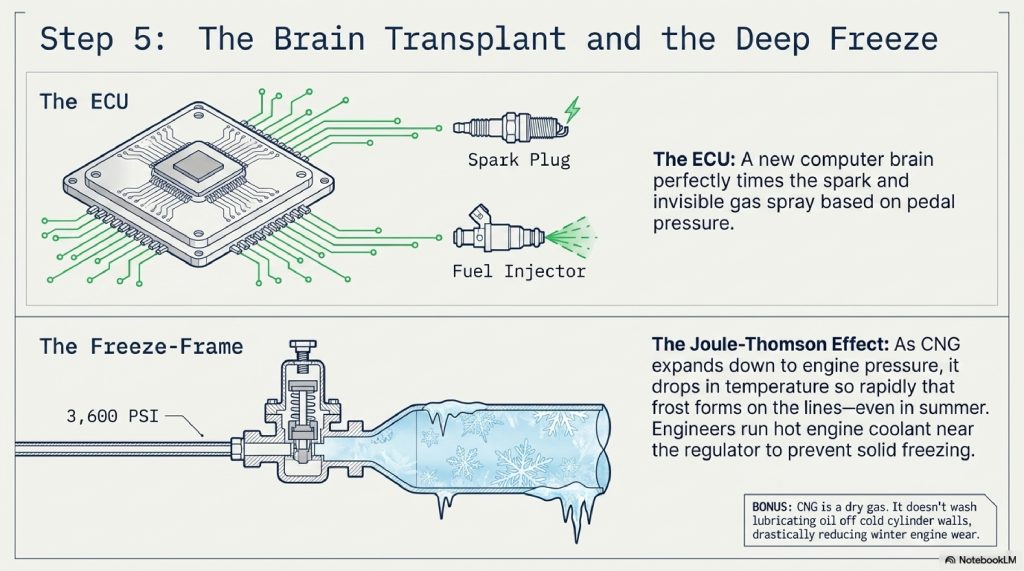
Step 5: The Brain Transplant (The ECU)
Finally, the truck gets a new brain. The old Engine Control Unit (ECU) is replaced or reprogrammed. This new computer precisely times exactly when to fire the new spark plugs and exactly how much invisible gas to spray into the engine based on how hard the driver is pressing the pedal.
When the key turns, what was once a rattling, soot-belching diesel beast purrs to life with the smooth, quiet hum of a gas engine.
C. REAL-WORLD EXAMPLE: Waking Up the City Bus
Let’s look at a relatable situation: the city public transit bus.
Historically, waiting at a bus stop meant breathing in a lungful of acrid diesel exhaust every time the bus pulled away from the curb. Diesel buses are loud, and because they do a lot of “stop-and-go” driving, their diesel particulate filters frequently clog, leading to massive maintenance bills for the city.
Now, imagine the city retrofits its fleet to CNG.
When the new CNG bus pulls up to your stop, the first thing you notice is the silence. Because CNG burns smoother and requires less aggressive compression, the engine noise is reduced by up to 50%. When the doors close and the bus accelerates away, there is absolutely zero black smoke. The exhaust smells faintly like a household heating vent, not a chemical plant.
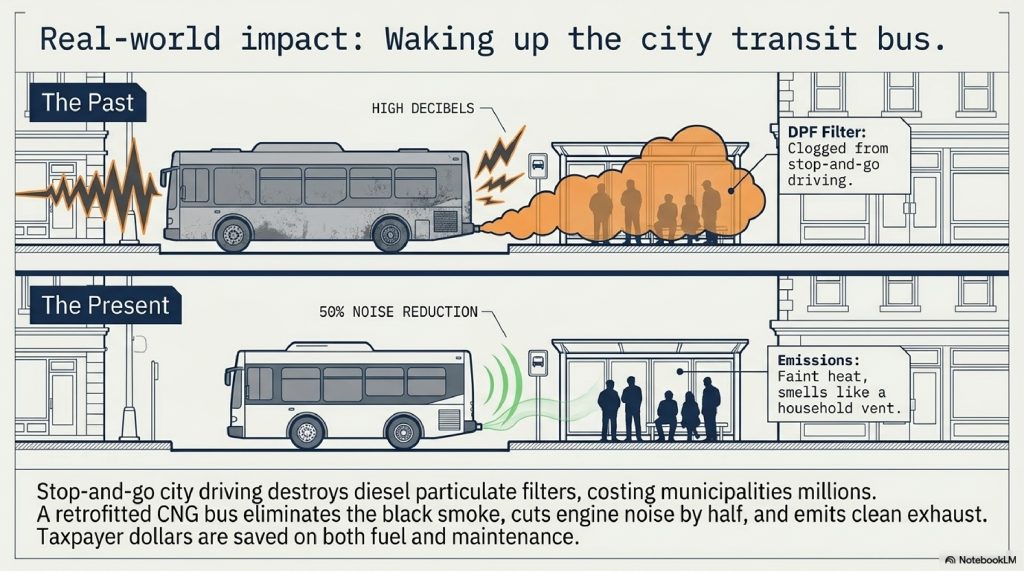
For the city, the benefits are immediate. They are no longer failing urban air quality metrics. The maintenance crews are no longer dealing with clogged soot filters. And because CNG is often sourced locally through city pipelines rather than imported on international oil tankers, the fuel costs for the transit authority plummet, saving taxpayer dollars.
D. THE ADVANCED TECHNICAL LAYER: The Physics of the Swap
For the engineers and performance enthusiasts reading this, let’s dive into the data. Recent studies published in journals like Cleaner Energy Systems use advanced thermodynamic simulation software like AVL Boost to map the exact performance parameters of a converted engine.

When you convert a diesel engine to CNG, it is not a perfect 1-to-1 swap. You are changing the fundamental chemistry of the combustion chamber.
1. The Volumetric Efficiency Problem
Diesel is a liquid. When it is sprayed into the cylinder, it takes up almost no space, leaving plenty of room for oxygen. CNG is a gas. When you inject CNG into the air intake, the gas physically displaces some of the incoming air. Less air means less oxygen; less oxygen means you can’t create as big of an explosion.
Result: A converted CNG engine usually experiences a slight drop in Brake Power and Torque compared to its original diesel form, particularly at lower RPMs. Engineers combat this by adding larger turbochargers to force more air into the engine.
2. Brake Thermal Efficiency (BTE)
BTE measures how well an engine turns the chemical energy of fuel into actual mechanical work (turning the wheels). Diesel engines are masters of BTE because of their ultra-high compression ratios. Because the CNG conversion requires lowering the compression ratio to avoid knocking, the BTE drops slightly. However, CNG has a higher calorific value (energy content by weight) than diesel, which helps balance the scales.
3. The Emissions Miracle
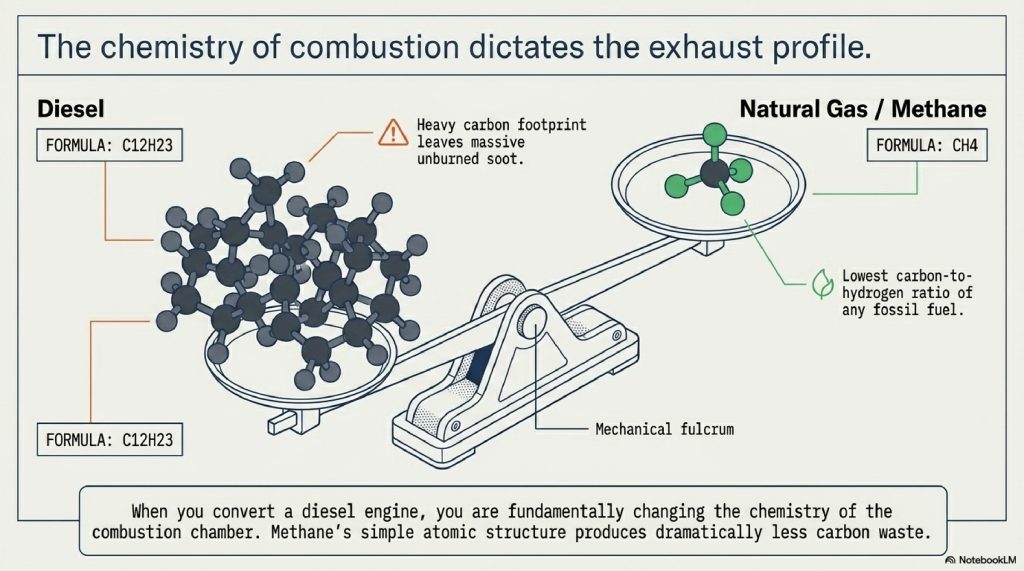
This is where the AVL Boost simulations truly shine. The chemical formula for diesel is roughly . It is heavy on carbon. Natural gas is mostly Methane .
Because methane has the lowest carbon-to-hydrogen ratio of any fossil fuel, the chemical combustion produces dramatically less carbon waste.
- Particulate Matter (Soot): Reduced by up to 95%. (CNG produces virtually no soot).
- Nitrogen Oxides (NOx): Reduced by 70-90% because CNG combustion temperatures can be tightly controlled with the new ECU and a three-way catalytic converter.
- Carbon Dioxide (CO2): Reduced by 15-20% simply due to the chemical makeup of methane.
E. THE ECONOMICS: Does It Actually Save Money?
If you lose a little bit of horsepower, why would a trucking company spend $20,000 to $40,000 to retrofit a truck?
The answer is the Total Cost of Ownership (TCO).
While diesel prices fluctuate wildly based on global oil markets, geopolitical tensions, and refining capacities, natural gas is often abundant, domestically produced, and highly stable. In many parts of the world, a Diesel Gallon Equivalent (DGE) of CNG is $1.00 to $1.50 cheaper than actual diesel.
Let’s do the math:
If a long-haul truck drives 100,000 miles a year and gets 6 miles to the gallon, it uses roughly 16,600 gallons of fuel annually.
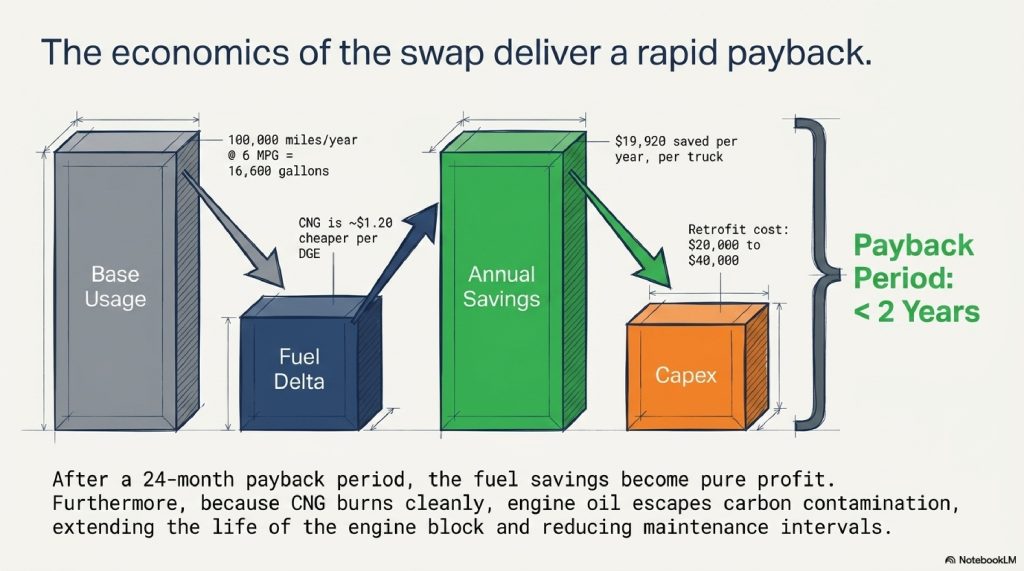
If CNG is $1.20 cheaper per gallon, the fleet saves $19,920 per year, per truck.
The payback period for the conversion is often less than two years. After that, it is pure profit. Furthermore, because CNG burns so cleanly, the engine oil doesn’t get contaminated with carbon soot as quickly. This means the truck requires fewer oil changes and suffers less internal wear and tear, prolonging the life of the engine block.
F. COMMON MYTHS ABOUT CNG CONVERSIONS
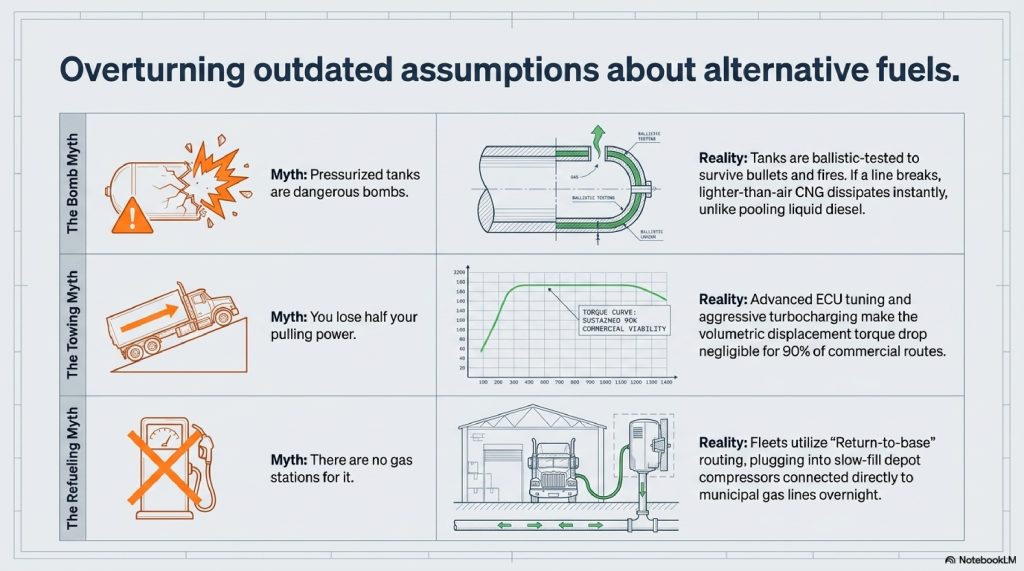
Myth 1: Driving around with highly pressurized gas tanks is a bomb waiting to go off.
Reality: CNG tanks are actually safer than liquid diesel tanks. They are subjected to brutal testing, including being shot with high-caliber bullets, dropped from buildings, and placed in bonfires. Furthermore, if a leak does occur, diesel pools on the ground and creates a lasting fire hazard. CNG is lighter than air. If a line breaks, the gas instantly dissipates harmlessly into the atmosphere.
Myth 2: You will lose half your towing capacity.
Reality: While there is a slight drop in peak torque due to volumetric displacement, modern ECU tuning and turbocharging make the difference negligible for 90% of commercial applications. The driver will barely notice a difference.
Myth 3: You can’t refuel them anywhere.
Reality: While CNG stations aren’t as common as standard gas stations, logistics fleets use “return-to-base” routing. The trucks drive their routes during the day and return to a central depot at night, where they plug into a slow-fill CNG compressor that runs off the city’s natural gas line.
G. THE FUTURE: Biogas and the Bridge to Zero
Is CNG the final answer to climate change? No. It is still a fossil fuel that releases CO2. However, experts refer to CNG as the ultimate “Bridge Technology.”
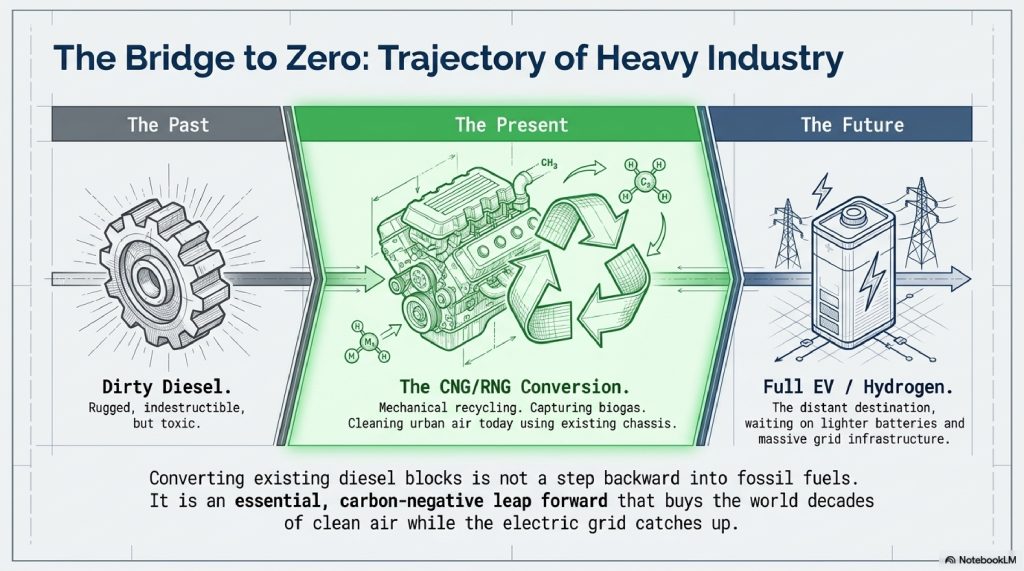
While we wait for battery technology to become light enough and cheap enough to power 80,000-pound semi-trucks over long distances, CNG cleans up the air today.
But the most exciting frontier isn’t fossil natural gas; it is Renewable Natural Gas (RNG), also known as Biogas.
RNG is methane captured from rotting organic waste in landfills, wastewater treatment plants, and dairy farms. Methane is a greenhouse gas 25 times more potent than CO2 if left to float into the atmosphere. By capturing that gas, compressing it, and putting it into a converted diesel engine, the truck is literally running on yesterday’s garbage.
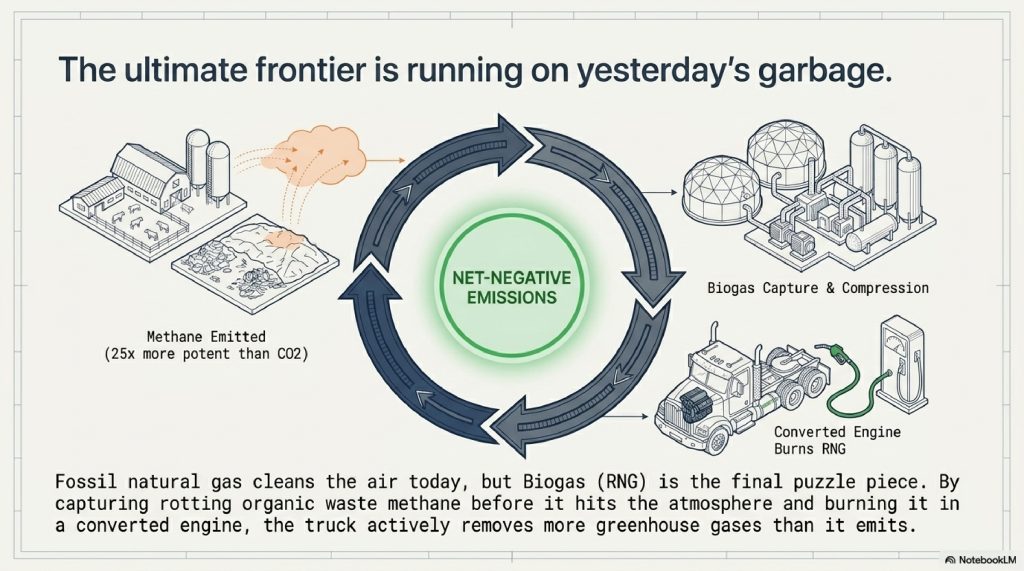
When powered by RNG, a converted diesel truck is considered carbon-negative. It is actually removing more harmful greenhouse gases from the atmosphere than it is emitting.
H. SURPRISING FACTS YOU DIDN’T KNOW ABOUT CNG
- Mind-Blowing Octane: Regular gasoline has an octane rating of about 87. Premium is 93. CNG has an octane rating of roughly 120 to 130. This makes it incredibly resistant to engine knock.
- The Deep Freeze: When CNG expands from 3,600 psi in the tank down to engine pressure, it drops in temperature so rapidly (due to the Joule-Thomson effect) that frost can form on the fuel lines, even in the middle of summer. Engineers have to run engine coolant lines near the gas regulator to keep it from freezing solid.
- No “Flooded” Engines: Because CNG enters the cylinder as a dry gas, it doesn’t wash the lubricating oil off the cylinder walls the way liquid fuels can when starting a cold engine. This drastically reduces engine wear during winter startups.
FAQS
1. Can any diesel engine be converted to CNG?
Technically, yes. However, it is most economically viable for heavy-duty commercial engines (like Cummins or Detroit Diesel blocks) used in fleets, buses, and refuse trucks. Converting a small passenger diesel car is rarely cost-effective.
2. How long does a CNG conversion take?
A professional conversion for a heavy-duty truck usually takes between 3 to 5 days, depending on the complexity of the tank mounting and ECU programming.
3. What is a “Dual-Fuel” system?
Unlike the “Dedicated CNG” system described above, a dual-fuel system leaves the diesel injectors intact. It squirts a tiny bit of diesel into the cylinder to act as a “liquid spark plug,” which then ignites a larger mixture of CNG. It is cheaper to install but doesn’t offer the same massive emission reductions.
4. Will a converted CNG engine pass emissions tests?
Yes. In fact, it will pass them with flying colors. A converted CNG engine produces a fraction of the emissions of its diesel counterpart, easily passing strict guidelines set by the EPA and Euro 6 standards.
5. How much does a CNG conversion cost?
For a Class 8 heavy-duty semi-truck, a full dedicated CNG conversion can cost between $25,000 and $45,000, largely due to the high cost of the carbon-fiber high-pressure fuel tanks.
6. Does CNG smell like the gas in my kitchen?
Yes. In its natural state, methane is completely odorless. Energy companies add a chemical called mercaptan to the gas, which gives it that distinctive “rotten egg” smell so leaks can be easily detected.
7. Can I still use diesel fuel after a dedicated conversion?
No. Once the heavy diesel fuel lines and injectors are removed, and spark plugs are installed, the engine can only run on compressed natural gas.
8. Are CNG tanks heavy?
Older steel tanks were incredibly heavy and reduced the amount of cargo a truck could legally carry. Modern Type 4 tanks are made of lightweight polymer wrapped in carbon fiber, making them immensely strong and significantly lighter.
9. How do you refuel a CNG truck?
You connect a specialized, high-pressure nozzle to the truck’s receptacle. It locks on tightly. “Fast-fill” stations can fill a truck in 10-15 minutes, while “time-fill” stations (used overnight at depots) slowly fill the tanks over several hours.
10. Is CNG the same as LPG (Propane)?
No. CNG is Compressed Natural Gas (mostly Methane) and is stored at ultra-high pressures as a gas. LPG is Liquefied Petroleum Gas (mostly Propane), which turns into a liquid under much lower pressure. Engines require different hardware to run on each.
OTHER BLOG SUGGESTIONS
To keep readers engaged and improve your site’s SEO architecture, consider linking to these related topics:
- Engine Knocking in Modern Cars: Causes, Fixes & Engineering
- How Intercoolers Improve Turbo Engine Performance (Engineering Guide)
- Why Modern Engines Are Becoming Smaller and More Powerful | Engineering Deep Dive
CONCLUSION
We are standing at a critical crossroads in the history of transportation. The pristine, all-electric future we dream of is still decades away from replacing the millions of heavy-duty trucks that keep human civilization fed, clothed, and moving today.
But progress doesn’t always require throwing away the past. Sometimes, it just requires a brilliant mechanical pivot.
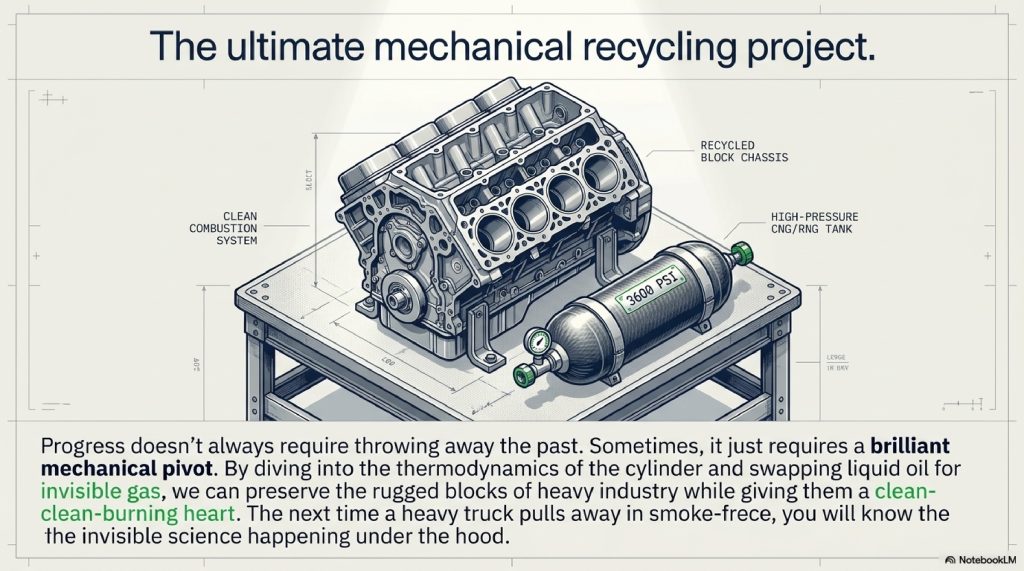
The research into converting diesel engines to Compressed Natural Gas proves that we don’t have to accept the toxic soot and choking smog of the 20th century. By diving into the thermodynamics of the cylinder, tweaking compression ratios, and swapping liquid oil for invisible gas, engineers have found a way to teach an old dog a revolutionary new trick.
The diesel to CNG conversion is the ultimate mechanical recycling project. It preserves the rugged, indestructible blocks of heavy industry while giving them a new, clean-burning heart. So, the next time you see a massive garbage truck or city bus pull away from a stop in total, smoke-free silence, you’ll know exactly the invisible science happening under the hood.
Comments (2)