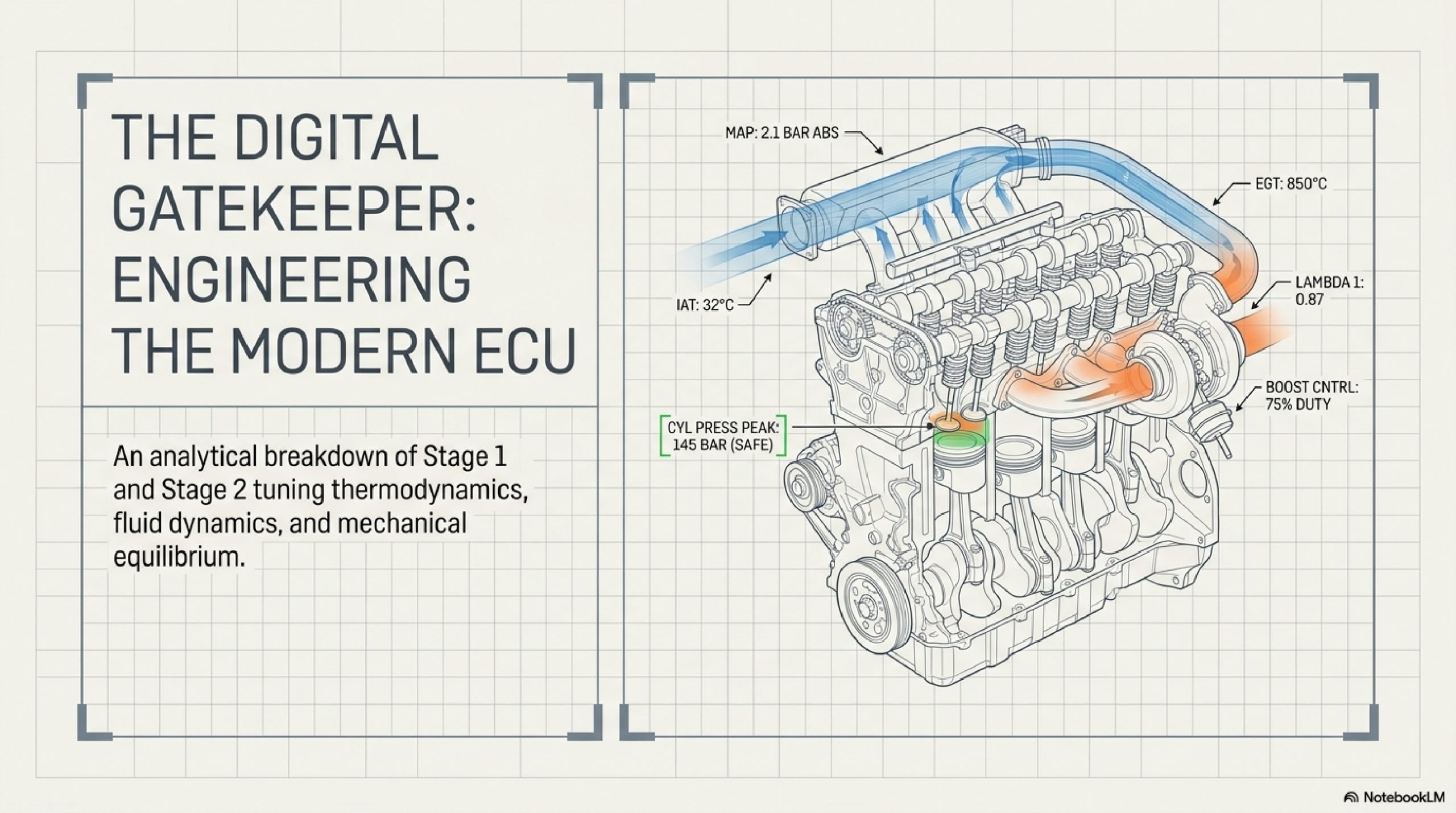
When you purchase a modern turbocharged vehicle, you are not buying an engine that operates at its maximum mechanical potential. You are buying an engine that has been deliberately restricted by a digital gatekeeper: the Engine Control Unit (ECU).
Automakers globally program ECUs with incredibly wide safety margins. They must account for a driver in the Middle East dealing with 50°C (122°F) ambient heat, a driver in the high altitudes of Colorado, and a driver in Southeast Asia using low-grade, inconsistent fuel. If you live in a moderate climate and have access to premium fuel, your factory engine is hiding significant power.
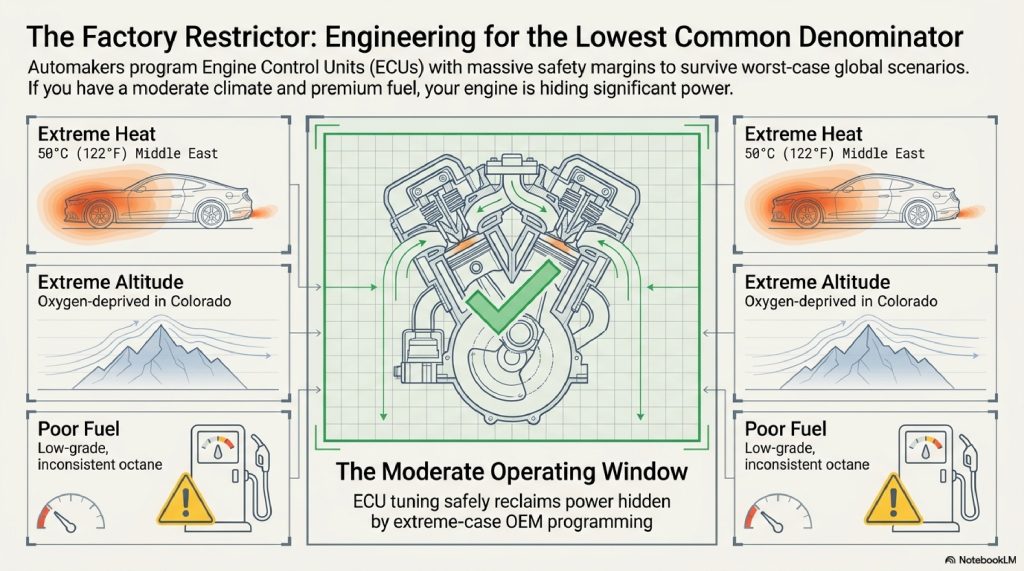
Unlocking this power is done through ECU tuning, most commonly categorized into “Stages.” But the jump from Stage 1 to Stage 2 is not just a software update; it is a fundamental shift in fluid dynamics and thermodynamics. Here is the complete engineering breakdown of Stage 1 vs Stage 2 ECU tuning.
Technical Explanation: Re-Writing the Rules of Combustion
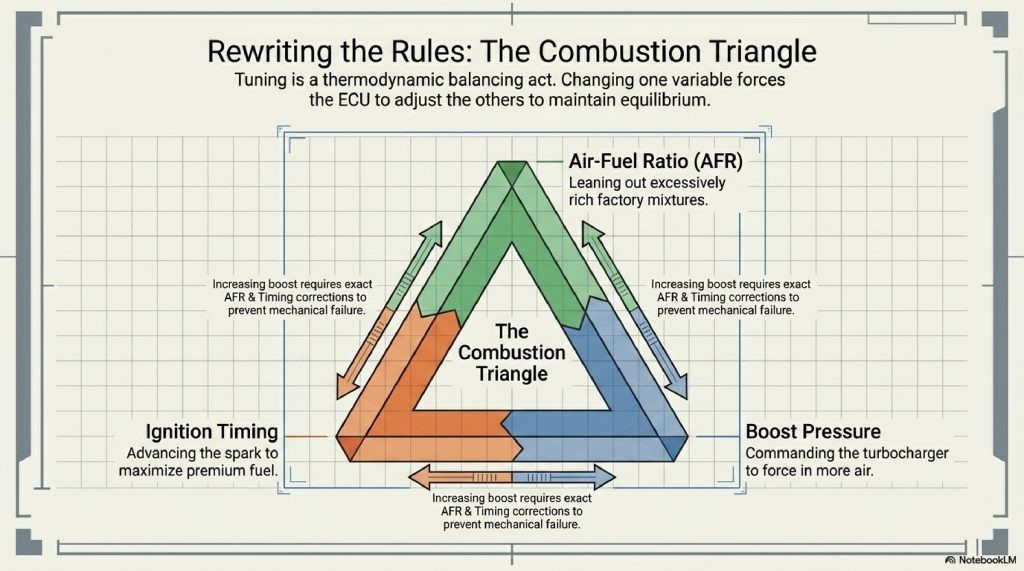
To understand tuning, you must first understand what the ECU controls. The ECU constantly adjusts three critical parameters:
- Air-Fuel Ratio (AFR): How much fuel is mixed with the incoming air.
- Ignition Timing: Exactly when the spark plug fires during the compression stroke.
- Boost Pressure: How much compressed air the turbocharger forces into the cylinders.
What is a Stage 1 Tune?
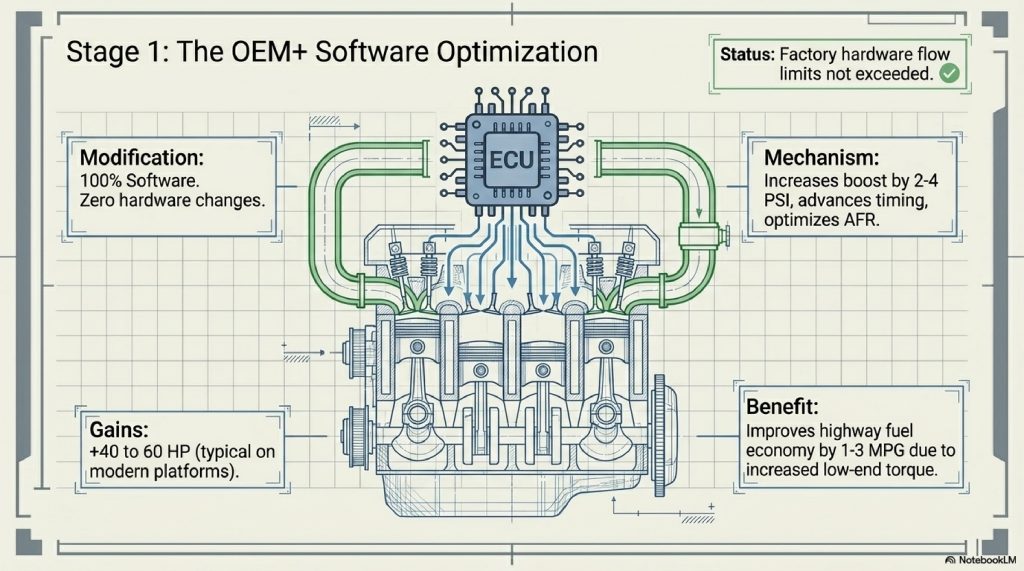
Stage 1 is a software-only modification. It requires zero hardware changes. The goal of a Stage 1 tune is simply to optimize the factory parameters, eating into the wide safety margins left by the OEM.
In a turbocharged engine, a Stage 1 flash typically increases boost pressure by 2 to 4 PSI, advances the ignition timing for premium fuel, and leans out the excessively rich factory AFR. Because the factory intake and exhaust systems flow well enough to handle this mild increase in volumetric efficiency, the physical engine components remain unstressed.
What is a Stage 2 Tune?
Stage 2 is a software modification paired with mandatory physical hardware upgrades.
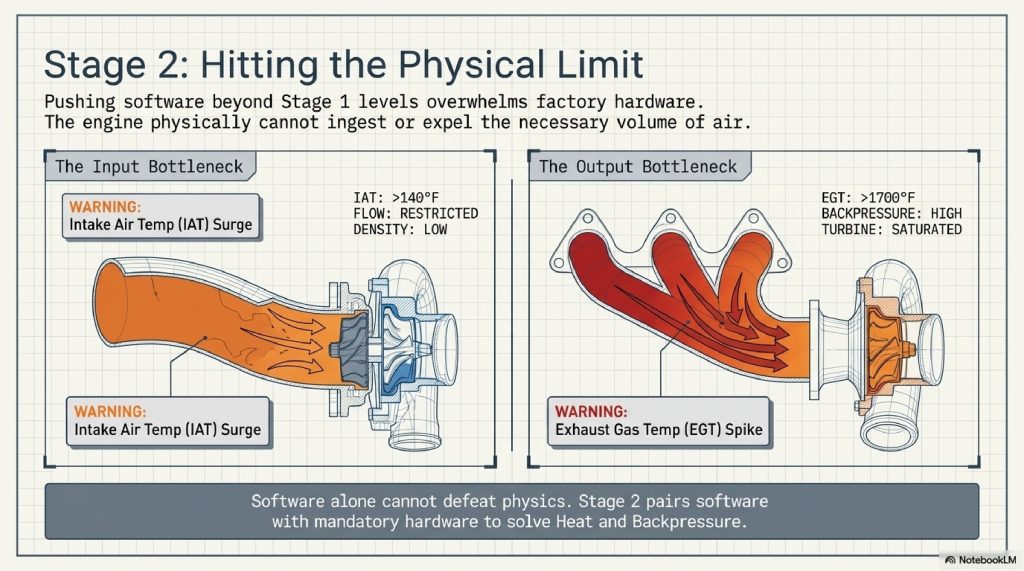
Once you push beyond Stage 1, the factory engine hardware becomes a physical bottleneck. You cannot simply command the turbocharger to produce more boost, because the engine cannot efficiently ingest or expel that much air. Stage 2 tuning targets two distinct engineering challenges:
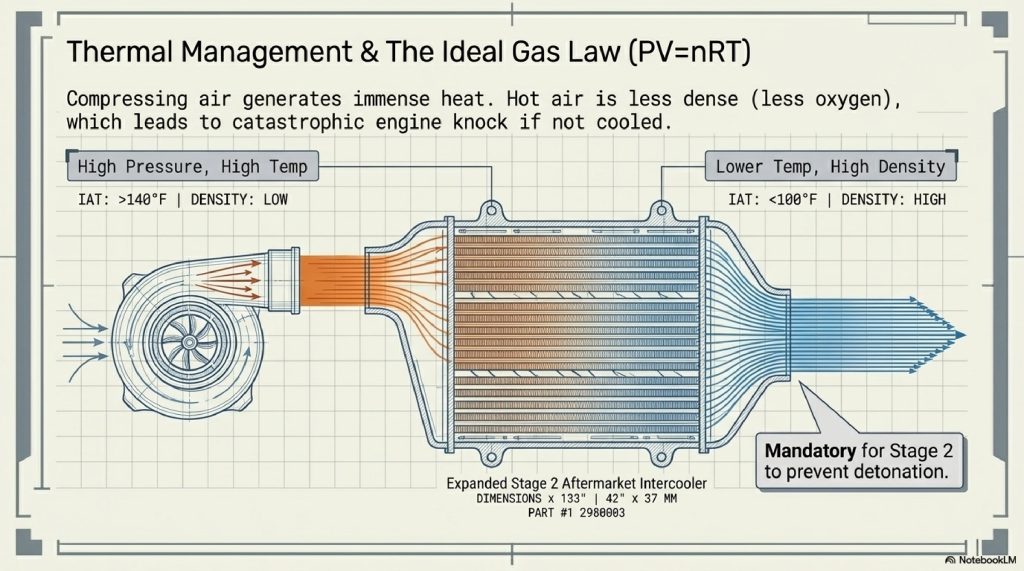
- Thermal Management (The Intercooler): Compressing air creates immense heat, dictated by the ideal gas law: . When you ask a factory turbo to spin faster for Stage 2 boost levels, the intake air temperature (IAT) skyrockets. Hot air is less dense, meaning less oxygen per cubic centimeter, leading to engine knock (detonation). A larger, more efficient aftermarket intercooler is mandatory to drop these temperatures.
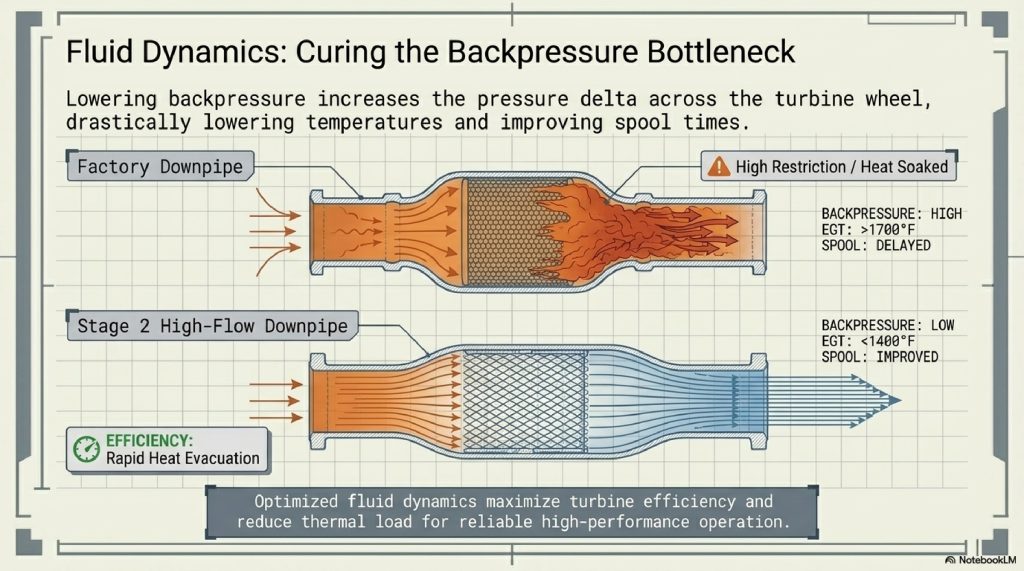
- Backpressure Reduction (The Downpipe): The factory catalytic converter, located in the downpipe directly behind the turbocharger, is highly restrictive. To flow more air out of the engine, this restriction must be removed or replaced with a high-flow catalytic converter. Lowering exhaust backpressure increases the pressure delta across the turbine wheel, allowing the turbo to spool faster and drastically lowering Exhaust Gas Temperature (EGT).
Real-World Performance: What to Expect Behind the Wheel
The difference between these two stages drastically alters the ownership experience.
Reliability and Heat Management
A Stage 1 tune is widely considered OEM+. On platforms like the Volkswagen EA888 or the BMW B58, a Stage 1 tune can add 40 to 60 horsepower with virtually no impact on long-term reliability, provided maintenance is kept up.
A Stage 2 tune pushes the engine closer to its mechanical limits. While modern engine blocks are robust, the increased torque often overwhelms factory clutch packs in manual transmissions, or requires a TCU (Transmission Control Unit) tune for automatics to increase clutch clamping force. Heat soak becomes a real issue if the car is driven hard on a track, necessitating upgraded oil coolers.
Fuel Economy
Counterintuitively, a Stage 1 tune can actually improve fuel economy by 1 to 3 MPG during highway cruising. Because the engine produces more low-end torque, you do not need to press the accelerator pedal as far to maintain speed. However, under heavy throttle, both stages will consume significantly more fuel than stock.
Common Problems: Pushing the Limits
Modifying the ECU comes with specific risks that owners must be prepared to mitigate.
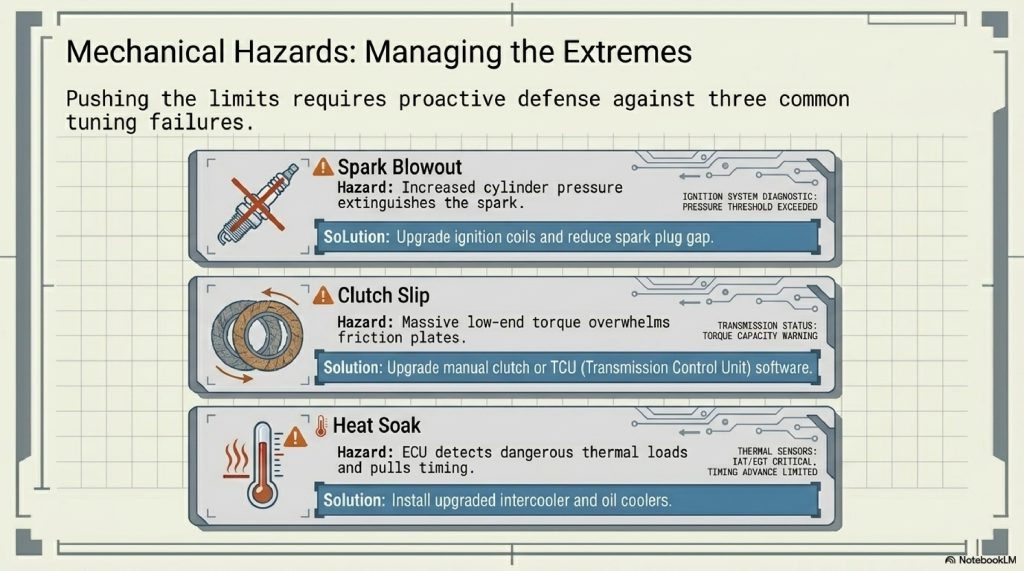
- Spark Blowout (Misfires): Increased cylinder pressure from higher boost can literally extinguish the spark before it ignites the fuel.
- Prevention: Upgrading ignition coils and reducing the spark plug gap.
- Clutch Slip: The massive low-end torque surge of a Stage 2 file will quickly wear out a factory manual clutch.
- Heat Soak: If a driver attempts to run a Stage 2 software file without the required intercooler, the ECU will detect dangerous heat levels and pull ignition timing, resulting in a car that is actually slower than stock.
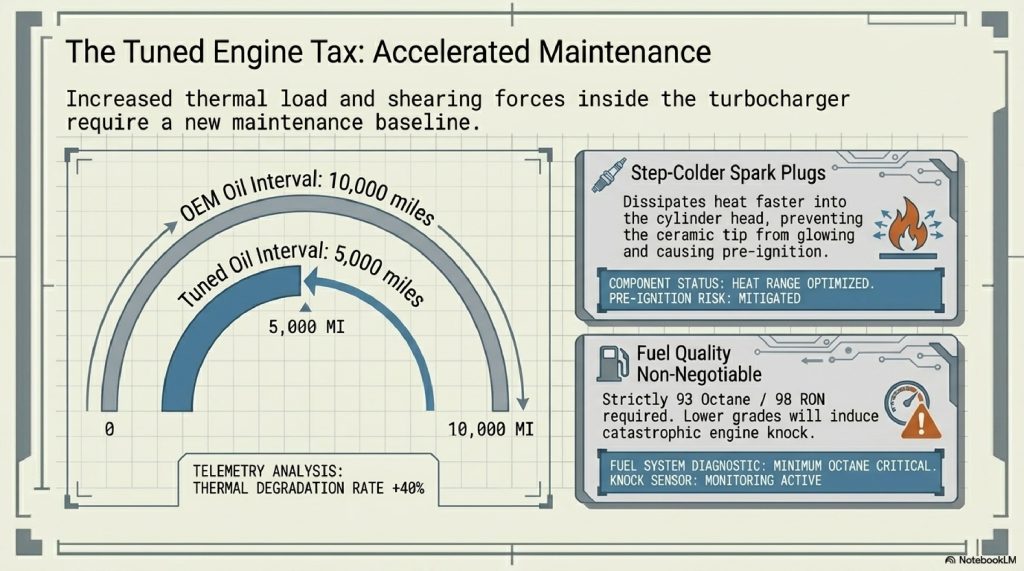
Servicing & Maintenance: The Tuned Engine Tax
You cannot maintain a Stage 2 tuned engine using the dealership’s standard service manual.
1. Slicing Maintenance Intervals in Half
If the factory manual suggests a 10,000-mile (16,000 km) oil change, a tuned car requires fresh oil every 5,000 miles. The increased heat and shearing forces inside the turbocharger break down engine oil much faster.
2. Step-Colder Spark Plugs
Because Stage 2 generates vastly more cylinder heat, engineers recommend switching to “one-step colder” spark plugs. These plugs dissipate heat faster into the cylinder head, preventing the ceramic tip from glowing red-hot and causing pre-ignition.
3. Fuel Quality is Non-Negotiable
A tuned ECU is mapped for a specific octane rating (e.g., 93 Octane / 98 RON). Putting low-grade fuel in a tuned car will cause catastrophic engine knock.
Comparison Section: Stage 1 vs. Stage 2
| Feature | Stage 1 Tune | Stage 2 Tune |
| Hardware Required | None (Stock) | High-Flow Downpipe, Upgraded Intercooler |
| Average Power Gain | 10% – 20% | 20% – 35% |
| Warranty Status | Likely Voided (Flagged by dealer) | Definitely Voided |
| Cost to Execute | $400 – $800 (Software only) | $1,500 – $3,000 (Parts + Labor + Software) |
| Daily Drivability | Identical to stock, but faster. | Noticeably louder, more aggressive throttle. |
| Transmission Impact | Usually fine on factory clutch. | Often requires upgraded clutch or TCU tune. |
Future Technology: The Encryption War
The future of engine tuning is currently a massive cybersecurity battle. Modern architectures, like the Bosch MG1/MD1 ECUs, feature military-grade hardware encryption.
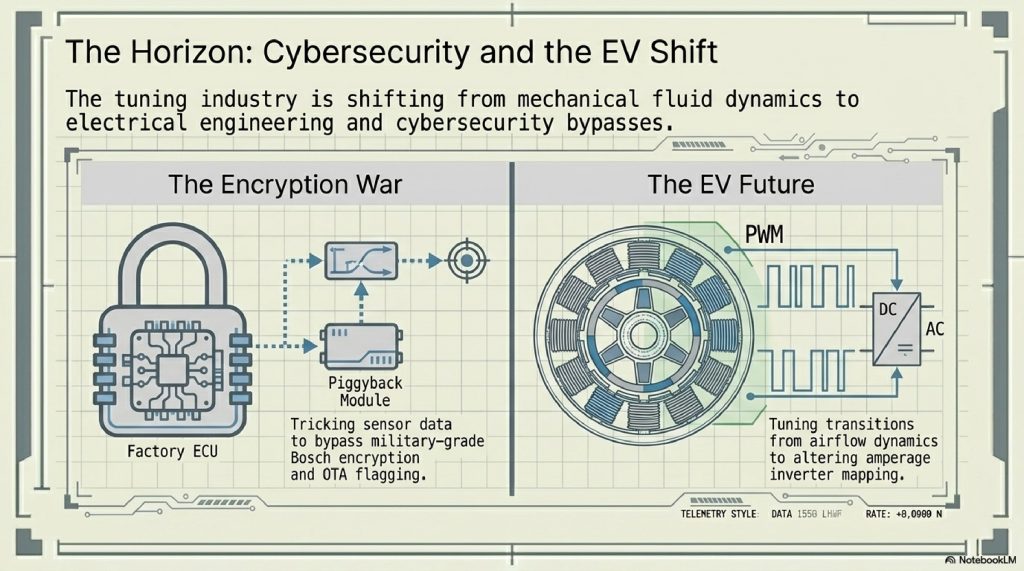
Automakers are moving toward Over-The-Air (OTA) updates, meaning a dealership can scan and detect an ECU flash remotely, flagging the VIN and voiding the powertrain warranty instantly. To combat this, tuning engineers are focusing heavily on Piggyback Modules devices that intercept sensor data before it reaches the factory ECU, tricking it into making more boost without actually breaking the ECU’s encryption.
Furthermore, as the EV powertrain revolution expands, “tuning” is shifting from fluid dynamics to inverter mapping, altering the electrical pulse width modulation to send more amperage to electric motors.
Historical Background: From Carburetors to Laptops
Engine tuning has evolved drastically. In the 1970s, “tuning” meant physically swapping out carburetor jets and advancing the distributor cap by hand.
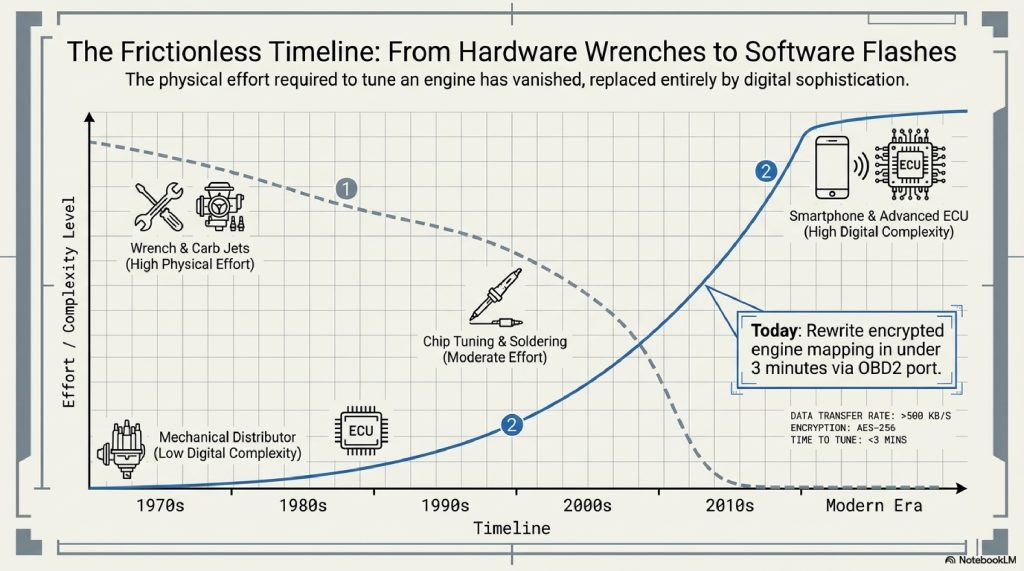
By the late 1980s and 1990s, cars utilized early electronic fuel injection. Tuners had to physically desolder the EEPROM chip from the ECU motherboard, burn a new fuel map onto it with a specialized machine, and solder it back on.
The modern era of OBD2 port flashing began in the mid-2000s, revolutionizing the industry. Today, anyone with a smartphone, a Bluetooth OBD2 adapter, and an internet connection can completely rewrite their car’s engine mapping in under three minutes from their driveway.
Expert Insights: Engineering Observations
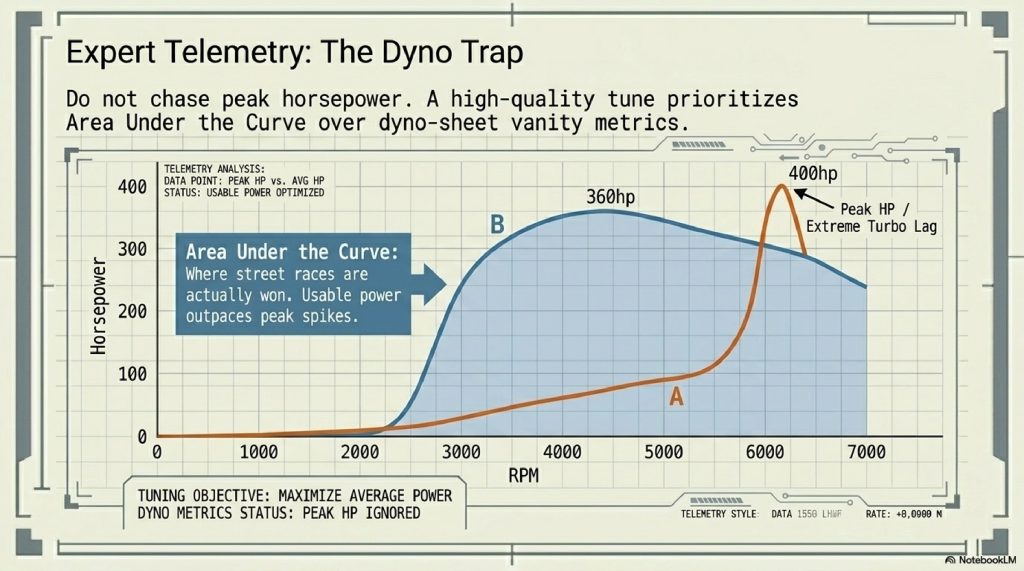
As an automotive engineer who has spent countless hours on dynamometers, the most critical piece of advice I can offer regarding engine tuning is this: Do not chase the dyno graph.
Many enthusiasts fixate on “Peak Horsepower.” However, a car that makes 400 peak horsepower at 6,500 RPM but has extreme turbo lag will be beaten on the street by a car making 360 horsepower with a massive, flat torque curve starting at 2,500 RPM. A high-quality tune prioritizes “Area Under the Curve”, maximizing the usable power across the entire RPM range while keeping Exhaust Gas Temperatures (EGT) within safe metallurgical limits.
Furthermore, if you are considering an engine swap, a flashed OEM ECU is vastly superior to an expensive Standalone ECU for a daily driver, as the OEM ECU retains factory idle control, cold start mapping, and safety knock-retard logic that takes OEM engineers thousands of hours to perfect.
Conclusion
The decision between a Stage 1 and Stage 2 tune ultimately comes down to your budget, your mechanical sympathy, and your goals.
- Stage 1 is the undisputed king of “bang-for-your-buck.” It wakes up the engine, optimizes factory parameters, and maintains daily drivability without requiring thousands of dollars in supporting hardware.
- Stage 2 is for the dedicated enthusiast. It requires a commitment to rigorous maintenance, higher costs, and an understanding of engine thermodynamics, but rewards the driver with exotic-level power figures from a standard commuter car.
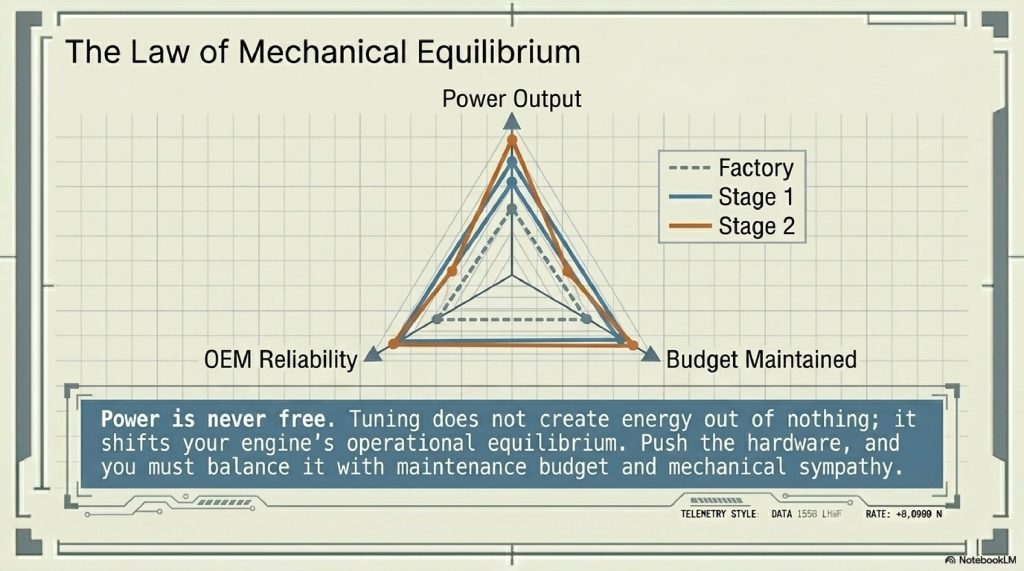
Whatever route you choose, respect the science happening under your hood. Log your data, buy quality parts, and use premium fuel.
Frequently Asked Questions (FAQ)
Q: Will a Stage 1 tune void my car’s warranty?
A: Yes. Modern dealerships use diagnostic tools that check the ECU’s “flash counter” or detect torque values exceeding factory parameters. Even if you flash the car back to stock before a dealer visit, a “TD1” flag (or equivalent) will likely void the powertrain warranty.
Q: Do I need a custom “Dyno Tune” or is an “Off-The-Shelf” (OTS) map okay?
A: For lightly modified Stage 1 and Stage 2 cars, high-quality OTS maps from reputable companies are incredibly safe and well-tested. A custom dyno tune is highly recommended if you upgrade the turbocharger or use exotic fuels like E85.
Q: Can I run a Stage 2 tune with a stock downpipe?
A: No. Running Stage 2 boost levels through a restrictive factory downpipe will cause extreme exhaust backpressure. This leads to dangerous Exhaust Gas Temperatures (EGT) that can melt the catalytic converter or destroy the turbocharger seals.
Q: How do I know if my engine is handling the tune safely?
A: Datalogging. Use your tuning device to log parameters during a wide-open throttle pull (usually in 3rd or 4th gear). Monitor “Ignition Timing Correction” (Knock Retard) and “Air-Fuel Ratio.” If the ECU is heavily pulling timing, the octane is too low or the engine is too hot.
Product Name: OBDLink CX Bimmercode/MHD Bluetooth Adapter
Why it is useful: This is the physical bridge between your smartphone and your car’s ECU, allowing you to flash Stage 1 or Stage 2 off-the-shelf (OTS) maps from your driveway.
Best use case: Flashing software, reading engine diagnostic codes, and live datalogging boost pressure.
Product Name: NGK Ruthenium HX or Iridium IX Spark Plugs
Why it is useful: Handles the increased cylinder pressures and temperatures of a tuned engine without misfiring.
Best use case: Mandatory preventative maintenance before flashing a Stage 1 or Stage 2 tune.
Comments (3)