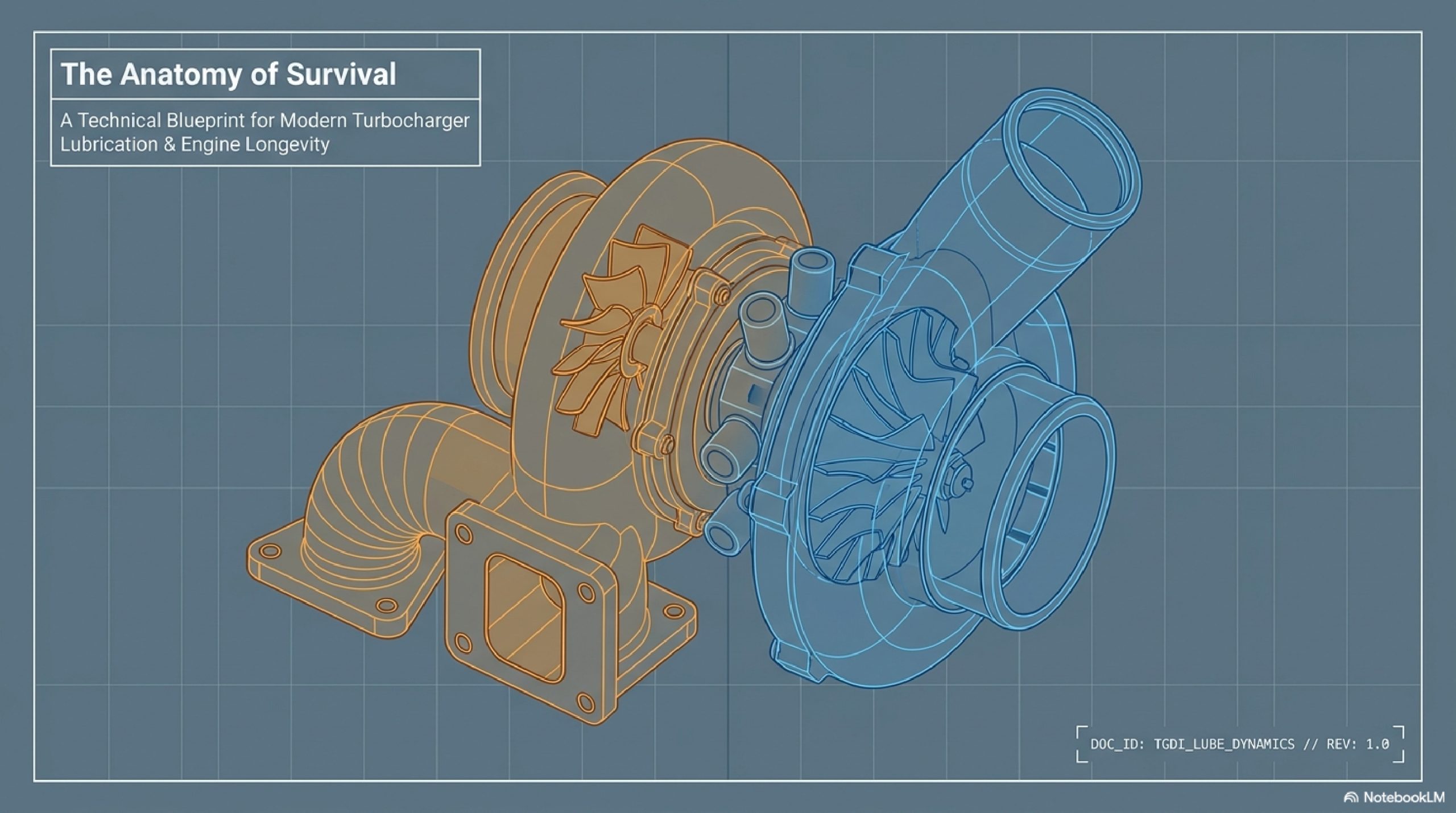
Introduction
If you have purchased a car within the last decade, there is a massive probability that you are driving a Turbocharged Gasoline Direct Injection (TGDI) vehicle. Automakers have aggressively downsized engines, relying on turbochargers to make a 1.5-liter four-cylinder produce the horsepower of an older V6 while meeting strict global emissions standards.
While these engines are marvels of modern power density, they operate in a completely different thermal and mechanical universe than naturally aspirated engines. A modern turbocharger spins at speeds exceeding 150,000 RPM and is driven by exhaust gases that can reach 1,800°F (980°C). The only thing standing between those spinning metal components and catastrophic destruction is a microscopic film of engine oil.
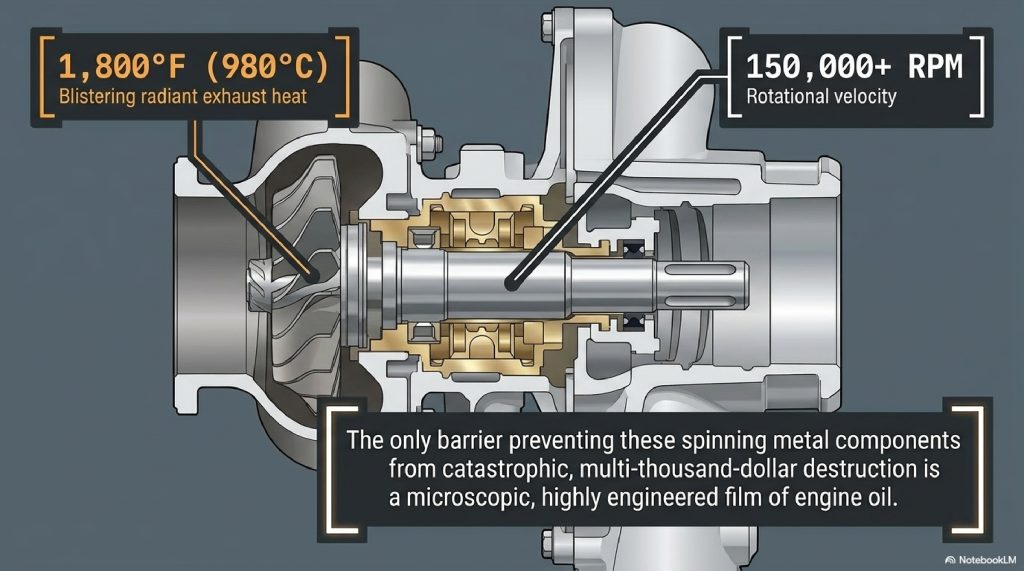
Using “standard” conventional oil in a modern turbo engine is the fastest way to guarantee a multi-thousand-dollar repair bill. To protect your investment, you must understand the fluid dynamics occurring under your hood. Here is the definitive engineering guide to the best engine oils for turbocharged engines, how they prevent catastrophic failure, and the exact specifications you must look for.
Technical Explanation: The Physics of Turbo Lubrication
Why do turbocharged engines need special oil? Turbocharged engines require high-quality full synthetic oil because turbo turbine shafts spin up to 200,000 RPM at extreme temperatures. Conventional oils cannot withstand these shear forces and thermal loads, leading to oil vaporization, sludge buildup (coking), and rapid bearing destruction.
Let us break down the specific mechanical demands a turbocharger places on engine oil:
1. Hydrodynamic Lubrication in Journal Bearings
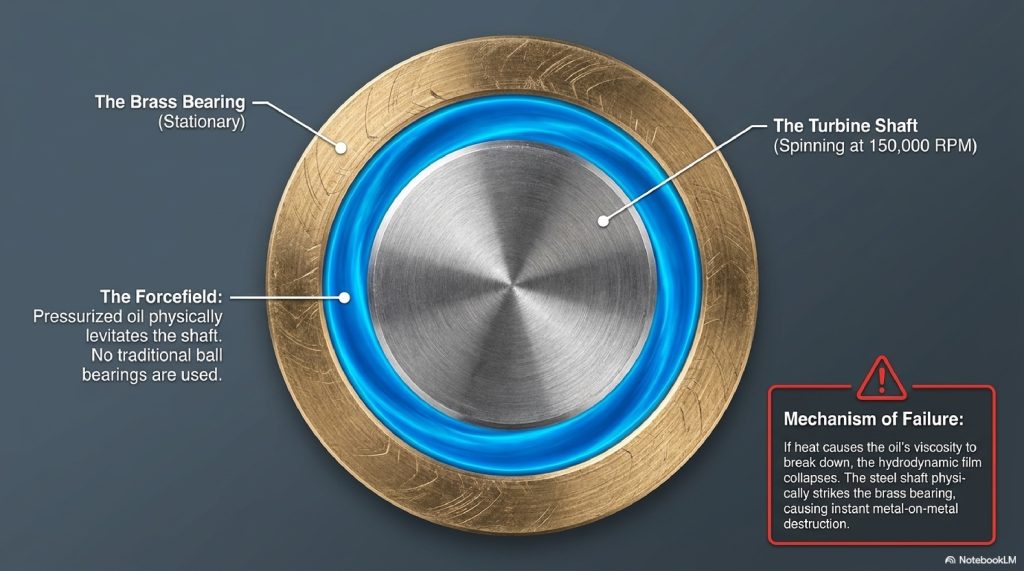
Most passenger-car turbochargers do not use traditional ball bearings. Instead, they use “journal bearings,” where the turbine shaft literally floats on a pressurized film of engine oil. If the oil’s viscosity breaks down under heat, that film collapses. The shaft will physically strike the brass bearing, causing instant, catastrophic metal-on-metal failure.
2. High-Temperature Shear Stability
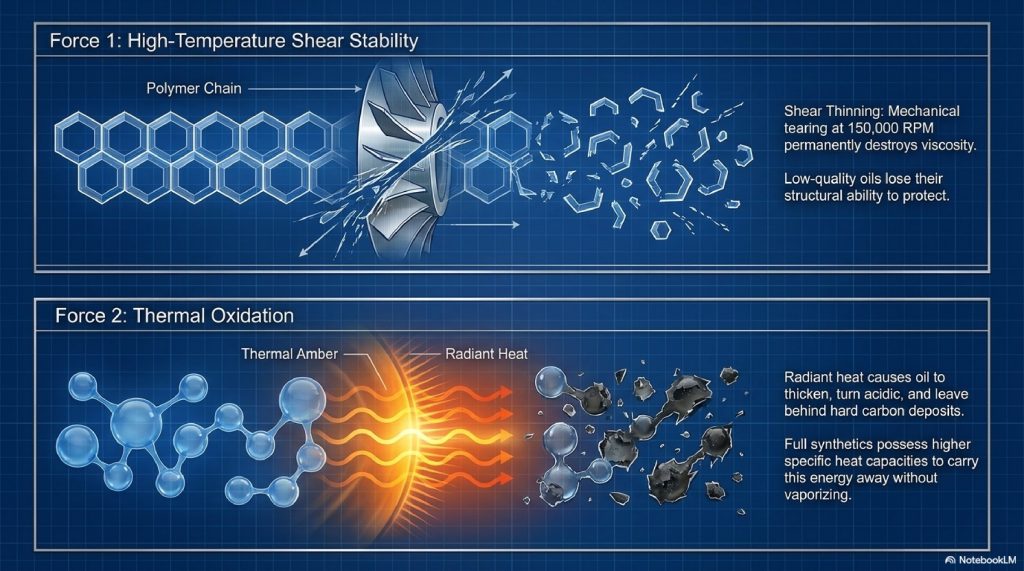
At 150,000 RPM, the mechanical tearing forces (shear) on the oil’s polymer chains are immense. Low-quality oils will experience “shear thinning,” permanently losing their viscosity and becoming too thin to provide protection. Premium synthetic base oils especially Gas-to-Liquid (GTL) formulations have uniform molecular structures that resist being torn apart by the turbo shaft.
3. Thermal Oxidation
When oil is subjected to the blistering radiant heat of the exhaust housing, it chemically reacts with oxygen. This is thermal oxidation. It causes the oil to thicken, turn acidic, and leave behind hard, abrasive carbon deposits.
Real-World Performance: Efficiency and Viscosity
The right oil does not just prevent failure; it actively improves how the engine drives.
Cold Start Flow and Turbo Lag
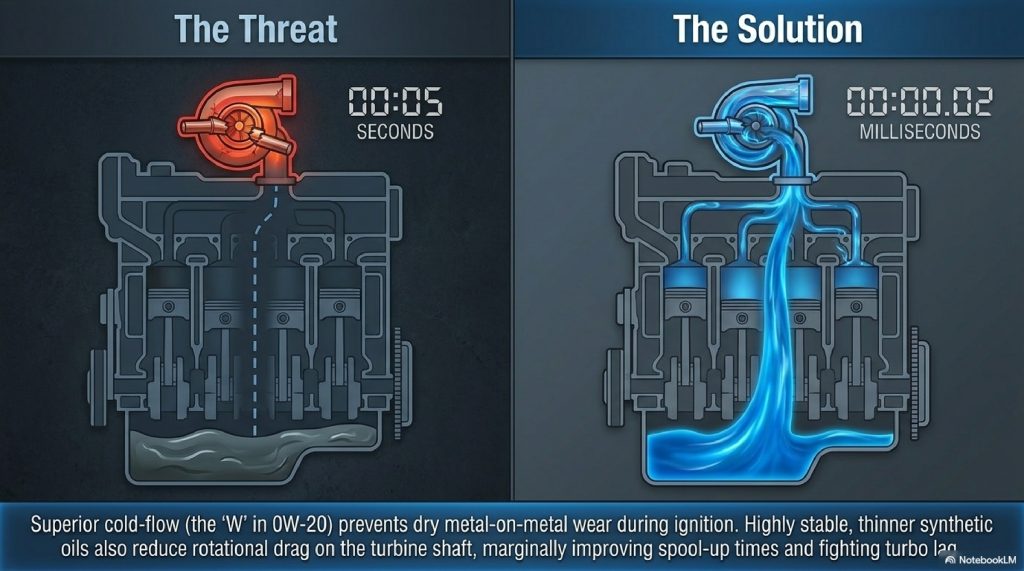
When you start a car in the winter, the oil is thick and sits in the oil pan. The turbocharger is located at the top of the engine and is the last component to receive lubrication. Premium synthetic oils have superior “cold-flow” properties (represented by the “W” in 0W-20 or 5W-30). A 0W-20 synthetic reaches the turbo bearings in milliseconds, preventing dry metal-on-metal wear during cold starts. Furthermore, thinner, highly stable oils reduce rotational drag on the turbine shaft, marginally improving spool-up times and reducing turbo lag.
Heat Management
Turbo engines run significantly hotter than naturally aspirated engines. Full synthetic oils possess a higher specific heat capacity, meaning they can absorb and carry away more thermal energy from the turbocharger housing and the piston under-crowns without vaporizing.
Common Problems: The Twin Killers of Modern Turbos
If you are using the wrong oil, you are inviting two highly destructive engineering phenomena into your engine bay.
1. LSPI (Low-Speed Pre-Ignition)
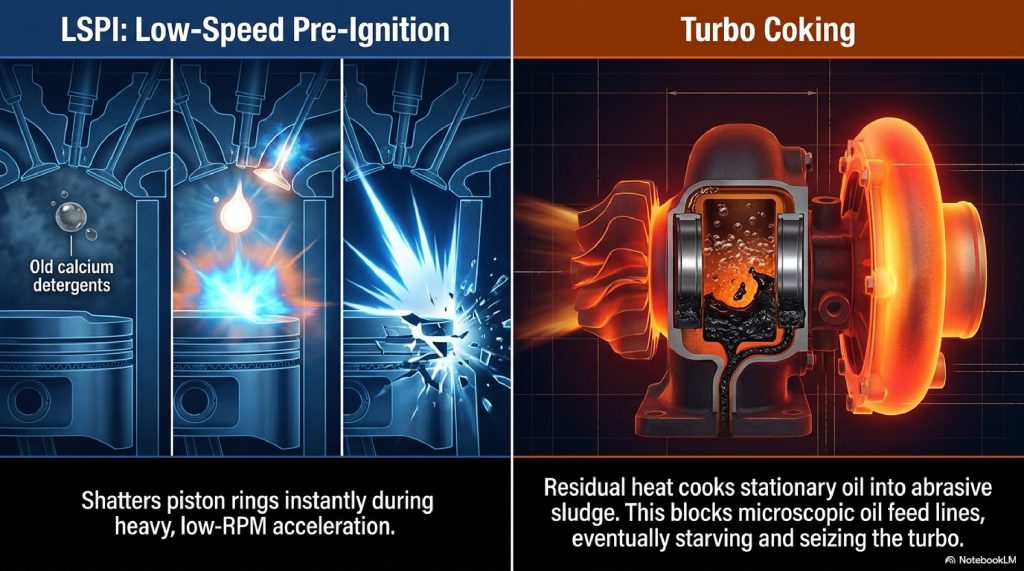
LSPI is the silent killer of modern TGDI engines. When accelerating heavily at low RPMs, microscopic droplets of engine oil bypass the piston rings and enter the combustion chamber. Because older oil formulations used calcium-based detergents, these droplets act like liquid spark plugs, spontaneously igniting the air-fuel mixture before the actual spark plug fires. This creates a supersonic shockwave that can shatter a piston ring land instantly.
2. Turbo Coking
If you shut off a turbocharged engine immediately after driving hard, the oil inside the bearing housing stops flowing. The residual heat from the exhaust turbine “cooks” the stationary oil, turning it into hard, abrasive carbon soot. This is known as “turbo coking.” Over time, this sludge blocks the microscopic oil feed lines, starving the turbo of lubrication and causing it to seize.
Servicing & Maintenance: The Golden Rules for Turbo Cars
You cannot rely on the dealership’s 10,000-mile “extended” service intervals if you want your turbo engine to last 200,000 miles.
1. The API SP / ILSAC GF-6 Mandate
When buying oil, you must look for the API SP or ILSAC GF-6 (or the upcoming GF-7) “Starburst” certification on the bottle. Introduced in 2020, API SP oils were specifically re-engineered, replacing calcium detergents with magnesium-based packages. This chemical shift virtually eliminates the risk of LSPI in modern TGDI engines.
2. Halve Your Drain Intervals
Turbochargers shear oil and burn off its protective additives faster than any other engine type. Ignore the dashboard computer. For maximum longevity, change your full synthetic oil every 5,000 miles (8,000 km).
3. The Idling Rule
Never shut off a turbocharged engine immediately after aggressive highway driving. Let the engine idle for 30 to 60 seconds before turning the key off. This allows the oil pump to circulate fresh, cool oil through the incredibly hot turbo center housing, preventing turbo coking.

Comparison Section: Oil Types in a Turbo Engine
| Feature | Conventional (Mineral) Oil | Synthetic Blend | Full Synthetic (API SP) |
| Base Oil Purity | Low (Irregular molecules) | Medium | High (Uniform molecules) |
| High-Temp Resistance | Fails at ~250°F (Sludges) | Survives up to ~300°F | Thrives up to 450°F+ |
| Shear Stability | Poor | Average | Excellent |
| LSPI Protection | None (Calcium heavy) | Varies | Maximum (Magnesium detergents) |
| Verdict for Turbos | Engine Destroyer | Acceptable for short intervals | Mandatory Engineering Requirement |
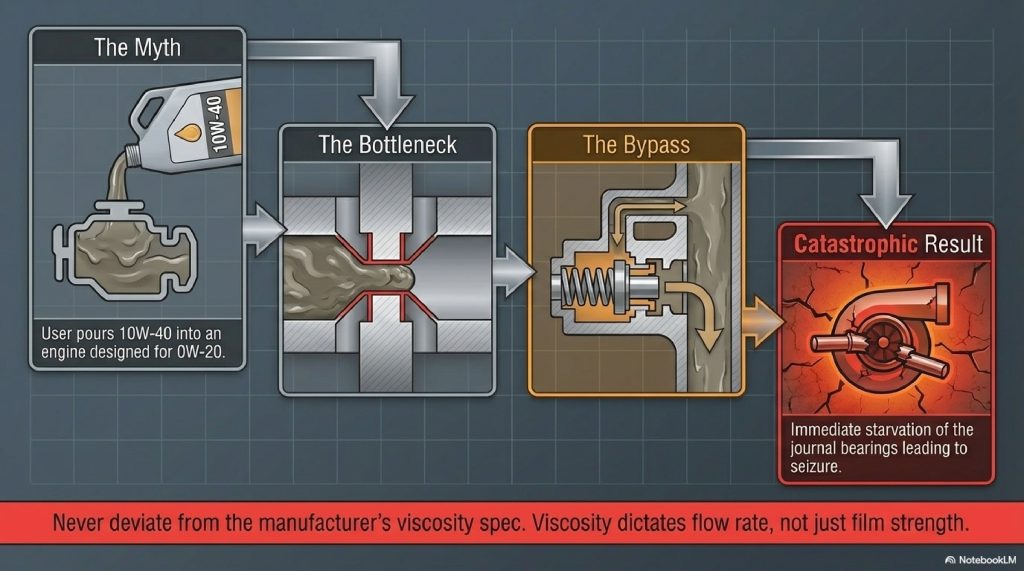
Note: The myth that “thicker oil is better for turbos” is dangerous. Pouring 10W-40 into a modern engine designed for 0W-20 will cause the thick oil to bypass the microscopic turbo feed lines, resulting in instant starvation.
Future Technology: 0W-8 and Electric Turbos
As automotive engineering pushes toward net-zero emissions, engine oils are becoming alarmingly thin. Japanese automakers are already moving toward 0W-8 viscosity oils. To maintain shear stability at such water-like viscosities, chemists are relying entirely on advanced nano-additives and Gas-to-Liquid (GTL) base stocks derived from natural gas rather than crude oil.
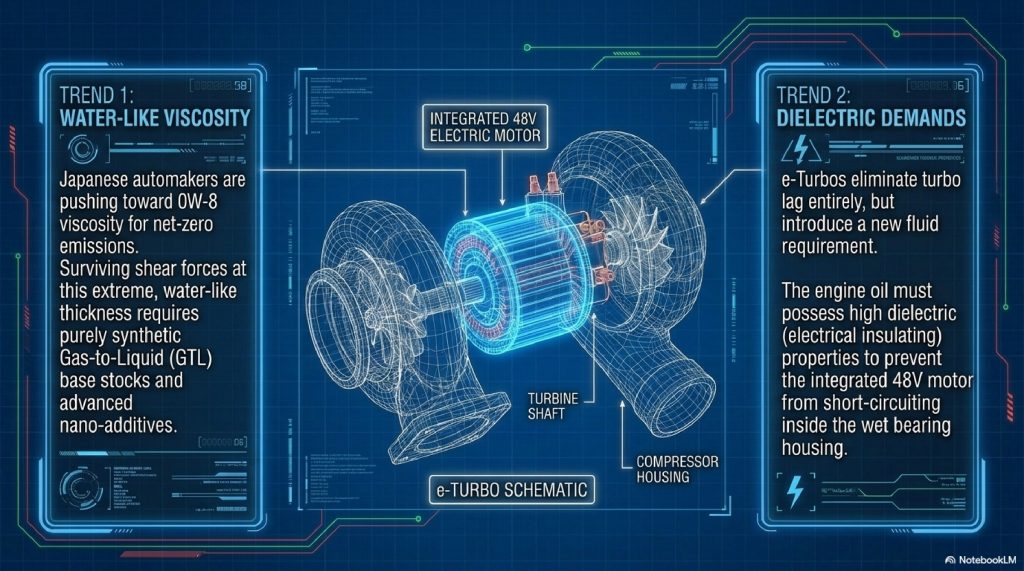
Furthermore, the introduction of e-Turbos (turbochargers spun by an electric 48V motor rather than purely exhaust gas) will shift the thermal dynamics once again. While e-Turbos eliminate turbo lag, the integrated electric motors require oil that possesses high dielectric (electrical insulating) properties to prevent short circuits within the bearing housing.
Historical Background: The 1980s Turbo Crisis
If you lived through the 1980s, you likely remember turbochargers having a terrible reputation for reliability. Cars like the Chrysler LeBaron Turbo or the early Porsche 930s suffered catastrophic turbo failures regularly.
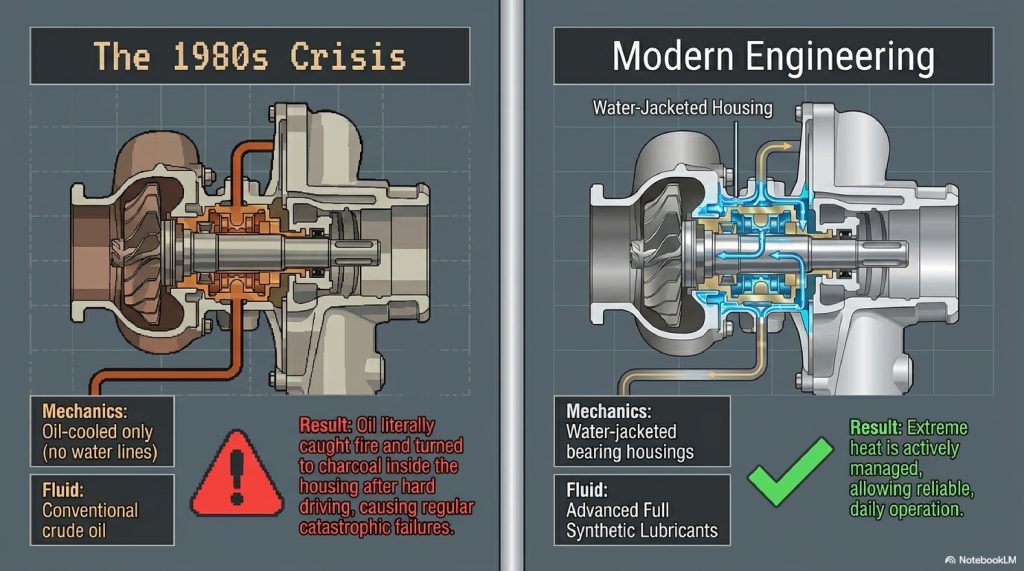
The issue was not the turbochargers themselves; it was the fluids. In the 1980s, full synthetic oils were rare and incredibly expensive. Owners used conventional crude oil, and the turbos were only oil-cooled (no water lines). Drivers would race their cars, turn them off immediately, and the conventional oil would literally catch fire and turn to charcoal inside the turbo housing. The invention of modern synthetic lubricants and water-jacketed bearing housings is the sole reason turbos are reliable today.
Expert Insights: The Mechanic’s Recommendation
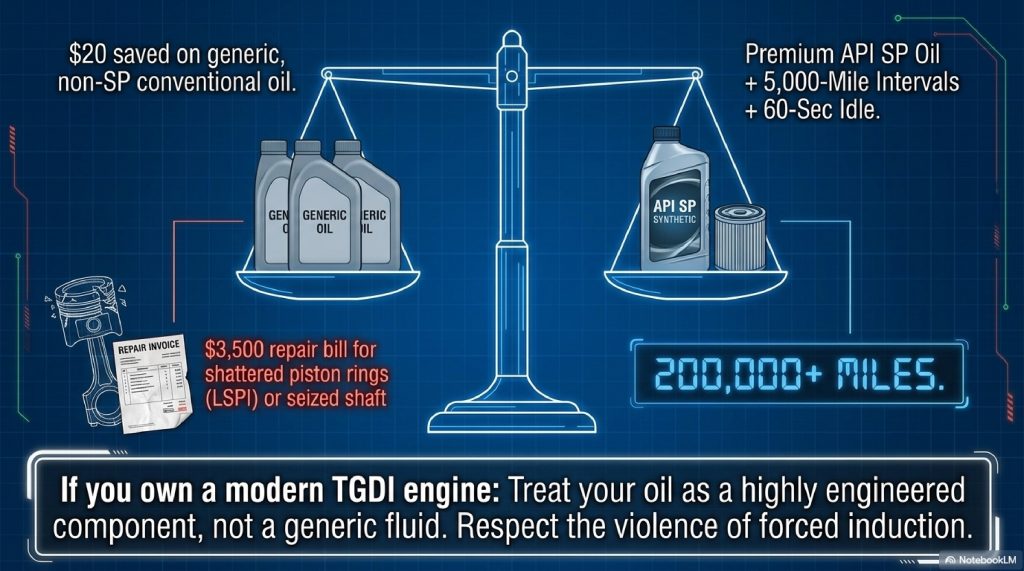
As a mechanical expert, my ownership recommendation is uncompromising: Treat your oil as a highly engineered car part, not a generic fluid.

If you own a Ford EcoBoost, a VW 2.0T, or a Honda 1.5T, the health of your engine is entirely dependent on the API SP specification. The $20 you might save by buying generic, non-SP conventional oil at a discount store will result in a $3,500 bill for a shattered piston caused by LSPI or a seized turbocharger shaft. Buy the best full synthetic oil you can afford, pair it with a premium synthetic-media filter, and change it every 5,000 miles. Your engine will easily outlast the chassis.
Conclusion
The best engine oil for a turbocharged engine is not defined by brand marketing, but by chemical engineering. A modern TGDI engine demands a lubricant that can survive 150,000 RPM shear forces, resist 450°F ambient heat without coking, and suppress Low-Speed Pre-Ignition through advanced magnesium detergent packages.
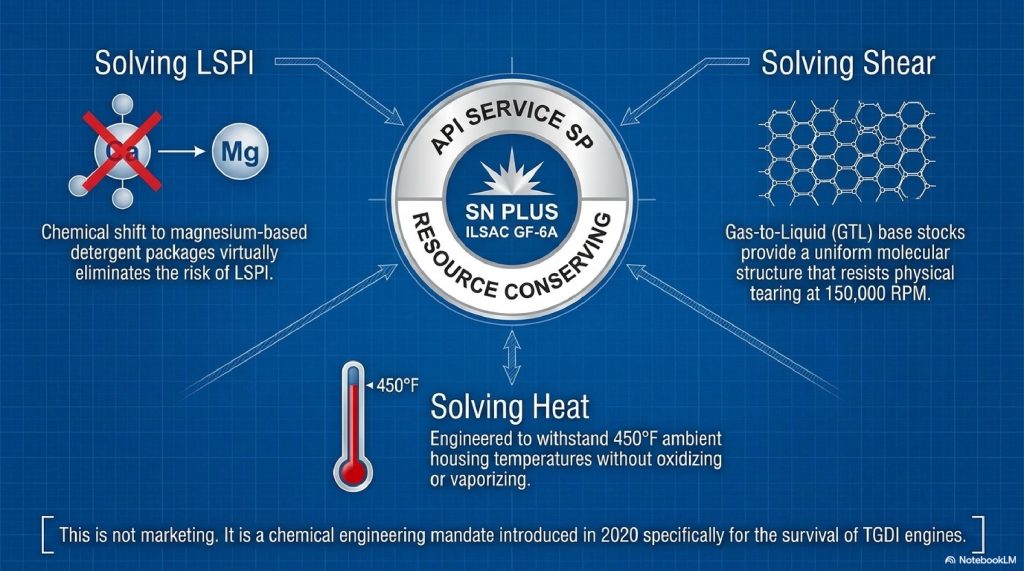
By ensuring your oil meets the API SP or ILSAC GF-6/GF-7 standards, adhering to strict 5,000-mile drain intervals, and practicing proper cool-down idling, you safeguard the most expensive components under your hood against the violence of forced induction.
Keep Learning:
- How Diesel to CNG Conversion Works (And Saves Money)
- Engine Knocking in Modern Cars: Causes, Fixes & Engineering
- How Intercoolers Improve Turbo Engine Performance (Engineering Guide)
- Stage 1 vs Stage 2 ECU Tuning Explained (An Engineer’s Guide)
- Why Modern Engines Are Becoming Smaller and More Powerful | Engineering Deep Dive
Frequently Asked Questions (FAQ)
Q: Can I use conventional oil in my turbocharged car if I change it more often?
A: No. Conventional oil cannot withstand the extreme heat generated by a turbocharger turbine. It will break down and leave carbon sludge (coking) inside the bearings almost immediately, regardless of how often you change it. Full synthetic is mandatory.
Q: What does the API SP rating mean for my turbo engine?
A: API SP is a performance standard introduced in 2020 specifically designed for TGDI (Turbo Gasoline Direct Injection) engines. It requires the oil to contain chemical detergents that physically prevent Low-Speed Pre-Ignition (LSPI), which is known to shatter pistons in modern turbos.
Q: Should I use a thicker oil (like 5W-40) in the summer to protect my turbo?
A: You should always stick to the manufacturer’s recommended viscosity. Modern turbo engine tolerances are incredibly tight. Thick oil takes too long to flow through microscopic oil galleys during cold starts, causing dry-wear on the turbo shaft. The heat protection comes from the synthetic base, not the thickness.
Q: Why does my turbo engine burn oil between changes?
A: Turbochargers operate under extreme pressure and utilize dynamic seals. A microscopic amount of oil naturally bypasses these seals and enters the intake tract (blow-by). It is completely normal for a high-performance turbo engine to consume half a quart of oil every few thousand miles. Check your dipstick regularly.
Product Name: Mobil 1 Extended Performance Full Synthetic Motor Oil (API SP)
Why it is useful: Formulated with advanced anti-wear additive packages, it provides exceptional thermal stability up to 500°F (260°C), preventing turbocharger coking.
Best use case: Routine oil changes for any modern TGDI engine (Ford EcoBoost, VW TSI, Honda VTEC Turbo).
Click Here to Shop: [Protect Your Turbo – Shop Mobil 1 on Amazon]
Product Name: Liqui Moly Pro-Line Engine Flush
Why it is useful: It safely breaks down existing oil sludge and coked carbon inside the turbo feed lines before you perform an oil change.
Best use case: Highly recommended for cars with over 50,000 miles or unknown maintenance history before switching to a premium synthetic.
Click Here to Shop: [Clean Your Oil Passages – Buy Liqui Moly on Amazon]
Product Name: K&N Premium Oil Filter
Why it is useful: Modern TGDI engines produce high levels of soot that contaminate the oil. Standard paper filters collapse under high flow. K&N uses a synthetic-blend media that traps microscopic soot while maintaining high flow rates to the turbo.
Best use case: Pair this filter with every 5,000-mile synthetic oil change.
Click Here to Shop: [Get Superior Filtration – Shop K&N on Amazon]
Comment